Nominal Interest Rate: Definition and How It Works
Understanding nominal interest rates and how they differ from real and effective rates.
What Is a Nominal Interest Rate?
A nominal interest rate is the stated rate of interest on a loan, bond, or savings account without any adjustments for inflation or compounding frequency. It represents the percentage of principal that a borrower pays to a lender or that a saver receives from a financial institution over a specified period, typically expressed on an annual basis. The nominal rate is the most commonly advertised interest rate by banks, lenders, and investment firms, as it appears in loan agreements and financial product disclosures.
The term “nominal” comes from the Latin word “nominalis,” meaning “in name only.” This reflects the fundamental nature of the nominal interest rate—it is the rate “in name” that appears in contracts, without reflecting the true economic impact of inflation or the effects of compounding over multiple periods within a year.
Key Characteristics of Nominal Interest Rates
Understanding the key features of nominal interest rates helps borrowers and lenders make informed financial decisions:
- Stated Rate: The nominal rate is the rate explicitly mentioned in loan documents and advertisements.
- No Inflation Adjustment: Unlike real interest rates, nominal rates do not account for the effects of inflation on purchasing power.
- No Compounding Adjustment: The nominal rate does not reflect how frequently interest is compounded throughout the year.
- Annual Percentage Rate (APR): The nominal rate is often referred to as the APR when discussing annual interest calculations.
- Tool of Monetary Policy: Central banks use nominal interest rates as a primary instrument to manage economic growth and inflation.
Nominal Interest Rate vs. Real Interest Rate
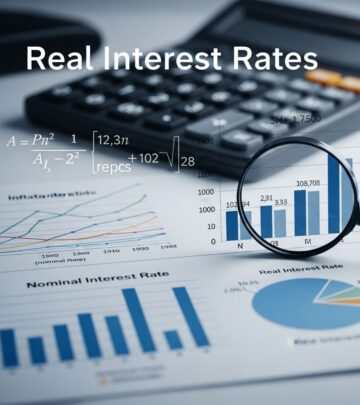
One of the most important distinctions in finance is the difference between nominal and real interest rates. While the nominal rate is what is stated in contracts, the real interest rate reflects what borrowers and lenders actually earn or pay after accounting for inflation.
The Real Interest Rate Formula: The relationship between the real interest rate (r), the nominal interest rate (R), and the inflation rate (i) can be expressed as:
r = (R − i) / (1 + i)
When inflation is low, this simplifies to approximately: r ≈ R − i
Practical Example: Consider a saver who deposits €1,000 in a savings account with a nominal interest rate of 2.5%. After one year, they receive €1,025. However, if inflation during that year is 3%, the purchasing power of their money has actually decreased. To purchase the same goods that cost €1,000 one year ago, they would now need €1,030. This means the real return on their savings is negative: 2.5% − 3% = −0.5%.
For lenders, understanding the real interest rate is crucial. If a lender receives 8% interest on a loan and inflation is also 8%, the real interest rate is effectively zero. Despite the increased nominal amount of money received, the lender gains no monetary benefit because inflation devalues each unit of currency proportionally.
Nominal Interest Rate vs. Effective Interest Rate
Another critical distinction exists between nominal interest rates and effective interest rates, which accounts for the impact of compounding within a year.
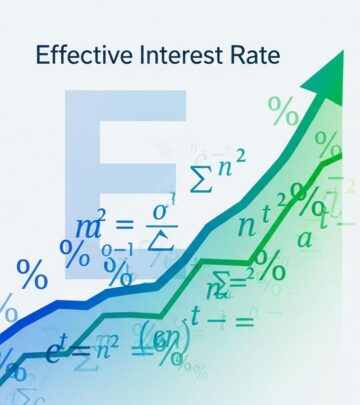
Definition: The nominal interest rate, also known as the annual percentage rate (APR), is the periodic interest rate multiplied by the number of periods per year. The effective interest rate, also called the annual percentage yield (APY), reflects the true cost or return when compounding is taken into account.
Why This Matters: Nominal interest rates are not directly comparable unless they have the same compounding frequency. For example, a loan with 12% interest compounded monthly is not equivalent to a loan with 12% interest compounded annually. The effective rate standardizes these comparisons by converting all nominal rates into annual compound interest equivalents.
Example of Monthly Compounding: A nominal interest rate of 6% compounded monthly is equivalent to an effective interest rate of 6.17%. Here’s how it works: if the nominal annual rate is 6%, the monthly rate is 6% ÷ 12 = 0.5%. After one year, an initial capital amount grows by the factor (1 + 0.005)^12 ≈ 1.0617, which represents a 6.17% effective annual rate.
When Are Nominal and Effective Rates the Same?
Nominal and effective interest rates are identical when the compounding period is exactly one year. For instance, a bond with a 5% annual interest rate compounded annually has both a nominal rate and an effective rate of 5%.
How Nominal Interest Rates Are Determined
Nominal interest rates are influenced by numerous economic and policy factors:
- Demand and Supply of Money: When money is scarce, interest rates rise; when money is abundant, rates typically fall.
- Central Bank Policy: Central banks, such as the Federal Reserve or European Central Bank, set benchmark rates that influence all other rates in the economy.
- Inflation Expectations: When inflation is expected to rise, lenders demand higher nominal rates to compensate for the anticipated loss of purchasing power.
- Government Actions: Fiscal policies, taxes, and government spending affect interest rates.
- Credit Risk: The borrower’s creditworthiness affects the nominal rate offered by lenders.
- Economic Conditions: During recessions, rates are typically lowered to stimulate borrowing and economic activity; during inflationary periods, rates are raised to cool the economy.
Components of a Nominal Interest Rate
A nominal interest rate comprises two fundamental components: the real interest rate and the inflation premium.
Real Interest Rate Component: This represents the true return or cost of borrowing in terms of actual goods and services, stripped of inflation effects. It reflects the time value of money and the lender’s compensation for deferring consumption.
Inflation Premium: This is the additional interest rate charged to compensate for expected inflation. If a lender expects a real return of 5% and inflation is expected to be 3%, the nominal rate should be approximately 8% (5% + 3%).
More precisely, using the Fisher Effect formula: i = (1 + R)(1 + h) − 1, where i is the nominal rate, R is the real rate, and h is the inflation rate. In this example: i = (1.05)(1.03) − 1 = 0.0815 or 8.15%.
The Fisher Effect and Nominal Rates
The Fisher Effect describes the relationship between inflation, nominal interest rates, and real interest rates. According to this principle, if inflation increases while the nominal interest rate remains constant, the real interest rate will fall. This occurs because the lender’s purchasing power declines more rapidly.
Conversely, if both the nominal interest rate and the expected inflation rate increase at the same rate, the real interest rate remains unchanged. This balance is important for maintaining stable lending conditions and consumer behavior.
Practical Applications of Nominal Interest Rates
For Borrowers
Borrowers encounter nominal interest rates when taking out mortgages, car loans, credit cards, and personal loans. The nominal rate determines how much they pay in interest over the life of the loan. However, borrowers should also consider the effective rate to understand the true cost of borrowing, especially for loans with frequent compounding periods.
For Savers and Investors
Savers and investors receive nominal interest rates on savings accounts, certificates of deposit (CDs), and bonds. A saver should evaluate the nominal rate in relation to expected inflation to determine whether their savings will actually grow in purchasing power. A nominal rate lower than the inflation rate results in negative real returns, eroding wealth over time.
For Monetary Policy
Central banks manipulate nominal interest rates as a primary tool of monetary policy. During economic recessions, central banks lower nominal rates to encourage borrowing and spending, which stimulates economic activity. During periods of high inflation, central banks raise nominal rates to reduce borrowing and spending, thereby cooling inflation.
Why Nominal Rates Alone Are Misleading
Relying solely on nominal interest rates without considering inflation or compounding can lead to poor financial decisions. Consumers may believe they are earning attractive returns or paying reasonable rates when, in reality, the real returns are negative or the effective cost is much higher than advertised.
For example, a savings account advertising a 2% nominal rate may seem reasonable until you consider that inflation is running at 3%. In this case, your real return is negative, and your savings are actually losing purchasing power. Similarly, a credit card offering a “low” 18% nominal annual rate with daily compounding actually carries an effective annual rate significantly higher than 18%.
Comparing Nominal Rates Across Different Products
When comparing financial products with different compounding frequencies, consumers and investors must use effective rates. A mortgage with 6% compounded annually is not directly comparable to a bond with 6% compounded semiannually without calculating their respective effective rates.
| Interest Rate Type | Definition | Includes Inflation? | Includes Compounding? | Use Case |
|---|---|---|---|---|
| Nominal Rate | Stated rate in contracts | No | No | Official documentation, contracts |
| Real Rate | Rate adjusted for inflation | Yes | No | Measuring true borrowing/lending cost |
| Effective Rate | Rate adjusted for compounding | No | Yes | Comparing products with different compounding |
Frequently Asked Questions
Q: What is the difference between nominal and real interest rates?
The nominal interest rate is the stated rate without adjustment for inflation, while the real interest rate accounts for inflation’s impact on purchasing power. If you earn 5% nominal interest but inflation is 3%, your real return is approximately 2%.
Q: Why do banks advertise nominal rates instead of effective rates?
Nominal rates typically appear higher and more attractive to consumers than effective rates. Banks use nominal rates because they are legally required to disclose them, though they must also provide effective rate information. However, regulations vary by jurisdiction.
Q: How does inflation affect nominal interest rates?
Lenders demand higher nominal rates when inflation is expected to rise, to compensate for the anticipated decrease in purchasing power. This additional compensation is called the inflation premium and is a key component of nominal rates.
Q: Can a nominal interest rate be negative?
Yes, in certain economic conditions, particularly during extreme deflationary periods or as a monetary policy tool, nominal interest rates can be negative. This means savers pay to hold deposits rather than earning interest.
Q: How do I calculate the effective interest rate from a nominal rate?
Use the formula: Effective Rate = (1 + Nominal Rate / Compounding Periods)^Compounding Periods − 1. For example, a 6% nominal rate compounded monthly: (1 + 0.06/12)^12 − 1 = 6.17% effective rate.
Q: Why should I care about nominal vs. real interest rates?
Understanding the difference helps you make better financial decisions. A high nominal rate may provide poor real returns if inflation is also high. For savers and investors, real rates determine whether wealth actually grows.
References
- Nominal interest rate — Wikipedia. Accessed November 2025. https://en.wikipedia.org/wiki/Nominal_interest_rate
- Nominal Interest Rate – Overview, Inflation and Compounding — Corporate Finance Institute. https://corporatefinanceinstitute.com/resources/capital-markets/nominal-interest-rate/
- What is the difference between nominal and real interest rates? — European Central Bank. https://www.ecb.europa.eu/ecb-and-you/explainers/tell-me/html/nominal_and_real_interest_rates.en.html
Similar Articles








Read full bio of medha deb