Nominal GDP: Definition, Formula & Comparison to Real GDP
Understanding nominal GDP, its calculation methods, and how it differs from real GDP for economic analysis.
Understanding Nominal GDP: Definition and Basics
Nominal Gross Domestic Product (GDP) represents the total market value of all finished goods and services produced within a country during a specific period, calculated using current market prices. Unlike other GDP measurements, nominal GDP does not adjust for inflation or deflation, meaning it reflects both changes in economic output and price level changes in an economy. Understanding nominal GDP is crucial for economists, policymakers, and investors who need to assess economic performance and make informed financial decisions.
The primary characteristic of nominal GDP is that it incorporates all price changes occurring in the economy during the measurement period. When prices rise due to inflation, nominal GDP typically increases even if the actual quantity of goods and services produced remains constant. This makes nominal GDP particularly useful when analyzing economic variables that are not adjusted for inflation, such as national debt, government spending, and consumer expenditures. Nominal GDP provides a straightforward snapshot of an economy’s current economic activity without filtering out inflationary effects.
The Nominal GDP Formula Explained
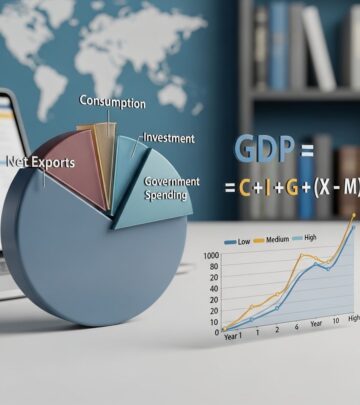
The fundamental formula for calculating nominal GDP using the expenditure approach is straightforward and widely adopted by economists worldwide:
GDP = C + I + G + (X – M)
Each component of this formula represents a distinct economic activity:
Formula Components Breakdown
C (Consumption) represents the total private consumption of goods and services purchased by households for personal use. This includes everything from groceries and clothing to entertainment and healthcare services that individuals spend money on throughout the year.
I (Investment) encompasses private investment in capital goods and business expansion. This includes purchases of factory equipment, machinery, residential construction, and business inventories. Investment reflects spending aimed at generating future income or appreciating in value over time.
G (Government Spending) includes all government expenditures on goods and services, such as infrastructure projects, military spending, education, and healthcare. Government spending also includes transfer payments and government wages paid to public sector employees.
X (Exports) represents the value of goods and services produced domestically and sold to foreign buyers. Exports contribute positively to GDP as they reflect domestic production sold internationally.
M (Imports) represents the value of goods and services produced in foreign countries and purchased by domestic consumers. Imports are subtracted from the formula because they represent spending on foreign production, not domestic production.
Three Approaches to Calculating Nominal GDP
Economists have developed three distinct methodologies for calculating nominal GDP, each offering unique insights into economic activity:
1. The Expenditure Approach
The expenditure approach is the most commonly used method for calculating nominal GDP. This approach sums all spending on final goods and services produced within the country during a specific period. It measures output by aggregating private consumption, private investment, government expenditures, and net exports (exports minus imports). The expenditure approach accounts for both quantity changes and prevailing market prices, making it particularly suitable for measuring nominal GDP. For example, if a country has consumption of $13.5 billion, investment of $6.7 billion, government spending of $20 billion, exports of $12 billion, and imports of $2.1 billion, the nominal GDP would be calculated as: $13.5B + $6.7B + $20B + ($12B – $2.1B) = $50.1 billion.
2. The Income Approach
The income approach calculates nominal GDP by summing all incomes earned in producing goods and services. This method adds together employee compensation, rent, interest earned, self-employment income, business profits, indirect business taxes, depreciation, and net foreign income. The income approach is based on the principle that all output produced generates corresponding income for factors of production. This method provides insights into income distribution across the economy and how production translates into earnings for workers, business owners, and investors.
3. The Product Approach
The product approach, also called the value-added method, calculates nominal GDP by finding the difference between the price of all finished goods and services and the total cost of intermediate goods and services used in production. The formula is: GDP = P – C, where P represents the price of all finished goods and services and C represents the total cost of intermediate goods used in production. This approach avoids double-counting by only including the value added at each production stage.
Impact of Inflation on Nominal GDP
Inflation significantly affects nominal GDP calculations and interpretations. As nominal GDP is calculated using current market prices, growth in nominal GDP may indicate price increases rather than actual increases in the quantity of goods and services produced. When inflation rises, nominal GDP typically increases even if real economic output remains unchanged. This distinction is critical because policymakers and investors need to understand whether economic growth reflects genuine expansion in production or merely reflects price level increases.
For instance, if nominal GDP grows by 8% in a year, but inflation is 5%, then real economic growth is only approximately 3%. Understanding this relationship helps economists distinguish between nominal and real economic performance, enabling more accurate assessments of whether an economy is genuinely expanding or simply experiencing price increases. The relationship between inflation and nominal GDP makes it essential to compare nominal GDP figures with inflation data to gain a true understanding of economic growth.
Nominal GDP vs. Real GDP: Key Differences
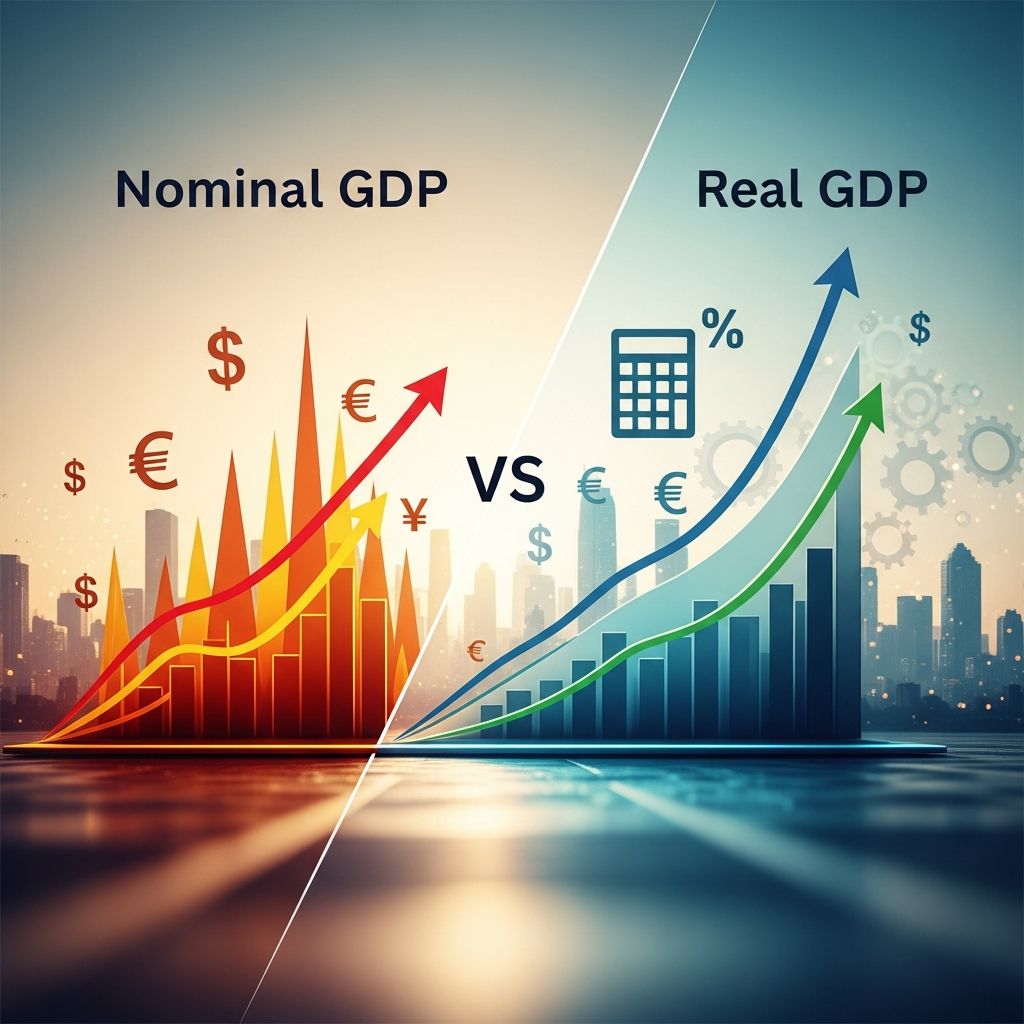
While nominal GDP uses current market prices, real GDP adjusts for inflation by using constant prices from a base year. Real GDP provides a more accurate measure of economic growth by removing the effects of price level changes, allowing for meaningful year-to-year comparisons. Real GDP accounts for changes in price that may occur due to inflation or deflation, either by using prices from a designated base year or by applying a GDP Deflator to adjust for price changes.
The distinction between nominal and real GDP is fundamental for economic analysis. Nominal GDP can be misleading when comparing economic performance across different time periods because it includes inflationary effects. Real GDP, conversely, provides a clearer picture of actual economic growth by isolating the quantity of goods and services produced from price-level changes. For example, a country’s nominal GDP might increase from $1 trillion to $1.1 trillion over a year, suggesting 10% growth. However, if inflation was 8% during that period, real GDP growth would only be approximately 2%, revealing that actual economic expansion was much more modest.
When to Use Nominal vs. Real GDP
Nominal GDP is particularly useful when analyzing economic variables unaffected by inflation, such as comparing national debt to GDP or analyzing government revenues and spending in current dollars. Nominal GDP also serves purposes such as international economic comparisons using current exchange rates and benchmarking within companies to set targets and revenue sales goals. Real GDP, conversely, is superior for analyzing long-term economic trends, comparing economic performance across multiple years, and understanding genuine economic growth separate from inflationary effects.
The GDP Deflator and Its Role
The GDP Deflator is a crucial tool that connects nominal and real GDP by tracking price changes in an economy over time. The GDP Deflator takes a base year where nominal GDP equals real GDP and sets it equal to 100. Any changes in price are reflected in the GDP Deflator, which helps economists measure inflation’s impact on the economy. If the GDP Deflator is 112 in the year following the base year, it indicates that average prices increased by 12% compared to the base year. The GDP Deflator approach requires knowledge of the real GDP level and the price change to calculate nominal GDP by multiplying both elements together.
Practical Examples of Nominal GDP Calculation
To illustrate how nominal GDP functions in practice, consider a simple economy producing only one type of good. If Year 1 production involves 100 units sold at $10 each, the nominal GDP is $1,000. In Year 5, if production increases to 150 units sold at $15 each, the nominal GDP becomes $2,250. This example demonstrates how nominal GDP reflects both quantity changes and price changes occurring in the economy over time.
In more complex, real-world scenarios, economists must sum the market values of thousands of different products across multiple industries. For instance, when calculating the market value of final goods and services, economists must carefully distinguish between final goods (which count toward GDP) and intermediate goods (which are excluded to avoid double-counting). A car sold to a consumer counts as a final good, while steel sold to a car manufacturer counts as an intermediate good and should not be separately included in GDP calculations.
Uses and Applications of Nominal GDP
Nominal GDP serves several important economic functions beyond simple economic measurement. It provides a benchmark for comparing an economy’s size to other national economies on the international market using current exchange rates. Governments use nominal GDP to calculate tax revenues and plan expenditures in current dollars. Businesses use nominal GDP data to forecast demand for their products and make investment decisions. Investors analyze nominal GDP trends to identify economic cycles and make portfolio allocation decisions. Financial analysts use nominal GDP to calculate debt-to-GDP ratios and assess fiscal sustainability.
Additionally, nominal GDP plays a significant role in calculating the GDP Deflator and determining real GDP. The relationship between nominal and real GDP provides economists with a comprehensive understanding of both price-level changes and actual economic output, enabling more sophisticated economic analysis and policy decisions.
Frequently Asked Questions
Q: What is the key difference between nominal GDP and real GDP?
A: Nominal GDP uses current market prices and reflects both output and price changes, while real GDP adjusts for inflation using constant base-year prices, showing only actual output changes without price-level distortions.
Q: Why is nominal GDP important if it includes inflation effects?
A: Nominal GDP is useful for comparing economies internationally using current exchange rates, analyzing economic variables unaffected by inflation like debt, and for government budgeting in current-year dollars.
Q: How does inflation affect nominal GDP calculations?
A: Rising inflation increases nominal GDP even without increased production, as the same quantity of goods is valued at higher prices. This makes it essential to compare nominal GDP with inflation rates to understand real growth.
Q: Which GDP calculation method is most commonly used?
A: The expenditure approach is the most widely used method, summing consumption, investment, government spending, and net exports to calculate nominal GDP.
Q: How does the GDP Deflator help economists?
A: The GDP Deflator tracks price changes over time by comparing nominal and real GDP values, helping economists measure inflation’s impact and adjust economic data for price-level changes.
Q: Can nominal GDP decrease even if production increases?
A: Yes, if deflation (price decreases) is severe enough to outweigh production increases, nominal GDP can decrease despite higher output levels.
References
- Nominal GDP Formula — BYJU’S. 2024. https://byjus.com/commerce/nominal-gdp-formula/
- Nominal GDP | Definition, Formula & Examples — Study.com. 2024. https://study.com/academy/lesson/nominal-gdp-definition-formula-quiz.html
- Nominal Gross Domestic Product – Overview and How to Calculate — Corporate Finance Institute. 2024. https://corporatefinanceinstitute.com/resources/economics/nominal-gross-domestic-product/
- Lesson Summary: Real vs. Nominal GDP — Khan Academy. 2024. https://www.khanacademy.org/economics-finance-domain/ap-macroeconomics/economic-iondicators-and-the-business-cycle/real-vs-nominal-gdp/a/lesson-summary-real-vs-nominal-gdp
- Gross Domestic Product — U.S. Bureau of Economic Analysis (BEA). 2024. https://www.bea.gov/resources/learning-center/what-to-know-gdp
Similar Articles








Read full bio of Sneha Tete