Nominal GDP: Definition, Formula, and Calculation Methods
Understanding nominal GDP: current prices, calculation methods, and economic analysis.

Understanding Nominal Gross Domestic Product (GDP)
Nominal Gross Domestic Product, commonly referred to as nominal GDP, represents the total market value of all finished goods and services produced within a country’s borders during a specific period of time. Unlike other GDP measurements, nominal GDP is calculated using current market prices without adjusting for inflation or deflation. This means that the value reflects both changes in the quantity of goods and services produced as well as changes in their prices. Understanding nominal GDP is essential for economists, policymakers, and investors who need to assess economic performance and make informed financial decisions.
Definition of Nominal GDP
Nominal GDP is an economic measure that captures the aggregate value of all final goods and services produced in an economy at their current prices during a given time period. The term “nominal” indicates that the figures are expressed in current dollars without any adjustment for price-level changes. This contrasts with real GDP, which adjusts for inflation to provide a clearer picture of actual economic growth.
The primary characteristic of nominal GDP is its simplicity and immediacy. It provides a straightforward snapshot of an economy’s current monetary output, making it useful for short-term economic analysis and comparisons within the same fiscal year. However, because it includes the effects of inflation, nominal GDP can be misleading when making long-term comparisons across multiple years or when comparing economic performance between different time periods.
The Nominal GDP Formula
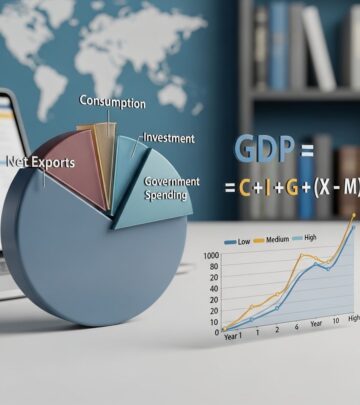
The most common method for calculating nominal GDP uses the expenditure approach, which sums up all spending on final goods and services in an economy. The fundamental formula is:
GDP = C + I + G + (X – M)
Where:
- C = Consumption: Private spending on goods and services by households and individuals
- I = Investment: Business investments such as factories, equipment, and inventories, as well as residential investment like home purchases
- G = Government Spending: Total expenditures by federal, state, and local governments on goods and services
- X = Exports: Value of goods and services produced domestically and sold to foreign countries
- M = Imports: Value of goods and services produced abroad and purchased by domestic consumers
This formula captures all spending in the economy and provides the foundation for nominal GDP calculations.
Three Methods to Calculate Nominal GDP
Economists and statisticians employ three distinct approaches to calculate nominal GDP, each offering different perspectives on economic activity:
1. The Expenditure Approach
The expenditure approach is the most commonly used method for calculating nominal GDP. It sums all spending on final goods and services produced during a specific period. Using the formula GDP = C + I + G + (X – M), this method accounts for both quantity changes and prevailing market prices, making it highly suitable for measuring nominal GDP accurately. The expenditure approach provides a clear picture of how consumer spending, business investment, government expenditure, and international trade contribute to overall economic output.
2. The Income Approach
The income approach calculates nominal GDP by summing all income earned in the production of goods and services. This method includes all payments made to factors of production, such as:
- Employee compensation (wages and salaries)
- Rental income from property
- Interest income from capital
- Self-employment income
- Business profits
- Indirect business taxes
- Depreciation of capital assets
- Net foreign income
The formula for this approach is: GDP = Employee Compensation + Rent + Interest + Self-Employment Income + Business Profits + Indirect Business Taxes + Depreciation + Net Foreign Income. This method ensures that all income generated during production is captured and properly accounted for in the GDP calculation.
3. The Product (Output) Approach
The product approach, also known as the value-added method, calculates nominal GDP by determining the total value of finished goods and services, then subtracting the value of intermediate goods used in production. The formula is simple: GDP = P – C, where P represents the price of all finished goods and services and C represents the total cost of intermediate goods and services consumed in production. This approach prevents double-counting by only including the value added at each stage of production, resulting in an accurate measure of total economic output.
Nominal GDP vs. Real GDP: Key Differences
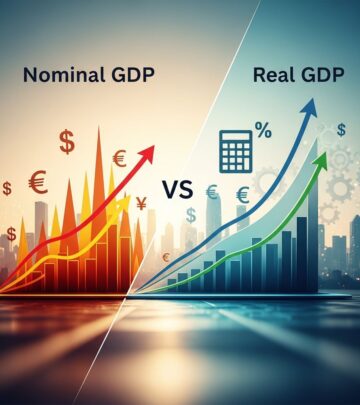
While nominal GDP measures economic output at current prices, real GDP adjusts for changes in the price level to provide a clearer picture of actual economic growth. The critical distinction lies in how inflation is handled. Nominal GDP rises and falls with both changes in output and changes in prices, while real GDP is adjusted using prices from a base year, providing a constant price framework for comparison.
Real GDP is generally preferred for long-term comparisons because it removes the distorting effects of inflation and deflation, allowing economists to see true changes in economic activity. However, nominal GDP remains valuable for short-term analysis within the same year or for comparing GDP to other economic variables that are not inflation-adjusted, such as national debt.
Why Use Nominal GDP?
Nominal GDP serves several important purposes in economic analysis and policy-making:
Snapshot of Current Economic Activity
Nominal GDP provides a real-time assessment of current economic output, useful for understanding present economic conditions without the complexity of inflation adjustments.
Comparison with Non-Inflation-Adjusted Variables
Nominal GDP is used when analyzing factors not affected by inflation, such as government debt levels, making it possible to compare economic output directly with outstanding obligations.
Short-Term Economic Performance
For quarterly or intra-year comparisons within the same economic cycle, nominal GDP offers valuable insights into economic trends without the complications of price deflation techniques.
Business Planning and Targets
Companies use nominal GDP for benchmarking performance, setting revenue targets, and making strategic decisions based on current market conditions and price levels.
The GDP Deflator and Nominal GDP
The GDP deflator is an important tool for understanding the relationship between nominal and real GDP. This measure tracks price changes in a country’s economy over time by comparing nominal GDP to real GDP. The deflator uses a base year where nominal GDP equals real GDP and sets it equal to 100. Any subsequent change in price is reflected in the GDP deflator value. For example, if the GDP deflator is 112 in the year following the base year, it indicates that the average price of output has increased by 12%.
The relationship can be expressed as: Nominal GDP = Real GDP × (GDP Deflator / 100). This formula allows economists to convert between nominal and real GDP measurements and understand the impact of inflation on economic growth.
Practical Example of Nominal GDP Calculation
Consider a hypothetical country that produces only one type of good. Using the expenditure method, if the country produces 100 units in Year 1 at $10 per unit, the nominal GDP for Year 1 would be $1,000 (100 × $10). By Year 5, if production increases to 150 units and the price rises to $15 per unit, the nominal GDP would be $2,250 (150 × $15). While this represents an increase in nominal GDP of 125%, the actual output growth was only 50%, with the remaining increase due to price inflation.
Limitations of Nominal GDP
Although nominal GDP provides valuable information, it has several limitations. The primary drawback is that it conflates real economic growth with inflation, making it unsuitable for long-term comparisons across multiple years. Additionally, nominal GDP can mask periods where the economy actually contracts but prices rise, or periods of real growth where prices remain stable or decline. These limitations make real GDP the preferred metric for assessing long-term economic health and comparing economic performance across different time periods.
Application in Economic Policy
Nominal GDP plays an important role in economic policymaking and analysis. Central banks and government agencies monitor nominal GDP growth to assess current economic conditions and make decisions regarding interest rates, taxation, and spending. International organizations use nominal GDP comparisons to evaluate economic performance across countries in the same time period, though they recognize the limitations for historical comparisons.
Frequently Asked Questions
What is the main difference between nominal GDP and real GDP?
Nominal GDP is calculated using current prices without adjusting for inflation, while real GDP adjusts for price changes using prices from a base year, providing a more accurate measure of actual economic growth over time.
Why would economists use nominal GDP instead of real GDP?
Nominal GDP is useful for short-term analysis within the same year, comparing economic output to non-inflation-adjusted variables like national debt, and providing snapshots of current economic conditions. It’s also easier to calculate and understand for current assessments.
Can nominal GDP decrease even if production increases?
Yes, nominal GDP can decrease if prices fall faster than production increases, or it can increase if prices rise faster than production increases, making it an imperfect measure of actual economic output changes.
Which GDP calculation method is most commonly used?
The expenditure approach is the most commonly used method for calculating nominal GDP, as it directly accounts for all spending on final goods and services in the economy.
What does a GDP deflator of 110 mean?
A GDP deflator of 110 indicates that prices have increased by 10% compared to the base year, where the deflator equals 100. This means average price levels in the economy have risen by 10%.
How does nominal GDP relate to a country’s economic health?
While nominal GDP provides information about current economic output, it should be used alongside real GDP, unemployment rates, inflation rates, and other economic indicators to gain a comprehensive understanding of a country’s true economic health.
References
- Nominal Gross Domestic Product – Overview and How to Calculate — Corporate Finance Institute. Accessed 2025-11-29. https://corporatefinanceinstitute.com/resources/economics/nominal-gross-domestic-product/
- Lesson Summary: Real vs. Nominal GDP — Khan Academy. Accessed 2025-11-29. https://www.khanacademy.org/economics-finance-domain/ap-macroeconomics/economic-iondicators-and-the-business-cycle/real-vs-nominal-gdp/a/lesson-summary-real-vs-nominal-gdp
- Nominal Gross Domestic Product (GDP) — Organisation for Economic Co-operation and Development (OECD). Accessed 2025-11-29. https://www.oecd.org/en/data/indicators/nominal-gross-domestic-product-gdp.html
Similar Articles








Read full bio of medha deb