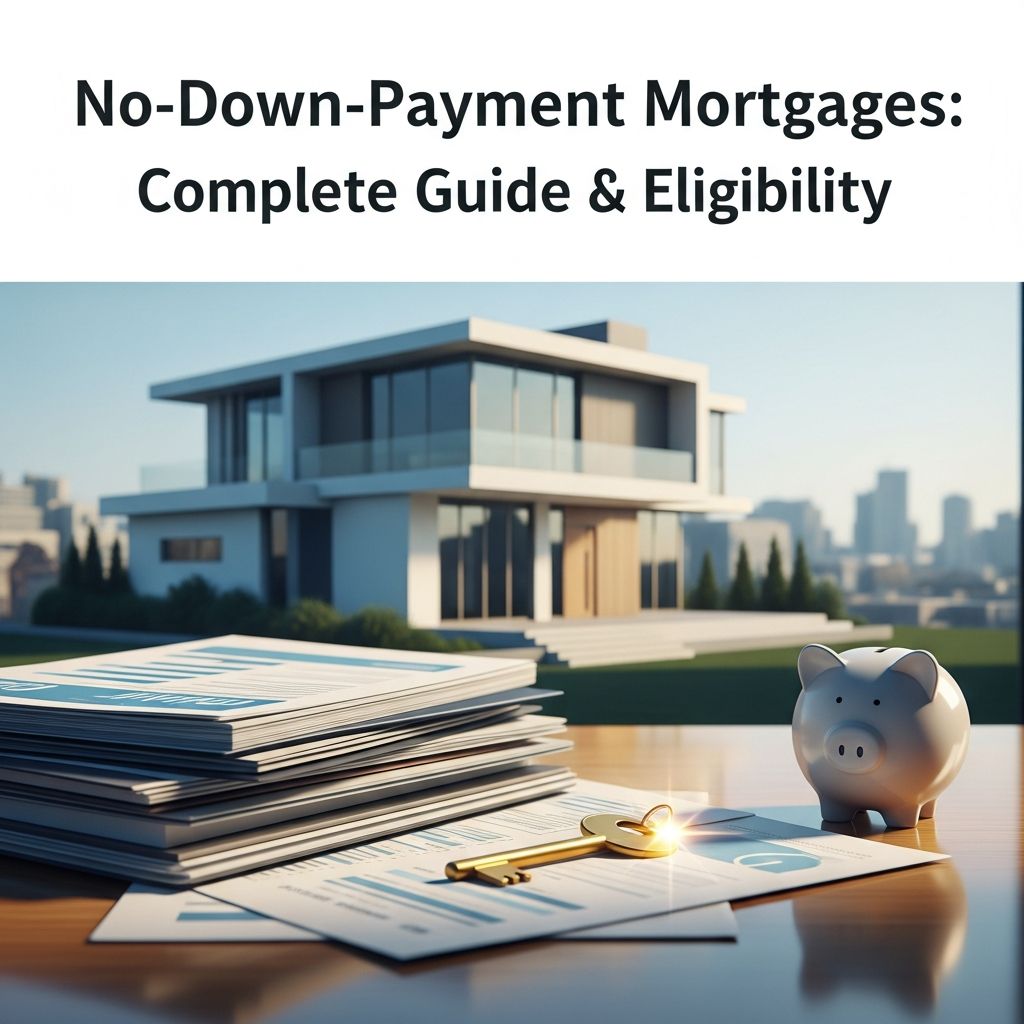
No-Down-Payment Mortgages: Complete Guide & Eligibility
Explore zero-down mortgage options, eligibility requirements, and alternatives for first-time homebuyers.
What is a No-Down-Payment Mortgage?
A no-down-payment mortgage eliminates one of the largest upfront barriers to homeownership by allowing you to finance 100 percent of your home’s purchase price without making a down payment at closing. With rising home prices making it increasingly difficult for buyers to accumulate substantial savings, no-down-payment loans have become an attractive option for many aspiring homeowners. According to recent data, one-fifth of prospective homebuyers believe they will never be able to save enough for a traditional down payment, making these alternative financing options crucial for expanding homeownership opportunities.
However, it’s important to understand that while you won’t make a down payment, you will still have closing costs to address. These costs can either be paid at closing or rolled into your mortgage, adding to your overall loan amount. Additionally, depending on the loan type you choose, you may be required to pay various fees and insurance premiums that increase the total cost of borrowing.
Types of No-Down-Payment Mortgage Options
VA Loans
VA loans represent one of the most accessible no-down-payment mortgage options available. These loans are guaranteed by the U.S. Department of Veterans Affairs and are exclusively available to eligible veterans, active-duty service members, and certain surviving spouses. One of the primary advantages of VA loans is that they typically require no down payment, making them an excellent choice for those who qualify.
However, VA loan borrowers must pay a funding fee, which ranges from 1.25 percent to 3.3 percent of the loan amount. The exact fee depends on your down payment size and whether you’ve previously used a VA loan. Those who don’t make a down payment, as well as repeat VA loan applicants, typically pay the higher end of this fee range. This funding fee can be paid at closing or financed into your mortgage, providing flexibility in how you manage this cost.
USDA Loans
USDA loans, backed by the U.S. Department of Agriculture, are another government-sponsored option that doesn’t typically require a down payment. These loans are designed to promote homeownership in rural and suburban areas and are available to borrowers who meet specific income and property location requirements. Like VA loans, USDA loans offer the significant advantage of eliminating the down payment barrier, though they do come with associated fees and insurance costs.
FHA Loans
While not technically a no-down-payment option, FHA loans represent a practical alternative for those who can make a minimal down payment. Insured by the Federal Housing Administration, FHA loans require only 3.5 percent down if your credit score is 580 or higher. If your credit score falls between 500 and 579, you’ll need to put down 10 percent. The flexibility of FHA loans regarding credit score requirements makes them accessible to borrowers with less-than-perfect credit histories.
FHA borrowers must pay mortgage insurance, which includes both an upfront mortgage insurance premium (MIP) equal to 1.75 percent of the loan amount at closing and an annual MIP split across monthly payments. The duration of annual MIP payments depends on your down payment amount. If you make a down payment of 10 percent or more, you’ll pay annual MIP for 11 years. Otherwise, you’ll pay it for the life of the loan.
1-Percent-Down Mortgage Programs
Some conventional mortgage lenders have developed innovative programs requiring only 1 percent down, such as Rocket Mortgage’s ONE+ program. These programs work by having the lender contribute 2 percent of the required 3 percent down payment for loans like HomeReady or Home Possible, while you provide only the remaining 1 percent. This option bridges the gap between no-down-payment and traditional down payment requirements, making homeownership more accessible for buyers with limited savings.
Understanding Mortgage Insurance and Additional Costs
Private Mortgage Insurance (PMI)
With conventional loans requiring minimal or no down payment, you’ll typically need to pay private mortgage insurance (PMI). The cost of PMI varies depending on your down payment amount and credit score. One significant advantage is that once your loan-to-value (LTV) reaches 80 percent, you can request your lender to remove PMI. If you don’t request removal, PMI will automatically be removed once you reach 78 percent LTV through regular principal payments.
FHA Mortgage Insurance
FHA mortgage insurance operates differently from conventional PMI. You’ll pay an upfront mortgage insurance premium at closing, with the amount fixed at 1.75 percent of your loan amount. Additionally, you’ll pay annual mortgage insurance premiums that are divided into your monthly mortgage payments. The duration of these payments depends on your down payment size and loan term, potentially lasting the entire life of the loan if you put down less than 10 percent.
Pros of No-Down-Payment Mortgages
No-down-payment mortgages offer several compelling advantages for eligible borrowers:
Buy a home sooner: Without the need to accumulate a substantial down payment, you can transition to homeownership much faster. This is particularly valuable in appreciating real estate markets where purchasing earlier allows you to benefit from property value increases and begin building equity immediately.
Maintain liquidity: Even if you have sufficient savings for a down payment, you might prefer to keep that money liquid. No-down-payment mortgages allow you to preserve cash reserves for emergency savings, home renovations, investing, or other financial priorities.
Access competitive terms: In some cases, government-backed mortgages offer more competitive or generous terms compared to conventional loans. These programs were specifically designed to expand homeownership opportunities, sometimes resulting in favorable conditions for borrowers.
Participate in appreciation: Purchasing a home sooner allows you to capture the full benefit of property appreciation and begin building equity through principal paydown without any initial out-of-pocket investment.
Cons of No-Down-Payment Mortgages
While no-down-payment mortgages offer accessibility, they come with significant drawbacks:
Higher interest rates: Lenders typically charge higher interest rates on loans with little or no down payment. From the lender’s perspective, your reduced financial investment in the property represents greater risk. This higher interest rate means you’ll pay substantially more over the life of your loan.
Larger loan amount: The less you put down, the more you need to borrow. A larger loan amount results in higher monthly payments and significantly more interest paid over the loan term, sometimes totaling tens of thousands of dollars more than a loan with a substantial down payment.
Required insurance fees: Both VA and USDA loans require funding fees, while conventional and FHA loans require mortgage insurance premiums. These fees add considerable costs to your loan and cannot be avoided with no-down-payment financing.
Limited equity: Without a down payment, you start with zero equity in your home. Building equity takes significantly longer, and you’re vulnerable to becoming underwater on your loan if property values decline. If your home loses value, you could owe more than the property is worth.
Negative equity risk: In declining real estate markets, homeowners with no down payment face substantial risk. Property value declines can quickly result in owing more than your home is worth, making it difficult or impossible to sell without taking a financial loss.
Eligibility and Requirements
Eligibility for no-down-payment mortgages varies significantly depending on the loan type:
VA Loans: Available to eligible veterans, active-duty service members, and certain surviving spouses. Lenders typically require a credit score of 620 or higher, though some may work with lower scores on a case-by-case basis.
USDA Loans: Available to borrowers purchasing property in eligible rural and suburban areas. Income limits apply, and borrowers must meet specific credit and debt-to-income requirements.
FHA Loans: Available to most borrowers regardless of first-time homebuyer status. Credit scores as low as 500 are acceptable, though 10 percent down is required for scores between 500-579. Most lenders prefer credit scores of 580 or higher for the 3.5 percent down option.
Conventional Low-Down Options: 1-percent-down programs may have flexible credit requirements, though specific criteria vary by lender. Most lenders require a minimum credit score around 620.
Alternatives to No-Down-Payment Mortgages
If you don’t qualify for a true no-down-payment mortgage, several alternatives can help minimize your down payment requirements:
Conventional low-down mortgages: Traditional mortgages typically allow minimum down payments of 3-5 percent for qualified borrowers, reducing your upfront cash requirement while potentially offering better terms than no-down options.
Down payment assistance programs: Many government, nonprofit, and employer-sponsored programs provide loans or grants to help cover down payments and closing costs. These programs are typically reserved for first-time homebuyers purchasing primary residences.
Gift funds: Family members can provide down payment funds through gifts, though lenders typically require documentation that these funds are true gifts with no repayment obligation.
Comparing Loan Types and Features
| Loan Type | Down Payment | Credit Score | Insurance/Fees | Eligibility |
|---|---|---|---|---|
| VA Loans | 0% | 620+ (flexible) | Funding fee 1.25-3.3% | Veterans and active duty |
| USDA Loans | 0% | Varies | Guarantee fee + annual MIP | Rural/suburban properties |
| FHA Loans | 3.5-10% | 500+ accepted | MIP 1.75% upfront + annual | Most borrowers |
| 1% Down | 1% | 620+ | PMI required | Qualified borrowers |
Frequently Asked Questions
What happens if I can’t afford closing costs with a no-down-payment mortgage?
Many lenders allow you to roll closing costs into your mortgage, increasing your loan amount. This defers the expense but means you’ll pay interest on these costs over your loan term, increasing your total cost of borrowing.
Can I remove mortgage insurance from my loan?
With conventional loans, you can request PMI removal once you reach 80 percent LTV. It will automatically be removed at 78 percent LTV. FHA loans have different rules: if you put down 10 percent or more, annual MIP lasts 11 years; otherwise, it continues for the loan’s life.
Do I need to be a first-time homebuyer for a no-down-payment mortgage?
No. While some programs prioritize first-time buyers, many no-down-payment options like VA and USDA loans don’t have first-time buyer restrictions. You simply need to meet the specific eligibility requirements for each loan type.
Will I pay more for a no-down-payment mortgage?
Yes, typically. You’ll likely pay a higher interest rate, mandatory insurance or fees, and significantly more in interest over the loan term compared to putting down 20 percent. However, if you wouldn’t otherwise be able to purchase a home, the trade-off may be worthwhile.
Can I get a no-down-payment mortgage on a second home?
Most lenders require at least 10 percent down on second homes. However, if you’re purchasing a property to convert to your primary residence, you may qualify for certain government-backed programs with lower or no down payment requirements.
What credit score do I need for a no-down-payment mortgage?
Requirements vary by loan type. VA loans typically require 620+, USDA loans vary, and FHA loans accept scores as low as 500. Some lenders may be flexible with lower scores, but most prefer 620 or higher for the best terms.
How do I determine which no-down-payment mortgage is right for me?
Assess your eligibility first (military service for VA, rural property for USDA, etc.), then compare total costs including interest rates, insurance premiums, and fees. Consider your long-term plans, as these mortgages work best when you plan to stay in the home for several years.
Making Your Decision
No-down-payment mortgages represent an important pathway to homeownership for those who lack substantial savings. These loans can be particularly valuable if you’re confident in your long-term housing stability and plan to build equity over time. However, it’s crucial to understand that you’ll likely pay more through higher interest rates, mandatory insurance, and fees compared to making a down payment.
Before committing to a no-down-payment mortgage, thoroughly review the total cost of borrowing, compare options among multiple lenders, and ensure you can comfortably afford the monthly payments. If possible, try to save for at least a small down payment, as even 3-5 percent can meaningfully reduce your long-term costs. Whatever path you choose, working with a knowledgeable lender and getting pre-approved will help you understand your specific options and make an informed decision about your homeownership journey.
References
- Guide to no-down-payment mortgages: Am I eligible? — Bankrate. 2025. https://www.bankrate.com/mortgages/no-down-payment-mortgage/
- Buying A House With No Money Down — Bankrate. 2025. https://www.bankrate.com/real-estate/buying-a-house-with-no-money-down/
- What is a down payment? How do they work? — Bankrate. 2025. https://www.bankrate.com/mortgages/what-is-down-payment/
- No-down-payment mortgages: Loan types and eligibility requirements — Fortune. 2025. https://fortune.com/article/no-down-payment-mortgage/
- Down Payment Assistance Programs — Bankrate. 2025. https://www.bankrate.com/mortgages/down-payment-assistance/
- How To Buy A Second Home With No Down Payment — Bankrate. 2025. https://www.bankrate.com/real-estate/second-home-no-down-payment/
Similar Articles








Read full bio of medha deb