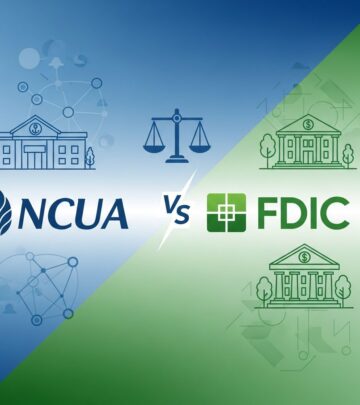
NCUA Insurance Explained
Discover how NCUA insurance safeguards your credit union deposits up to $250,000, offering government-backed security similar to FDIC protection.

The National Credit Union Administration (NCUA) provides essential protection for deposits held at federally insured credit unions, guaranteeing up to $250,000 per depositor, per institution, per ownership category. This coverage, administered through the National Credit Union Share Insurance Fund (NCUSIF), ensures members recover their funds in the event of a credit union failure, backed by the full faith and credit of the U.S. government.
Understanding the Foundations of NCUA Protection
Congress established the NCUA in 1970 as an independent federal agency to insure deposits at federally insured credit unions, mirroring the role of the FDIC for banks. The NCUSIF, managed by the NCUA, maintains a reserve at or near 1.30% of total insured deposits, funded by premiums from credit unions. This system has protected millions of accounts without a single penny of insured savings lost.
Federally insured credit unions, which include all federal charters and most state-chartered ones, automatically provide this coverage to members upon account opening—no application or fees required. Approximately 98% of U.S. credit unions participate, safeguarding over 143 million account holders.
Core Coverage Limits and What They Protect
Standard NCUA insurance covers principal and posted dividends up to $250,000 for each eligible account category. This applies to common deposit types like savings, checking, money market accounts, and certificates of deposit (share certificates).
- Savings and Checking Accounts: Everyday transaction accounts fully insured up to the limit.
- Share Certificates: Fixed-term deposits similar to CDs, protected equally.
- Money Market Accounts: Higher-yield options with check-writing features, covered standardly.
Coverage is calculated separately for each ownership category, allowing members to multiply protection across account types without exceeding per-category limits.
Detailed Breakdown of Account Ownership Categories
NCUA distinguishes coverage based on ownership structure to maximize protection. Here’s how it applies:
| Ownership Type | Coverage Amount | Key Conditions |
|---|---|---|
| Single Ownership | $250,000 per owner | No beneficiaries; one person controls the account. |
| Joint Ownership | $250,000 per co-owner | Two or more owners; primary owner must be a credit union member. |
| IRA/KEOGH Retirement | $250,000 per owner | Separate category from other accounts. |
| Revocable Trust | $250,000 per beneficiary (up to limits) | Per eligible beneficiary named; owner insured accordingly. |
| Irrevocable Trust | $250,000 per beneficiary | All owners or beneficiaries must be credit union members. |
For example, a single member with a $200,000 savings account and $200,000 IRA enjoys $450,000 total coverage since retirement accounts are segregated. Joint accounts double protection if both owners qualify.
NCUA Insurance Versus FDIC: A Side-by-Side Comparison
From a depositor’s viewpoint, NCUA and FDIC insurance are nearly identical: both cap at $250,000 per depositor, per institution, per category, with full U.S. government backing. The primary distinction lies in institutional focus—NCUA for credit unions, FDIC for banks.
| Feature | NCUA (Credit Unions) | FDIC (Banks) |
|---|---|---|
| Coverage Limit | $250,000 per depositor, per CU, per category | $250,000 per depositor, per bank, per category |
| Government Backing | Full faith and credit | Full faith and credit |
| Fund Name | NCUSIF | Deposit Insurance Fund |
| Institution Type | Credit unions (federal & most state) | Commercial banks |
| Automatic? | Yes, for members | Yes, for depositors |
Both funds are self-sustaining, with credit unions contributing 1% of deposits to NCUSIF by law, and NCUA able to assess premiums if needed.
Strategies to Maximize Your NCUA Coverage
Members can structure accounts to amplify protection beyond $250,000 at a single credit union:
- Diversify Categories: Use single, joint, retirement, and trust accounts separately.
- Spread Across Institutions: Open accounts at multiple federally insured credit unions for additional $250,000 per category per institution.
- Trust Planning: Name multiple beneficiaries in revocable trusts to unlock up to $250,000 per beneficiary (with limits).
- Verify Insurance Status: Confirm the NCUA logo or use the NCUA locator tool.
For instance, a couple could insure $1.5 million: $250k single each, $250k joint each co-owner share, $250k IRA each, totaling across categories.
Identifying Federally Insured Credit Unions
Not all credit unions offer NCUA protection—state-chartered ones may use private insurers lacking government backing. Always check for the official NCUA emblem on statements, websites, or premises. Use NCUA’s online research tool to verify membership in the Share Insurance Fund.
Federal credit unions must be insured; participating state ones cover the vast majority, ensuring broad access to secure saving.
The Payout Process in Case of Failure
Credit union failures are rare, but if one occurs, NCUA steps in swiftly. Members receive funds dollar-for-dollar up to limits, typically within days via direct deposit to another institution or new accounts. Principal and accrued dividends through the failure date are covered—no losses since inception.
Recent Developments and Future Changes
NCUA periodically updates rules for clarity. Post-December 2026, revocable trust coverage may expand to $1,250,000 maximum per owner, enhancing estate planning options.
Frequently Asked Questions
What happens if my balance exceeds $250,000?
Only up to $250,000 per category is insured; excess is at risk. Diversify to protect more.
Does NCUA cover loans or investments?
No—only deposit accounts like shares and certificates. Stocks, bonds, or mutual funds are not insured.
Is private insurance as safe?
No; it’s not government-backed and may not guarantee full recovery.
How do I calculate my total coverage?
Use NCUA’s online estimator for personalized scenarios.
Are dividends insured?
Yes, posted dividends up to the failure date are included.
Why Choose a Federally Insured Credit Union?
With government-backed safety matching banks, plus member-owned benefits like higher yields and lower fees, NCUA-insured credit unions offer secure, rewarding saving. No insured losses in over 50 years underscore their reliability.
References
- NCUA: What it is and how it keeps your credit union deposits safe — Bankrate. 2023. https://www.bankrate.com/banking/ncua-how-your-savings-at-credit-unions-are-insured-by-the-government/
- Share Insurance Coverage — NCUA.gov. Accessed 2026. https://ncua.gov/consumers/share-insurance-coverage
- NCUA Insurance: What It Means & How It Works — First Tech Federal Credit Union. 2023. https://www.firsttechfed.com/articles/bank/what-does-it-mean-to-be-insured-by-ncua
- How Does Share Insurance Work? — MyCreditUnion.gov. Accessed 2026. https://mycreditunion.gov/protect-your-money/share-insurance/how-does-share-insurance-work
- Frequently Asked Questions About Share Insurance — NCUA.gov. Accessed 2026. https://ncua.gov/consumers/share-insurance-coverage/frequently-asked-questions-about-share-insurance
- About NCUA — NCUA.gov. Accessed 2026. https://ncua.gov/about
Similar Articles








Read full bio of Sneha Tete