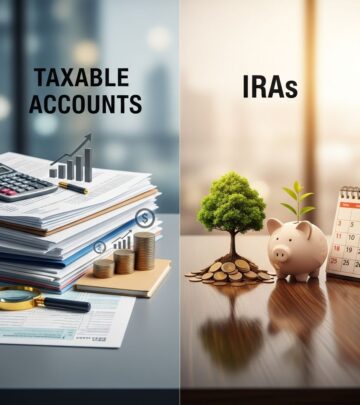
Investment Account Types: How To Choose The Right Account
Discover which investment account structure aligns with your financial objectives and timeline.

When beginning your investment journey, one of the most critical decisions involves selecting the appropriate account structure to hold your investments. Different account types offer varying tax treatments, contribution limits, withdrawal flexibility, and eligibility requirements. Understanding these distinctions allows you to strategically allocate your resources across multiple accounts to maximize growth while minimizing tax liability and aligning with your specific financial objectives.
The Foundation: Understanding General Investing Accounts
For those seeking maximum flexibility without retirement-focused restrictions, general investing accounts (also called taxable or standard brokerage accounts) serve as the foundational investment vehicle. These accounts permit virtually unrestricted buying and selling of investments, with no contribution caps and no income limitations for opening. You maintain complete control over when to invest, what to purchase, and when to withdraw your funds.
The primary trade-off involves taxation. Unlike retirement-focused accounts that offer tax deferral or elimination, earnings within taxable accounts face taxation in the year you realize gains or receive dividends. This tax reality makes these accounts particularly suitable for investors with intermediate time horizons or those requiring access to capital without penalty. Anyone aged 18 or older can open a general investing account at virtually any financial institution.
Variations Within Taxable Accounts
- Cash Accounts: You deposit money and purchase securities using only available funds, making this the most straightforward approach
- Margin Accounts: These permit borrowing from your broker to purchase additional securities, introducing leverage and heightened risk suitable only for experienced investors
- Individual Accounts: Single-owner accounts held in one person’s name
- Joint Accounts: Shared ownership accounts allowing two or more people to invest together
Tax-Advantaged Retirement Structures
Retirement accounts represent fundamentally different investment vehicles, engineered specifically to encourage long-term savings through tax incentives. These accounts feature contribution limits, specific withdrawal rules, and potentially restricted access to funds before reaching retirement age. Despite these limitations, the tax advantages can dramatically amplify wealth accumulation over decades.
Individual Retirement Accounts (IRAs)
Traditional IRAs allow you to contribute pre-tax dollars, reducing your current taxable income. Your investments grow tax-deferred, meaning no annual tax on gains, interest, or dividends. When you withdraw funds during retirement, those distributions face taxation at your applicable rate. This structure benefits investors expecting lower income during retirement, potentially positioning them in lower tax brackets.
Roth IRAs operate in reverse. You contribute after-tax dollars without reducing current-year taxable income. However, investments grow entirely tax-free, and qualified withdrawals—taken after age 59½ and with at least five years of account ownership—incur no federal income tax whatsoever. This makes Roth accounts exceptional for younger investors anticipating substantial earnings over their careers. Additionally, Roth IRAs permit withdrawing contributions (though not earnings) at any time without penalty, offering greater flexibility.
Both IRA types face annual contribution limits of $6,500, with an additional $1,000 catch-up contribution available for those over 50. Roth IRAs include income restrictions that vary based on filing status, potentially disqualifying higher earners from direct contributions.
Self-Directed and Specialized IRAs
Self-directed IRAs can be structured as either traditional or Roth versions, but grant significantly broader investment latitude. Beyond conventional stocks and mutual funds, self-directed IRA owners can invest in real estate, precious metals, partnerships, and other alternative assets. This flexibility attracts sophisticated investors seeking diversification beyond standard securities.
For small business owners and self-employed individuals, SEP IRAs and SIMPLE IRAs provide substantial retirement savings opportunities with higher contribution limits than standard IRAs. These vehicles enable business owners to make significant tax-deductible contributions while establishing retirement security independently.
Employer-Sponsored Retirement Plans
Employees with access to workplace retirement plans enjoy employer matching opportunities and elevated contribution limits. 401(k) plans serve private-sector employees, allowing annual contributions of $23,500 (with $7,500 additional for those over 50). Many employers match a percentage of employee contributions, providing essentially free money for retirement savings.
Employees in nonprofit organizations and public agencies access 403(b) plans, featuring comparable benefits and limits. State and local government employees utilize 457(b) plans, with unique features including early withdrawal opportunities without penalty in certain circumstances. Federal employees and military personnel benefit from Thrift Savings Plans, combining government matching contributions with low-cost investment options.
Employer plans typically offer two tax structures: traditional accounts that provide current-year tax deductions and tax-deferred growth, or Roth accounts featuring after-tax contributions with tax-free withdrawals in retirement.
Education-Focused Investment Vehicles
Parents and guardians planning for children’s educational expenses can leverage specialized savings accounts designed with tax advantages. 529 college savings plans represent the most popular education funding vehicle, allowing unlimited contributions with earnings growing tax-free when used for qualified education expenses. These plans exist in two formats: prepaid tuition plans locking in current tuition rates, and investment-based plans providing growth potential through market investments.
Coverdell Education Savings Accounts (ESAs) offer broader investment flexibility than 529 plans, permitting investments in stocks, bonds, ETFs, mutual funds, and real estate. However, annual contribution limits cap at $2,000 per beneficiary, and funds must be distributed by age 30. ESAs work particularly well for investors comfortable self-directing educational investment choices.
For individuals with disabilities, ABLE accounts provide similar tax-advantaged structures specifically for disability-related expenses, while protecting access to essential public benefits like Medicaid. These accounts permit $18,000 annual contributions, with additional earnings capacity through employment income.
Health-Focused Savings Structures
Health Savings Accounts (HSAs) offer unique triple tax advantages for individuals enrolled in high-deductible health plans. Contributions reduce taxable income, growth occurs tax-free, and withdrawals for qualified medical expenses face no taxation. Unlike flexible spending accounts that forfeit unused balances, HSA funds roll over indefinitely, functioning as long-term investment vehicles once medical expenses are covered through other means.
Comparative Account Framework
| Account Type | Tax Treatment | Contribution Limits | Withdrawal Flexibility | Best For |
|---|---|---|---|---|
| Taxable Brokerage | Annual taxation on gains/dividends | Unlimited | Anytime without penalty | Short-term goals, flexibility |
| Traditional IRA | Tax-deferred growth | $6,500 annually | Age 59½+ or penalties apply | Long-term retirement savings |
| Roth IRA | Tax-free growth and withdrawals | $6,500 annually | Contributions anytime; earnings age 59½+ | Young investors, tax-free retirement |
| 401(k) | Tax-deferred or tax-free growth | $23,500 annually | Age 59½+ or penalties apply | Maximizing retirement savings with match |
| 529 Plan | Tax-free for education expenses | Unlimited (gift tax considerations) | For education only; otherwise penalized | Education funding |
| HSA | Triple tax advantage | $4,150 individual; $8,300 family | Medical expenses anytime; others age 65+ | Medical expense planning |
Strategic Account Selection Framework
Selecting optimal account structures requires evaluating multiple factors simultaneously. Begin by identifying your primary financial objective: retirement security, educational funding, healthcare planning, or general wealth accumulation. Next, assess your time horizon—funds needed within five years typically belong in accessible accounts, while multi-decade timelines justify more restrictive structures offering superior tax advantages.
Examine your current and projected tax brackets. Higher-income individuals may benefit disproportionately from Roth conversions and tax-deferred growth, while those anticipating lower retirement income gain from traditional IRA deductions. Consider your employer situation: access to matching contributions in workplace plans should receive priority due to the immediate return equivalent to salary increases.
Evaluate income eligibility restrictions, particularly for Roth IRA contributions, which phase out at higher income levels. Review contribution capacity across multiple accounts—maximizing employer matches first, then funding IRAs, then utilizing taxable accounts creates an efficient savings hierarchy.
Integration Across Multiple Accounts
Most sophisticated investors maintain several accounts simultaneously, each serving distinct purposes within an integrated strategy. A typical multi-account approach might include employer retirement plans for matching contributions, IRAs for additional tax-advantaged savings, education accounts for children’s expenses, and taxable accounts for flexibility and intermediate-term goals.
This diversification approach permits optimization within each account type while maintaining overall portfolio coherence. Tax-loss harvesting opportunities emerge through coordinating sales across accounts, while strategic asset location—placing tax-inefficient investments in retirement accounts and tax-efficient holdings in taxable accounts—amplifies after-tax returns.
Common Misconceptions Clarified
Many investors mistakenly believe contribution limits apply across all IRAs combined, leading to over-contribution violations. Actually, the $6,500 limit applies to total IRA contributions across all traditional and Roth accounts for a given year. Similarly, some assume taxable accounts create disadvantages; in reality, their unlimited access and flexibility benefit specific situations, particularly when funding non-retirement goals or requiring emergency capital accessibility.
Another frequent misunderstanding involves Roth IRA earnings accessibility. While contributions can be withdrawn anytime penalty-free, earnings withdrawals before age 59½ incur both taxes and penalties unless you satisfy specific exceptions like disability or first-time home purchase (up to $10,000 lifetime). Understanding these nuances prevents costly mistakes.
Ongoing Account Management
Selecting appropriate accounts represents just the initial step. Annual reviews should confirm your account structure still aligns with evolving circumstances. Job changes, income fluctuations, marriage, children, and major purchases all trigger potential account reoptimization. Life transitions frequently create opportunities for Roth conversions, beneficiary designation updates, or allocation rebalancing across your account ecosystem.
Additionally, monitor contribution limit changes announced annually by the IRS, as limits typically adjust to accommodate inflation. Staying informed about regulatory changes ensures you maximize available savings opportunities and avoid inadvertent violations.
Frequently Asked Questions
Can I have multiple IRA accounts?
Yes, you can maintain multiple traditional IRAs, multiple Roth IRAs, or a combination of both. However, the annual contribution limit applies across all your IRAs collectively, not to each individual account.
What happens if I withdraw retirement funds early?
Early withdrawals from traditional IRAs and most employer plans trigger both income tax and a 10% penalty before age 59½, with limited exceptions for disability, medical expenses, or specific life events. Roth IRA contributions (not earnings) withdraw penalty-free at any time, offering greater flexibility.
Does employer matching go into the contribution limit?
No, employer contributions toward 401(k) plans don’t count against your employee contribution limit, allowing you to receive full matching benefits while maximizing your personal contributions.
Which account should I fund first?
Prioritize employer retirement plans offering matching contributions, as this represents immediate return. Then fund IRAs if eligible, followed by education or other specialized accounts, with remaining savings directed to taxable accounts.
Are investment choices limited in retirement accounts?
Standard IRAs and 401(k) plans typically offer stocks, bonds, mutual funds, and ETFs. Self-directed IRAs expand options to real estate and alternative investments. Most employer plans feature curated investment menus rather than unlimited choices.
References
- Types of Investment Accounts: Pros, Cons & Examples — Quicken. Retrieved February 6, 2026. https://www.quicken.com/blog/types-of-investment-accounts/
- What is an Investment Account? 5 Types to Know — NerdWallet. Retrieved February 6, 2026. https://www.nerdwallet.com/investing/learn/types-investment-accounts-know
- Types of Investment Accounts — Experian. Retrieved February 6, 2026. https://www.experian.com/blogs/ask-experian/types-of-investment-accounts/
- Three of the Most Common Investment Account Types — Franklin Templeton. Retrieved February 6, 2026. https://www.franklintempleton.com/planning-and-learning/learn-about-investing/investing-basics/three-of-the-most-common-investment-account-types
- Investment Accounts — FINRA.org. Retrieved February 6, 2026. https://www.finra.org/investors/investing/investment-accounts
Similar Articles








Read full bio of medha deb