Natural Rate of Unemployment: Definition and Trends
Understanding the natural rate of unemployment and its impact on economic policy and labor markets.
Understanding the Natural Rate of Unemployment
The natural rate of unemployment, commonly referred to as NAIRU (Non-Accelerating Inflation Rate of Unemployment), represents a fundamental concept in macroeconomics that helps policymakers and economists understand labor market dynamics and inflation pressures. This rate reflects the level of unemployment that exists when the economy is functioning at full capacity, with inflation remaining stable and not accelerating. Unlike the actual unemployment rate, which fluctuates with economic cycles, the natural rate represents a long-term equilibrium that remains relatively stable over extended periods.
Understanding this concept is crucial for monetary policy decisions, as central banks like the Federal Reserve use it to gauge whether labor markets are tight or slack. When actual unemployment falls below the natural rate, it signals that labor markets may be overheating, potentially leading to inflationary pressures. Conversely, when unemployment rises above the natural rate, it suggests economic slack and deflationary pressures.
What Is the Natural Rate of Unemployment?
The natural rate of unemployment is defined as the rate of unemployment arising from all sources except fluctuations in aggregate demand. It represents an unemployment rate that would prevail in the absence of cyclical shocks to the economy. This rate encompasses structural unemployment, frictional unemployment, and other long-term labor market characteristics that cannot be eliminated through aggregate demand management.
The concept was popularized by economist Milton Friedman, who described it as a rate that would be calculated in an economic model sophisticated enough to capture “the actual structural characteristics of the labor and commodity markets, including market imperfections, stochastic variability in demands and supplies, the cost of gathering information about job vacancies and labor availabilities, the cost of mobility, and so on.”
Unlike the actual unemployment rate, which is directly observable and reported monthly, the natural rate is not directly observable and must be estimated using various statistical and econometric methods. Different researchers and institutions may produce different estimates of the natural rate based on their methodologies, but these estimates typically cluster within a narrow range.
Key Differences: Actual vs. Natural Unemployment
It is essential to distinguish between the actual unemployment rate and the natural rate. The actual unemployment rate measures the percentage of the labor force that is currently unemployed at any given time. This rate fluctuates regularly based on economic conditions, seasonal factors, and cyclical trends. During recessions, the actual unemployment rate rises sharply above the natural rate, while during economic expansions, it typically falls closer to or even below the natural rate.
The natural rate, by contrast, represents a stable baseline that reflects long-term structural characteristics of the labor market. It captures elements such as worker skill mismatches, geographic immobility, job search frictions, and minimum wage effects. These structural factors persist even when the economy is performing well, which is why the natural rate remains positive even at full employment.
The difference between the actual and natural rates of unemployment is known as the unemployment gap. When this gap is negative (actual unemployment below the natural rate), it indicates tight labor markets and potential upward pressure on wages and inflation. When the gap is positive (actual unemployment above the natural rate), it suggests labor market slack and potential downward pressure on inflation.
Historical Trends in the Natural Rate
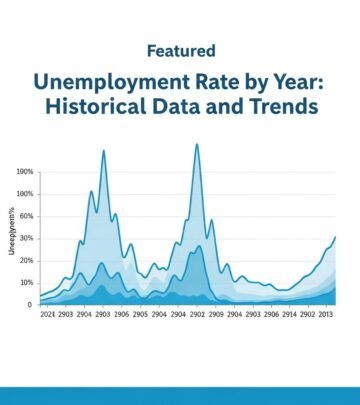
Historical analysis reveals that the natural rate of unemployment has been remarkably stable over the long term, typically hovering between 4.5 and 5.5 percent over extended periods. This stability is surprising given the dramatic economic changes that have occurred over the past century, including the Great Depression, wars, technological revolutions, and significant shifts in labor force composition.
During the Great Depression, despite an unemployment increase of more than 22 percentage points, estimates of the natural rate showed only a transitory increase of approximately 1 percentage point. This finding suggests that much of the elevated unemployment during that period was cyclical rather than structural in nature.
The post-World War II era saw fluctuations in the natural rate, with some evidence suggesting an increase during the 1970s and early 1980s, a period characterized by stagflation and rising inflation expectations. However, since the 1990s, the natural rate has trended downward, reflecting demographic changes, improved labor market matching, and better-anchored inflation expectations.
Recent estimates place the natural rate of unemployment between 3.8 and 4.5 percent, representing a decline from earlier historical levels. This decrease reflects several factors, including an aging labor force composition, increased efficiency in job matching through digital technologies, and demographic shifts in the labor force.
Factors Influencing the Natural Rate
Labor Market Flows and Job-Finding Rates
The natural rate of unemployment is intimately connected to labor market flows—the movement of workers between employment and unemployment. The natural rate depends on both the rate at which workers flow into unemployment (separation rate) and the rate at which they flow out of unemployment (job-finding rate). When job-finding rates decline, the natural rate tends to increase, as workers spend longer periods unemployed. Conversely, improvements in job matching and hiring efficiency can reduce the natural rate.
Demographic Composition
Changes in the demographic composition of the labor force significantly influence the natural rate. Different age and skill groups experience different rates of unemployment. An aging labor force, with a higher proportion of older, more experienced workers, typically experiences a lower natural rate because older workers have lower unemployment rates. The shift toward a more educated workforce and the changing composition of employment by skill level also contribute to changes in the natural rate over time.
Job Polarization and Skills Mismatch
Structural changes in the economy, such as job polarization—the growth of high-skilled and low-skilled jobs at the expense of middle-skilled positions—can affect the natural rate. Skills mismatches between unemployed workers and available jobs create frictional unemployment that persists even in good economic times. The rise of remote work and digital technologies has both reduced certain job search frictions and created new skill requirements, affecting how the natural rate evolves.
Inflation Expectations
The natural rate is fundamentally connected to inflation dynamics. When inflation expectations become unanchored or change, the relationship between unemployment and inflation shifts, potentially changing the estimated natural rate. Since the 1980s, improved inflation expectations management through central bank credibility has contributed to lower natural rates of unemployment.
Measuring the Natural Rate: Methodological Approaches
Economists employ various methods to estimate the natural rate of unemployment. These approaches differ in their underlying assumptions and data sources but generally aim to identify the trend component of unemployment that is not driven by cyclical factors.
Flow-Based Approaches
One prominent methodology uses labor market flow data—tracking how workers move between employment, unemployment, and non-participation. By analyzing trends in job-finding and separation rates, researchers can estimate the long-run level of unemployment that would persist absent cyclical shocks. This approach has the advantage of being grounded in microeconomic labor market dynamics.
Phillips Curve Framework
Another approach uses the Phillips Curve relationship between unemployment and inflation. By examining how inflation responds to changes in unemployment, researchers can infer the natural rate as the unemployment level consistent with stable inflation. This method relies on survey-based expectations of inflation at different horizons to provide signals of true inflation expectations.
Time-Series Statistical Methods
More recent approaches employ sophisticated statistical techniques to decompose the unemployment rate into trend and cyclical components. These methods use filtering techniques to isolate the slow-moving trend that represents the natural rate from short-term cyclical fluctuations. The advantage of these methods is their ability to estimate the natural rate over long historical periods.
The Natural Rate and Monetary Policy
The natural rate of unemployment plays a central role in monetary policy formulation. Central banks, including the Federal Reserve, use estimates of the natural rate to assess labor market slack and guide decisions about interest rates and monetary stimulus.
When policymakers believe the actual unemployment rate is below the natural rate, they interpret this as a sign that labor markets are tight, potentially generating upward pressure on wages and inflation. This typically prompts central banks to consider raising interest rates to cool the economy. Conversely, when actual unemployment exceeds the natural rate estimate, policymakers recognize labor market slack and may maintain accommodative monetary policies to stimulate employment growth.
However, the uncertainty surrounding natural rate estimates introduces challenges for policy implementation. Since the natural rate must be estimated and is subject to significant measurement error, policymakers may misjudge labor market conditions, leading to either excessive stimulus or overly restrictive policies.
Recent Trends and Contemporary Debates
Recent years have witnessed substantial debate about the natural rate of unemployment. Following the Great Recession, many observers suggested the natural rate had permanently risen due to structural factors such as long-term joblessness, skills erosion, and demographic shifts. However, as unemployment fell substantially in subsequent years without generating significant inflation, many researchers revised downward their estimates of the natural rate.
The unemployment rate has declined dramatically since 2009, reaching levels as low as 3.4 percent in recent years, which is notably below many estimates of the natural rate. This disconnect between low unemployment and modest inflation pressures has led some economists to question whether the natural rate is even lower than previously estimated or whether other factors are constraining inflation growth.
The COVID-19 pandemic created additional complexity in natural rate estimation, as the sharp but temporary rise in unemployment was followed by an exceptionally rapid decline. The subsequent inflation surge raised new questions about whether the natural rate concept remains as useful in environments with large supply shocks.
Frequently Asked Questions
Q: Why is the natural rate of unemployment positive?
A: The natural rate remains positive because even in well-functioning economies with strong demand, frictional unemployment persists. Workers and employers need time to find suitable matches, and structural factors like skills mismatches ensure some level of unemployment exists regardless of economic conditions.
Q: How often do economists revise natural rate estimates?
A: Natural rate estimates are revised regularly as new data becomes available and methodologies improve. Major revisions often follow significant economic events like recessions or structural changes in the labor market. Ongoing analysis and publication by institutions like the Federal Reserve system keep estimates relatively current.
Q: Can the natural rate change over time?
A: Yes, the natural rate can change gradually over time in response to demographic shifts, technological changes, and structural factors affecting labor markets. However, changes typically occur slowly over years or decades rather than in response to short-term economic fluctuations.
Q: How does the natural rate differ internationally?
A: Different countries have different natural rates based on their labor market institutions, demographic structures, and economic characteristics. Countries with more rigid labor markets typically have higher natural rates, while those with flexible labor markets and strong job matching systems tend to have lower natural rates.
Q: What happens if actual unemployment stays below the natural rate?
A: When actual unemployment remains below the natural rate for extended periods, it suggests tight labor markets that may generate wage and price pressures. This typically prompts central banks to raise interest rates to prevent the economy from overheating and inflation from accelerating.
References
- Noncyclical Rate of Unemployment — Federal Reserve Economic Data (FRED), St. Louis Federal Reserve. 2024. https://fred.stlouisfed.org/graph/?g=14GH
- Unemployment after the Recession: A New Natural Rate? — Federal Reserve Bank of Cleveland. 2010. https://www.clevelandfed.org/publications/economic-commentary/2010/ec-201011-unemployment-after-the-recession-a-new-natural-rate
- The Natural Rate of Unemployment over the Past 100 Years — Federal Reserve Bank of San Francisco, Regis Barnichon and Christian Matthes. 2017. https://www.frbsf.org/research-and-insights/publications/economic-letter/2017/08/natural-rate-of-unemployment-over-past-100-years/
- Long-Run Trends and the Natural Rate of Unemployment — National Bureau of Economic Research (NBER). 2021. https://www.nber.org/reporter/2021number2/long-run-trends-and-natural-rate-unemployment
- A New Estimate of the Natural Rate of Unemployment — Federal Reserve Bank of Kansas City. 2017. https://www.kansascityfed.org/research/economic-bulletin/new-estimate-natural-rate-unemployment-2017/
Similar Articles








Read full bio of medha deb