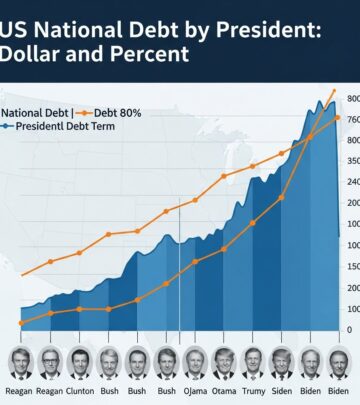
National Debt by Year Compared to GDP and Major Events
Explore the U.S. national debt history, key milestones, and economic impacts through decades of data.
Understanding the U.S. National Debt: A Historical Overview
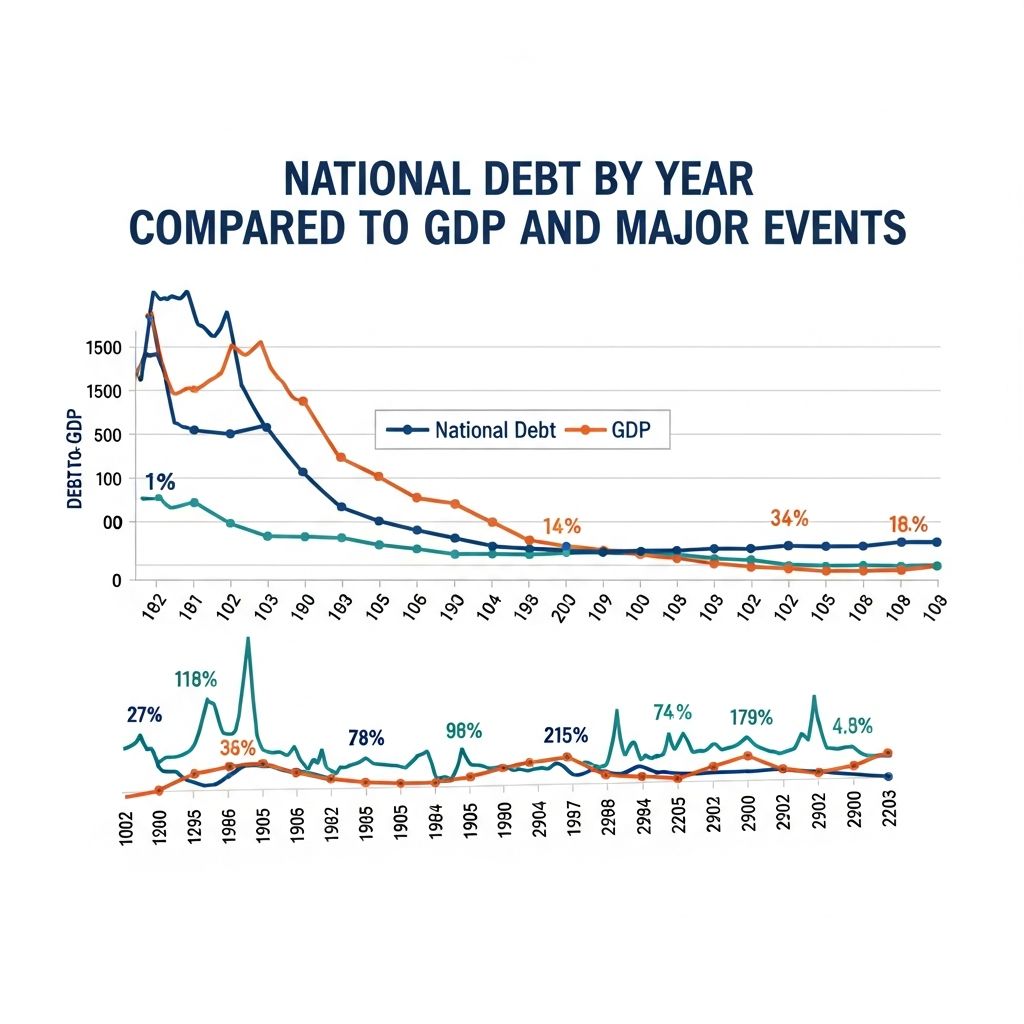
The United States national debt represents the total amount of money the federal government has borrowed to finance its operations and obligations. The debt-to-GDP ratio is a critical metric that compares the total national debt to the country’s Gross Domestic Product, providing insight into whether the debt is growing faster than the economy itself. Since 1940, this ratio has fluctuated significantly, reflecting major economic events, wars, recessions, and policy decisions that have shaped the nation’s fiscal landscape.
Understanding how the national debt has evolved over the decades is essential for comprehending current economic challenges and future financial projections. The relationship between debt and GDP reveals whether a nation’s economy is expanding enough to support its obligations or whether debt is accumulating at an unsustainable rate.
Historical Debt-to-GDP Ratios: The Long-Term Trend
From 1940 to 2024, the United States government debt-to-GDP ratio averaged 66.38 percent. This average masks significant volatility throughout the period, with the ratio reaching extremes that reflect the nation’s economic circumstances at different points in history.
The record low debt-to-GDP ratio occurred in 1981 at just 31.80 percent, representing a period when the economy had grown substantially relative to accumulated debt. This relatively low ratio reflected the post-World War II era’s strong economic growth and the effects of inflation that reduced the real burden of existing debt.
In stark contrast, the all-time high debt-to-GDP ratio reached 126.30 percent in 2020, coinciding with the COVID-19 pandemic. During this crisis, the federal government implemented unprecedented fiscal stimulus measures, leading to massive spending increases while economic activity contracted temporarily, pushing the debt-to-GDP ratio to historic levels.
Recent National Debt Figures and Current Status
As of 2024, the United States recorded a government debt-to-GDP ratio of 124.30 percent of the country’s Gross Domestic Product. More specifically, in December 2024, U.S. government debt accounted for 124.0 percent of the country’s nominal GDP, compared with 123.1 percent in the previous quarter. This elevated ratio reflects the persistent challenge of managing federal spending relative to economic output.
The national government debt itself reached 36,220.2 billion USD in January 2025, demonstrating the substantial absolute size of the nation’s debt obligations. These figures underscore the ongoing fiscal pressures facing the U.S. government and the need for comprehensive policy solutions.
Future Debt Projections Through 2027 and Beyond
According to current economic forecasts, the debt-to-GDP ratio is expected to reach 125.40 percent by the end of 2025. The long-term outlook presents a concerning picture, with projections suggesting the ratio will trend around 126.80 percent in 2026 and 128.10 percent in 2027.
Looking further ahead, the Congressional Budget Office (CBO) has provided sobering long-term projections. Federal debt held by the public is projected to rise from 99 percent of GDP in 2024 to 116 percent by 2034, driven primarily by the growth of interest costs and mandatory spending outpacing revenue and economic growth. If current laws remain generally unchanged, federal debt could reach an unprecedented 172 percent of GDP by 2054, creating significant economic challenges for future generations.
Major Economic Events and Their Impact on National Debt
The World War II Era (1940s)
The 1940s marked a dramatic increase in national debt as the United States mobilized for World War II. Federal spending surged to unprecedented levels to support military operations, defense production, and allied support. This period demonstrated how major geopolitical events can fundamentally alter a nation’s fiscal trajectory, with debt accumulating rapidly to support critical national objectives.
Post-War Economic Growth and Debt Reduction (1950s-1960s)
Following World War II, the American economy experienced robust growth during the 1950s and 1960s. Economic expansion outpaced debt growth, allowing the debt-to-GDP ratio to decline steadily. This period illustrated how sustained economic growth could reduce the burden of previously accumulated debt without requiring dramatic spending cuts.
The Great Recession (2007-2009) and Its Aftermath
Debt held by the public as a percentage of GDP rose from 34.7 percent in 2000 to 40.5 percent in 2008 and then to 67.7 percent in 2011. The financial crisis of 2007-2008 prompted massive government intervention, including bank bailouts, stimulus spending, and automatic increases in safety-net programs as economic activity contracted. The recession demonstrated how quickly the debt-to-GDP ratio can deteriorate during periods of economic distress.
The COVID-19 Pandemic (2020-2021)
The COVID-19 pandemic triggered unprecedented fiscal responses, with the federal government implementing multiple stimulus packages totaling trillions of dollars. The all-time high debt-to-GDP ratio of 130.4 percent was reached in March 2021, reflecting the combined effects of massive government spending and reduced economic activity. This period represented the fastest accumulation of national debt relative to GDP in the nation’s history outside of World War II.
Debt Accumulation Rate: The Pace of Growth
Recent years have seen remarkably rapid debt accumulation. Between August 12 and October 23 of 2024, the national debt increased by $1 trillion, rising from $37 trillion to $38 trillion over a period of just 71 days. This acceleration illustrates the growing challenges of managing federal finances, with debt accumulating at an average rate of approximately $192,200 per second during particularly concerning periods.
Even brief government shutdowns have contributed to debt accumulation. During a shutdown period, more than $382 billion of debt was added in just the first 23 days, further demonstrating the fiscal pressures facing the government.
Interest Payments: A Growing Burden
One of the most troubling aspects of rising national debt is the escalating cost of servicing that debt. According to the Congressional Budget Office, net interest payments have more than tripled, climbing from $231 billion in 2014 (1.3 percent of GDP) to $799 billion in 2024 (3.0 percent of GDP)—the highest ratio since 1996. A study by the Committee for a Responsible Federal Budget indicated that the U.S. government would spend more on servicing its debts than on the national defense budget by 2024.
As interest rates remain elevated and debt levels continue to climb, interest payments are projected to consume an ever-larger share of the federal budget, crowding out spending on education, infrastructure, and other productive investments.
Debt-to-GDP Comparison: A Critical Economic Metric
The debt-to-GDP ratio serves as a crucial indicator of fiscal health. A ratio below 60 percent is generally considered manageable by international standards, while ratios above 90 percent are associated with reduced economic growth potential. The U.S. debt-to-GDP ratio of 124.30 percent significantly exceeds both these benchmarks, indicating a debt burden that is historically elevated.
Mathematically, the debt-to-GDP ratio can decrease even while absolute debt grows if the rate of increase in GDP (accounting for inflation) exceeds the rate of increase in debt. This dynamic created opportunities during periods of strong economic growth to reduce the ratio without implementing austerity measures. However, recent trends show debt growing faster than GDP, pushing the ratio higher.
Factors Driving Increased Debt
Rising Mandatory Spending
Mandatory spending programs, particularly Social Security and Medicare, consume an increasingly large share of the federal budget. These programs are not discretionary and grow automatically as the population ages and healthcare costs rise. Without reform, mandatory spending will continue to drive budget deficits and debt accumulation.
Tax Policy Changes
Tax policy decisions significantly impact federal revenues and, consequently, debt levels. Reductions in tax rates, without corresponding spending cuts, increase deficits and accelerate debt accumulation. The CBO projected that tax cuts between 2018 and 2027 would result in $1.7 trillion less in revenues, partially offset by $1.1 trillion in additional revenue from higher economic growth than previously forecast.
Discretionary Spending Increases
Defense spending, infrastructure investment, and other discretionary programs contribute to budget deficits when they exceed available revenues. Between 2018 and 2027, CBO projected an additional $1.0 trillion in spending compared to previous baselines.
Historical Perspective: Debt in Wartime and Crisis
Throughout American history, national debt has surged during major wars and crises. During the War of 1812, debt increased to 10 percent of GDP by 1815. This pattern repeated during subsequent wars and economic emergencies, reflecting the reality that governments must borrow heavily during existential challenges and catastrophic economic disruptions.
International Comparisons
By international standards, the U.S. debt-to-GDP ratio is elevated but not unique. Several developed nations, including Italy, Spain, and Greece, carry higher debt-to-GDP ratios. However, the U.S. possesses certain advantages in managing high debt levels, including a reserve currency status that facilitates borrowing at relatively low costs and a large, productive economy that generates substantial tax revenues.
Long-Term Fiscal Sustainability Challenges
The CBO’s projections through 2049 paint a sobering picture of long-term fiscal sustainability. Large budget deficits over the next 30 years are projected to drive federal debt held by the public to unprecedented levels—from 78 percent in 2019 to 144 percent by 2049. Even accounting for uncertainty in economic projections, debt several decades from now would likely be substantially higher than current levels if current policies remain unchanged.
Policy Options and Potential Solutions
Revenue Enhancement
Policymakers could increase federal revenues through higher tax rates, broader tax bases, improved tax collection, or new revenue sources. However, revenue increases must be balanced against potential economic effects and political feasibility.
Spending Reforms
Controlling the growth of mandatory spending programs through means-testing, eligibility changes, or benefit adjustments could reduce future deficits. Discretionary spending also offers opportunities for efficiency improvements and prioritization.
Economic Growth
Robust economic growth would increase GDP growth, improving the debt-to-GDP ratio without requiring spending cuts or tax increases. Policies that enhance productivity, labor force participation, and innovation could support higher growth rates.
Debt Restructuring
In extreme scenarios, policymakers might consider restructuring existing debt, though this approach carries significant risks and costs.
Frequently Asked Questions (FAQs)
Q: What does the debt-to-GDP ratio measure?
A: The debt-to-GDP ratio compares a nation’s total debt to its economic output (GDP). It indicates whether debt is growing faster or slower than the economy, providing insight into fiscal sustainability. A higher ratio suggests debt is accumulating faster than economic growth.
Q: Why did the debt-to-GDP ratio reach its all-time high in 2020?
A: The all-time high of 126.30 percent in 2020 resulted from the COVID-19 pandemic, which prompted massive federal spending for stimulus and relief while economic activity contracted temporarily. The combination of increased spending and reduced GDP pushed the ratio to historic levels.
Q: What factors drive the national debt?
A: Major factors include mandatory spending programs (Social Security, Medicare), discretionary spending (defense, infrastructure), interest payments on existing debt, and the difference between government revenues and expenditures (the budget deficit).
Q: Can the debt-to-GDP ratio decrease while debt increases?
A: Yes, if the economy grows faster than debt accumulates (accounting for inflation), the debt-to-GDP ratio can decline despite rising absolute debt levels. This occurred during many post-World War II years when strong economic growth reduced the ratio.
Q: How much is the U.S. spending on interest payments?
A: As of 2024, the U.S. was spending approximately $799 billion annually on net interest payments, representing 3.0 percent of GDP—the highest ratio since 1996. This figure is projected to continue rising as debt levels increase.
Q: What are the long-term projections for U.S. national debt?
A: The Congressional Budget Office projects federal debt held by the public could reach 116 percent of GDP by 2034 and potentially 172 percent by 2054 if current laws remain unchanged, reflecting the unsustainability of current fiscal trajectories.
References
- United States Gross Federal Debt to GDP — Trading Economics. 2025-10. https://tradingeconomics.com/united-states/government-debt-to-gdp
- US Government Debt: % of GDP, 1969–2025 — CEIC Data. 2025-01. https://www.ceicdata.com/en/indicator/united-states/government-debt–of-nominal-gdp
- National Debt of the United States — Congressional Budget Office and U.S. Treasury Department. 2024-02. https://www.congress.gov
- Gross Federal Debt as Percent of Gross Domestic Product — Federal Reserve Economic Data (FRED). 2024. https://fred.stlouisfed.org/series/GFDGDPA188S
- Total Public Debt as Percent of Gross Domestic Product — Federal Reserve Economic Data (FRED). 2024. https://fred.stlouisfed.org/series/GFDEGDQ188S
- US Debt to GDP – Updated Chart — LongtermTrends. 2025. https://www.longtermtrends.net/us-debt-to-gdp/
- Federal Debt in Historical Perspective — Cato Institute. 2024. https://www.cato.org/outside-articles/federal-debt-historical-perspective
Similar Articles








Read full bio of Sneha Tete