Nasdaq Vs S&P 500: 2025 Investor Guide To Key Differences
Discover how Nasdaq and S&P 500 indexes differ in composition, weighting, performance, and investment strategies to make informed choices.
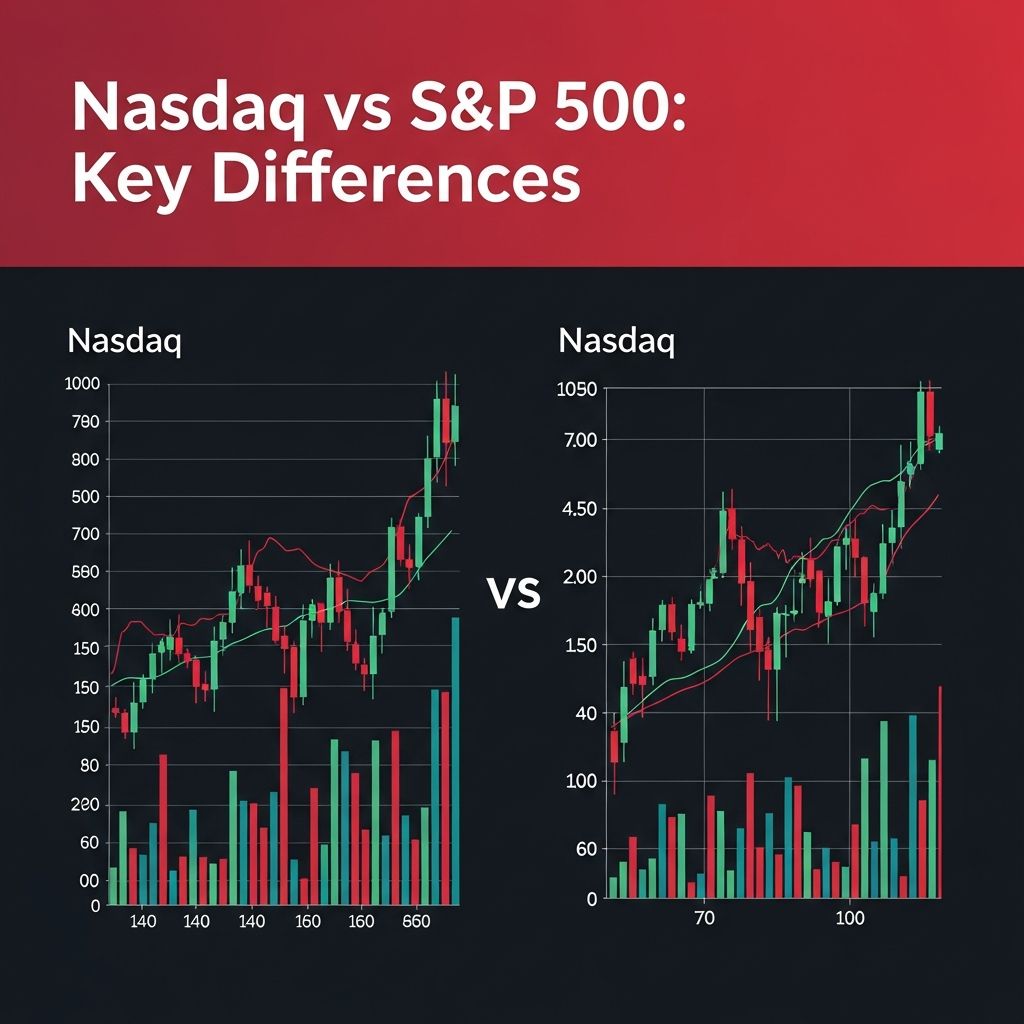
The Nasdaq Composite and Nasdaq 100 indexes emphasize technology-driven growth stocks traded primarily on the Nasdaq exchange, while the S&P 500 offers broader exposure to 500 of the largest U.S. companies across multiple sectors and exchanges.
Overview of Major U.S. Stock Indexes
Stock market indexes serve as benchmarks for overall market performance, allowing investors to gauge economic health without tracking individual stocks. The Nasdaq Composite tracks over 3,000 stocks listed on the Nasdaq exchange, with a heavy tilt toward innovative sectors like technology. In contrast, the S&P 500 selects approximately 500 leading U.S. firms by market capitalization, spanning various industries and trading on either the Nasdaq or NYSE.
These indexes differ fundamentally in scope and purpose. Nasdaq indexes highlight high-growth potential, often volatile due to tech dominance, whereas the S&P 500 provides a more balanced snapshot of the U.S. economy, representing about 80% of total U.S. stock market value.
Composition and Selection Criteria
The Nasdaq Composite includes all common stocks and similar equities listed on the Nasdaq exchange, totaling more than 3,000 components, primarily U.S.-based but with some international listings. The related Nasdaq 100 focuses on the 100 largest non-financial companies on that exchange, excluding banks and insurers.
The S&P 500, managed by S&P Dow Jones Indices, comprises 500 large-cap U.S. companies selected based on market cap, liquidity, profitability, and other factors. It includes firms from the Nasdaq, NYSE, and other exchanges, ensuring wide representation.
| Feature | Nasdaq Composite | Nasdaq 100 | S&P 500 |
|---|---|---|---|
| Number of Stocks | 3,000+ | 100 | ~500 |
| Listing Requirement | Nasdaq exchange | Largest non-financial on Nasdaq | Largest U.S. companies on major exchanges |
| Market Coverage | Tech-heavy Nasdaq listings | Non-financial Nasdaq leaders | 80% of U.S. market value |
How These Indexes Are Calculated
Both Nasdaq indexes and the S&P 500 use market-capitalization weighting, where a company’s influence is proportional to its total market value (share price times outstanding shares). For Nasdaq Composite, this sum is divided by a divisor to yield the index level.
The S&P 500 applies a similar formula but uses a float-adjusted market cap, accounting only for publicly available shares. Larger firms like Apple, Microsoft, and Nvidia dominate, with the top seven often comprising over 25% of the index.
- Market Cap Weighting Benefits: Reflects real capital flows in the market.
- Divisor Adjustment: Maintains continuity despite stock splits or changes.
- Free-Float Adjustment (S&P): Excludes closely held shares for accuracy.
Sector Breakdown and Exposure
Nasdaq indexes are tech-centric: Technology often exceeds 50% weighting in Nasdaq 100, with healthcare, consumer discretionary, and industrials following. This focus captures innovation but amplifies sector-specific risks.
The S&P 500 distributes across 11 sectors, led by information technology (around 30%), financials, healthcare, and consumer discretionary. It includes more industrials, communication services, and others for stability.
| Sector | Nasdaq 100 Weight (Approx.) | S&P 500 Weight (Approx.) |
|---|---|---|
| Technology | 50%+ | 30% |
| Healthcare | 15-20% | 12% |
| Consumer Discretionary | 15% | 10% |
| Financials | Minimal | 13% |
Historical Performance Comparison
Over long periods, Nasdaq 100 has outperformed S&P 500 due to tech growth. From 2007-2025, Nasdaq 100 averaged +17.1% annually vs. S&P 500’s +12.2%, though 2022 saw Nasdaq drop -14.3% amid growth stock weakness.
Past 15 years show Nasdaq 100 CAGR ~16% vs. S&P 500 ~8-10%. Ten-year rolling returns favor Nasdaq (avg. 9% vs. 5%), with peaks at 21%. Since inception, Nasdaq has occasionally led, like 21.0% vs. 17.9% in 2025.
- 1-Year: Nasdaq often edges out slightly.
- 3-Year: +82.55% (Nasdaq 100) vs. +57.53% (S&P).
- 5-Year: Comparable, with Nasdaq at +86.13%.
Volatility is higher in Nasdaq; diversification in S&P smooths returns.
Risk and Volatility Profiles
Nasdaq’s tech concentration heightens volatility—sharper drawdowns in downturns but explosive recoveries. S&P 500’s breadth reduces risk, behaving more like the overall market.
In 2022, tech lagged; in 2023-2024, “Magnificent Seven” (tech giants) drove S&P gains despite broader underperformance. Long-term, Nasdaq’s growth premium compensates for risk.
Investment Vehicles and Access
Investors access these via ETFs/ETFs: SPY or VOO for S&P 500 (tracks closely, e.g., index at 5,000 ≈ $500/share); QQQ for Nasdaq 100; ONEQ for Composite.
Index funds offer low-cost, passive exposure, mirroring performance with minimal tracking error.
Which Index Suits Your Strategy?
Growth Seekers: Nasdaq 100/Composite for higher potential returns, accepting volatility—ideal for long horizons.
Balanced Investors: S&P 500 for diversification, stability, and broad U.S. exposure.
Combine both for optimized portfolios: S&P core, Nasdaq tilt for growth.
Role in Portfolio Diversification
Indexes inherently diversify vs. single stocks, mitigating company risk. S&P covers 80% market value; Nasdaq adds tech beta. Still, concentration risks persist—e.g., Magnificent Seven in both.
Pair with bonds, international stocks, or small-caps (e.g., Russell 2000) for fuller diversification.
Future Outlook and Considerations
Tech evolution favors Nasdaq long-term, but economic shifts (rates, recessions) impact growth stocks more. S&P resilience shines in downturns. Monitor sector rotations, valuations.
Frequently Asked Questions
What is the main difference between Nasdaq and S&P 500?
Nasdaq focuses on exchange-listed tech/growth stocks; S&P 500 broadly represents top U.S. firms by market cap.
Has Nasdaq outperformed S&P 500 historically?
Yes, over 15+ years, Nasdaq 100 ~16% CAGR vs. S&P ~8-12%, with higher volatility.
Can I invest directly in these indexes?
No, use ETFs like QQQ (Nasdaq 100) or SPY (S&P 500).
Which is less risky?
S&P 500, due to broader sector diversification.
How often do these indexes change?
S&P quarterly reviews; Nasdaq adjusts with listings/delists.
References
- The Dow vs. Nasdaq vs. S&P 500: What’s the difference? — Bankrate. 2024. https://www.bankrate.com/investing/the-dow-nasdaq-sp-500-differences/
- Nasdaq vs. S&P 500: Understanding the Difference — Chase. 2025. https://www.chase.com/personal/investments/learning-and-insights/article/nasdaq-vs-sp-500-understanding-the-difference
- Nasdaq 100 Versus S&P 500- Which is Better for Investing — ET Money. 2024. https://www.etmoney.com/learn/stocks/nasdaq-100-versus-sp-500-which-index-is-better-for-investing-in-the-us/
- S&P 500 vs Nasdaq 100 — justETF. 2025. https://www.justetf.com/en/asset-comparisons/index-comparisons/sp-500-vs-nasdaq-100
- Dow vs S&P vs NASDAQ – What’s the difference? — YouTube (Joseph Carlson). 2023. https://www.youtube.com/watch?v=W6SS_ko-lRU
- When Performance Matters: Nasdaq-100 vs. S&P 500 — Nasdaq Global Index Watch. 2025-12-31. https://indexes.nasdaqomx.com/docs/NDX%20vs.%20SPX%20-%202%20pager.pdf
Similar Articles








Read full bio of Sneha Tete