NAFTA: North American Free Trade Agreement Definition
Understanding NAFTA: The landmark trade agreement that transformed North American commerce and economic relations.
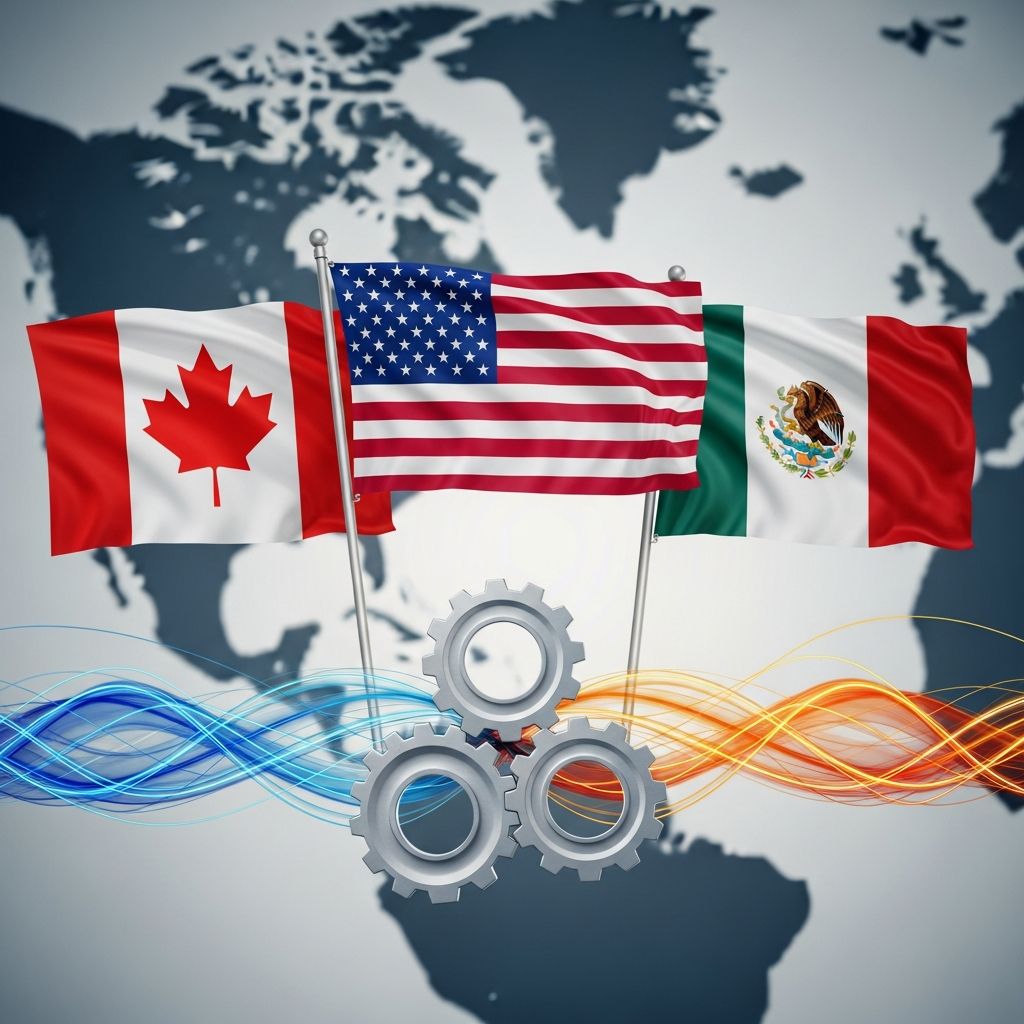
NAFTA: Definition and Overview
The North American Free Trade Agreement (NAFTA) was a landmark trade pact signed in 1992 that fundamentally transformed commercial relations between three major North American economies. NAFTA stands as one of the most significant trade agreements of the late twentieth century, creating the world’s largest free trade zone at the time of its implementation. The agreement eliminated most tariffs and other trade barriers on products and services exchanged between the United States, Canada, and Mexico, effectively creating a unified trading bloc across North America. This comprehensive trade agreement went into effect on January 1, 1994, and remained operational for over two decades until it was replaced by the United States-Mexico-Canada Agreement (USMCA) in 2020.
History and Background of NAFTA
The origins of NAFTA trace back to earlier trade initiatives between North American nations. The concept of a North American free trade zone began with U.S. President Ronald Reagan, who proposed the idea during his 1980 presidential campaign. The immediate predecessor to NAFTA was the U.S.-Canada Free Trade Agreement (FTA), which was signed in 1988 and entered into force on January 1, 1989. This bilateral agreement established a foundation for eliminating tariffs and addressing trade disputes between the United States and Canada, particularly concerning products like softwood lumber.
Following the success of the FTA, Mexican President Carlos Salinas de Gortari approached U.S. President George H.W. Bush about extending similar free trade arrangements to Mexico. In February 1991, the three nations agreed to begin negotiations for a comprehensive trilateral trade agreement. Formal negotiations commenced in June 1991, with preliminary agreement reached on August 12, 1992. The agreement was signed by President George H.W. Bush on December 17, 1992, by Canadian Prime Minister Brian Mulroney, and by Mexican President Carlos Salinas de Gortari. After ratification by all three countries’ national legislatures in 1993, NAFTA officially became effective on January 1, 1994.
Key Provisions and Main Features
NAFTA contained several groundbreaking provisions that reshaped trade relations across North America:
Tariff Elimination and Reduction
One of the central features of NAFTA was the gradual elimination of tariffs, customs duties, and other trade barriers between member countries. The agreement called for the progressive reduction of tariffs, with some duties removed immediately upon implementation and others phased out over periods extending up to 15 years. Upon NAFTA’s implementation, tariffs were eliminated on more than half of Mexico’s exports to the United States and more than one-third of U.S. exports to Mexico. Within a decade, virtually all U.S.-Mexico tariffs were eliminated, except for certain agricultural products that were phased out within 15 years. Most U.S.-Canada trade was already duty-free when NAFTA took effect.
National Goods Status
NAFTA granted “national goods” status to products imported from other member countries, prohibiting any state, local, or provincial government from imposing additional taxes or tariffs on such goods. This provision ensured that products from NAFTA partners received equal treatment to domestically produced goods, eliminating discriminatory tax practices.
Non-Tariff Barriers and Intellectual Property
Beyond tariff reductions, NAFTA sought to eliminate non-tariff trade barriers that could restrict commerce between nations. The agreement also included provisions to protect intellectual property rights on traded products, ensuring that creators and manufacturers received legal protections for their innovations and creations across all three member countries.
Rules of Origin
NAFTA established rules of origin requirements that mandated verification by suppliers that goods or services contained products exclusively from the providing country or one of the trading partners. These rules prevented transshipment and ensured that benefits of the agreement applied only to genuinely North American products.
Economic Impact on Member Countries
The implementation of NAFTA created significant economic consequences for all three member nations, though the effects were distributed unevenly:
Trade Volume Growth
NAFTA substantially increased trilateral trade among the member countries. The elimination of trade barriers created unprecedented market access, allowing companies to expand their operations across borders and consumers to access a wider range of products at competitive prices. Trade volumes between all three nations increased dramatically in the years following NAFTA’s implementation.
Job Creation and Economic Development
Proponents of NAFTA argued that establishing a free-trade area would bring prosperity through increased trade and production, resulting in the creation of millions of well-paying jobs in all participating countries. Supporters contended that the agreement would stimulate economic growth by encouraging foreign investment and allowing businesses to operate more efficiently across international borders.
Regional Disparities and Challenges
While NAFTA generated overall economic growth, the benefits were not evenly distributed across all regions and industries. Some sectors, particularly manufacturing in the United States, experienced job losses as companies relocated operations to Mexico where labor costs were lower. Agricultural communities faced both opportunities and challenges as markets opened. The distribution of gains varied significantly by country, industry, and region, creating winners and losers throughout the North American economy.
Controversies and Criticisms
Despite its stated objectives of mutual benefit, NAFTA became increasingly controversial across North America:
Manufacturing Job Losses
Critics argued that NAFTA contributed to significant job losses in the U.S. manufacturing sector. Companies relocated production facilities to Mexico to take advantage of lower wages and less stringent environmental regulations. Manufacturing communities in the American Midwest were particularly affected, with factories closing and entire industries contracting.
Environmental and Labor Concerns
Environmentalists criticized NAFTA for insufficient protections of natural resources and ecosystems. Although the U.S. required its partners to adhere to environmental practices and regulations similar to its own, enforcement mechanisms were weak. Labor rights advocates argued that the agreement did not adequately protect workers or prevent exploitation in low-wage countries.
Agricultural Impacts
Agricultural producers in all three countries faced both benefits and challenges. While some sectors flourished in the expanded market, others struggled to compete with cheaper imports or faced displacement due to industrial-scale agricultural operations.
Unequal Development Outcomes
Some economists noted that NAFTA exacerbated inequalities between developed nations (the U.S. and Canada) and the developing nation (Mexico), despite initial hopes that the agreement would narrow such gaps. The agreement marked the first time a developing nation had entered into such a comprehensive trade relationship with developed nations, and the outcomes were more complex than anticipated.
NAFTA’s Replacement: The USMCA
After more than two decades of operation, NAFTA was renegotiated and ultimately replaced by the United States-Mexico-Canada Agreement (USMCA), which entered into force in 2020. The renegotiation process began in 2017 and addressed criticisms of the original agreement, particularly regarding digital trade, labor protections, environmental standards, and rules of origin for the automotive industry. The USMCA retained the fundamental free-trade structure of NAFTA while modernizing provisions to reflect contemporary trade realities and addressing concerns raised by critics of the original agreement.
Legacy and Influence of NAFTA
NAFTA’s influence extended far beyond North America. The agreement demonstrated that comprehensive trilateral trade agreements were feasible and provided a template for subsequent regional trade arrangements. At the time of its implementation, NAFTA was the most comprehensive free trade agreement ever negotiated between friendly nations. Its success inspired similar initiatives in other regions and contributed to the broader global movement toward reducing trade barriers and promoting economic integration.
The agreement also influenced policy discussions about the appropriate balance between trade liberalization and protection for workers, environment, and domestic industries. Subsequent trade negotiations incorporated more robust provisions regarding labor rights and environmental protections, at least partly in response to NAFTA-related controversies.
Frequently Asked Questions
Q: What does NAFTA stand for?
A: NAFTA stands for the North American Free Trade Agreement. In Spanish it is known as TLCAN (Tratado de Libre Comercio de América del Norte) and in French as ALÉNA (Accord de libre-échange nord-américain).
Q: When did NAFTA go into effect?
A: NAFTA went into effect on January 1, 1994, after being signed in December 1992 and ratified by all three countries’ legislatures in 1993.
Q: Which countries were involved in NAFTA?
A: NAFTA involved three countries: the United States, Canada, and Mexico. It created the world’s largest free trade zone at that time.
Q: What was the main goal of NAFTA?
A: The primary goal of NAFTA was to eliminate trade barriers and tariffs between the three member countries, creating a free trade zone that would facilitate commerce, investment, and economic growth across North America.
Q: How long did NAFTA last?
A: NAFTA remained in force for over 26 years, from January 1, 1994, until it was replaced by the USMCA (United States-Mexico-Canada Agreement) in 2020.
Q: Did NAFTA achieve its goals?
A: NAFTA achieved its primary goal of eliminating most tariffs and trade barriers, significantly increasing trilateral trade. However, the distribution of economic benefits was uneven, with some regions and industries experiencing job losses while others prospered.
Q: What replaced NAFTA?
A: The United States-Mexico-Canada Agreement (USMCA) replaced NAFTA in 2020. The USMCA retained the free trade framework while modernizing provisions and addressing criticisms of the original agreement.
References
- North American Free Trade Agreement — Britannica. 2024. https://www.britannica.com/event/North-American-Free-Trade-Agreement
- North American Free Trade Agreement — EBSCO Research Starters. 2024. https://www.ebsco.com/research-starters/business-and-management/north-american-free-trade-agreement
- North American Free Trade Agreement (NAFTA) — Office of the U.S. Trade Representative, U.S. Government. 2024. https://ustr.gov/about-us/policy-offices/press-office/ustr-archives/north-american-free-trade-agreement-nafta
- North American Free Trade Agreement – International Trade Law — Columbia University Law School International Trade Law Guide. 2024. https://guides.law.columbia.edu/c.php?g=1221777&p=8966888
- North American Free Trade Agreement — Wikipedia. 2024. https://en.wikipedia.org/wiki/North_American_Free_Trade_Agreement
- The North American Free Trade Agreement: The Ties that Bind — Federal Reserve Bank of Chicago. September 1992. https://www.chicagofed.org/publications/chicago-fed-letter/1992/september-61
- The North American Free Trade Agreement (NAFTA) — U.S. Congress Research Service. 2024. https://www.congress.gov/crs-product/R42965
Similar Articles








Read full bio of Sneha Tete