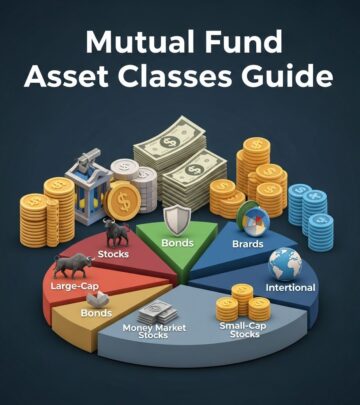
Mutual Funds: Definition, Types, and Investment Guide
Complete guide to mutual funds: Learn how they work, types, benefits, and risks.

What Is a Mutual Fund?
A mutual fund is an investment fund that pools money from many investors to purchase securities such as stocks, bonds, money market instruments, and other assets. Mutual funds are operated by professional money managers who allocate the fund’s assets and attempt to produce capital gains or income for the fund’s investors. A mutual fund’s portfolio is structured and maintained to match the investment objectives stated in its prospectus.
Mutual funds provide an accessible way for individual investors to gain exposure to diversified portfolios that might otherwise require substantial capital and expertise to manage independently. By pooling resources with other investors, individuals can benefit from professional management and economies of scale.
How Mutual Funds Work
Mutual funds operate on a straightforward principle: investors purchase shares or units in the fund, and the fund manager uses the collected capital to invest in various securities. The value of each share in the fund fluctuates based on the performance of the underlying securities held in the portfolio.
Key Operating Mechanisms:
- Share Classes: Mutual funds offer different share classes (Class A, B, C, etc.) with varying fee structures and investment minimums
- Net Asset Value (NAV): The price per share is calculated daily as the total value of assets minus liabilities, divided by outstanding shares
- Distribution of Returns: Income from dividends and capital gains is distributed to shareholders, typically annually or quarterly
- Professional Management: Experienced fund managers make investment decisions on behalf of all shareholders
- Liquidity: Investors can buy or sell mutual fund shares on any business day at the daily NAV price
Types of Mutual Funds
Mutual funds are categorized based on the types of securities they hold and their investment objectives. Understanding these categories helps investors select funds aligned with their financial goals and risk tolerance.
Equity Funds
Equity or stock funds primarily invest in company stocks. These funds aim for capital appreciation and are typically more volatile than other fund types. Equity funds can be further subdivided into growth funds, value funds, dividend funds, and sector-specific funds.
Fixed Income Funds
Bond or fixed income funds invest primarily in bonds and other debt securities. These funds generate regular income through interest payments and are generally less volatile than equity funds. They include government bond funds, corporate bond funds, and high-yield bond funds.
Money Market Funds
Money market funds invest in short-term, low-risk debt instruments such as Treasury bills, commercial paper, and certificates of deposit. These funds offer high liquidity and lower returns with minimal risk, making them suitable for conservative investors.
Balanced Funds
Balanced funds maintain a mix of stocks and bonds to provide both growth potential and income. The typical allocation is around 60% stocks and 40% bonds, though this varies depending on the fund’s objectives.
Index Funds
Index funds aim to replicate the performance of a specific market index, such as the S&P 500 or NASDAQ-100. These passively managed funds offer lower fees compared to actively managed funds and provide broad market exposure.
Sector Funds
Sector funds concentrate their investments in specific industries or sectors of the economy, such as technology, healthcare, energy, or finance. These funds offer targeted exposure to particular market segments.
International and Global Funds
International funds invest in securities from outside the investor’s home country, providing geographic diversification. Global funds invest worldwide, including both domestic and international securities.
Actively Managed vs. Passively Managed Funds
Mutual funds operate under two primary management strategies, each with distinct characteristics and implications for investors.
| Characteristic | Actively Managed Funds | Passively Managed Funds |
|---|---|---|
| Management Approach | Fund manager makes frequent buy/sell decisions to outperform the market | Fund tracks a specific index with minimal trading |
| Fees | Higher expense ratios (typically 0.5% to 2%+) | Lower expense ratios (typically 0.03% to 0.20%) |
| Performance | Aims to beat benchmark returns; results vary | Matches benchmark returns (minus fees) |
| Tax Efficiency | Frequent trading can trigger capital gains taxes | Lower turnover results in fewer taxable events |
| Best For | Investors seeking potential outperformance | Cost-conscious investors seeking broad diversification |
Advantages of Mutual Funds
Mutual funds offer numerous benefits that make them attractive to individual investors:
- Diversification: Investors gain exposure to a diversified portfolio of securities, reducing risk through spread investments
- Professional Management: Experienced fund managers handle investment decisions and portfolio adjustments
- Affordability: Low investment minimums allow investors to start with modest capital amounts
- Liquidity: Shares can be bought or sold daily at NAV, providing easy access to invested capital
- Transparency: Regular reporting and disclosures keep investors informed about fund holdings and performance
- Convenience: Automatic dividend reinvestment, recordkeeping, and simplified tax reporting
- Access to Expertise: Individual investors benefit from professional investment research and analysis
- Variety: Numerous fund options accommodate different investment objectives and risk tolerances
Disadvantages and Risks of Mutual Funds
Despite their benefits, mutual funds come with certain drawbacks and risks that investors should understand:
- Fees and Expenses: Management fees, expense ratios, and sales loads can significantly impact returns over time
- Lack of Control: Investors cannot influence individual investment decisions made by fund managers
- Market Risk: Fund values fluctuate with market conditions, and investors may experience losses
- Manager Risk: Fund performance depends on the skill and decisions of the fund manager
- Tax Inefficiency: Distributions of capital gains can create tax liabilities for shareholders
- Underperformance: Actively managed funds may fail to outperform their benchmark indices
- Concentration Risk: Some funds may have significant holdings in specific securities or sectors
- Redemption Risk: Large fund redemptions can force managers to sell securities at inopportune times
Mutual Fund Fees and Expenses
Understanding the fee structure is crucial for evaluating mutual fund investments, as fees directly reduce investor returns.
Types of Fees:
- Expense Ratio: Annual percentage of fund assets used to cover operating costs, management fees, and administrative expenses
- Sales Loads: Front-end loads charged when purchasing shares; back-end loads charged upon redemption; level loads charged annually
- 12b-1 Fees: Annual marketing and distribution fees, typically 0.25% to 1% of fund assets
- Transaction Costs: Expenses incurred when the fund buys or sells securities
- Redemption Fees: Charges for selling fund shares within a specific timeframe
How to Choose a Mutual Fund
Selecting appropriate mutual funds requires careful consideration of several factors aligned with your financial situation and objectives.
Selection Criteria:
- Investment Objectives: Determine whether you seek growth, income, or a balanced approach
- Risk Tolerance: Consider your ability and willingness to withstand market volatility
- Time Horizon: Longer investment periods may justify higher-risk, growth-oriented funds
- Fee Structure: Compare expense ratios and loads across similar fund categories
- Historical Performance: Review past performance, but remember it doesn’t guarantee future results
- Fund Manager Track Record: Evaluate the experience and consistency of the fund manager
- Fund Size: Larger funds may offer better liquidity; smaller funds may be more nimble
- Asset Allocation: Ensure the fund fits within your overall portfolio allocation strategy
Mutual Funds vs. Exchange-Traded Funds (ETFs)
While similar in many respects, mutual funds and ETFs have key differences investors should understand:
- Trading: Mutual fund shares are priced once daily; ETF shares trade throughout the day like stocks
- Fees: ETFs typically have lower expense ratios than actively managed mutual funds
- Transparency: ETFs disclose holdings daily; mutual funds typically report holdings quarterly
- Tax Efficiency: ETFs generally have lower capital gains distributions due to their structure
- Minimum Investment: ETFs may have lower minimums since you can purchase individual shares
- Flexibility: ETFs can be sold short, purchased on margin, or traded with limit orders
Frequently Asked Questions (FAQs)
Q: What is the minimum investment required to buy mutual fund shares?
A: Minimum investments vary by fund but typically range from $500 to $5,000 for initial purchases. Some funds offer lower minimums for retirement accounts or automatic investment plans. Many no-load funds have eliminated or significantly reduced minimums.
Q: How often are mutual fund dividends and capital gains distributed?
A: Most mutual funds distribute dividends and capital gains annually, though some distribute quarterly or semi-annually. Investors can typically choose to receive distributions as cash or automatically reinvest them to purchase additional shares.
Q: Are mutual fund investments guaranteed by the FDIC?
A: No. Mutual fund investments are not FDIC insured. The value of mutual fund shares fluctuates with market conditions. However, mutual funds are regulated by the Securities and Exchange Commission (SEC) to protect investor interests.
Q: Can I lose money investing in a mutual fund?
A: Yes. Mutual funds carry market risk, and the value of shares can decline. The extent of potential losses depends on the fund type and market conditions. Money market funds are considered lower risk, while equity funds carry higher risk.
Q: What is the difference between an open-end and closed-end mutual fund?
A: Open-end funds (most common) issue new shares continuously and redeem shares at NAV. Closed-end funds issue a fixed number of shares that trade on exchanges like stocks, often at a premium or discount to NAV.
Q: How do I evaluate a mutual fund’s performance?
A: Compare the fund’s returns against appropriate benchmarks over multiple time periods (1, 3, 5, and 10 years). Consider risk-adjusted metrics like Sharpe ratio and alpha. Remember that past performance doesn’t guarantee future results, and consider fees when evaluating net returns.
Q: Should I invest in actively managed or index funds?
A: This depends on your preferences and beliefs about market efficiency. Index funds offer lower costs and consistent performance tracking. Active funds offer potential for outperformance but charge higher fees. Many investors use a combination of both strategies.
References
- Investment Company Institute – Mutual Fund Basics — Investment Company Institute. 2024. https://www.ici.org/
- U.S. Securities and Exchange Commission – Mutual Funds and Exchange-Traded Funds (ETFs) — U.S. Securities and Exchange Commission. 2024. https://www.sec.gov/investor/products/mutualfunds/
- Financial Industry Regulatory Authority – Mutual Fund Information — FINRA. 2024. https://www.finra.org/investors/mutual-funds
- Federal Reserve Board – Investment Funds and Asset Management — Board of Governors of the Federal Reserve System. 2024. https://www.federalreserve.gov/
- Bogle, John C. The Little Book of Common Sense Investing — John Wiley & Sons. 2017. Foundational work on index investing and mutual fund selection principles.
- Morningstar Investment Research – Mutual Fund Selection Guide — Morningstar, Inc. 2024. https://www.morningstar.com/
Similar Articles








Read full bio of medha deb