Municipal Bonds: A Practical Guide For Investors
Discover how municipal bonds offer tax advantages and support public projects while balancing risks and rewards for investors.

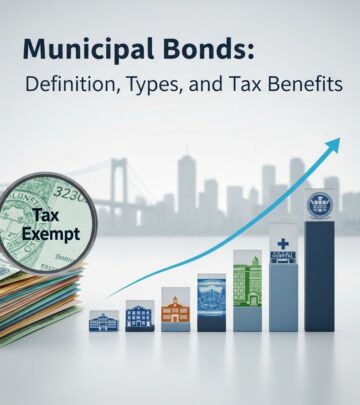
Municipal bonds, often called “munis,” represent debt securities issued by state and local governments to finance essential public infrastructure and services. Investors lend money to these entities in return for periodic interest payments and principal repayment at maturity.
Why Municipal Bonds Matter in Modern Portfolios
These investments play a crucial role in funding community needs like schools, roads, hospitals, and utilities without relying solely on federal aid. For investors, munis provide a blend of income stability and tax efficiency, particularly appealing in volatile markets. Their low default rates historically make them a cornerstone of conservative fixed-income strategies.
Unlike corporate bonds, municipal bonds derive strength from governmental backing, either through taxing authority or project-specific revenues. This structure supports trillions in outstanding debt, underscoring their scale in the U.S. financial system.
Core Varieties of Municipal Bonds
Municipal bonds primarily fall into two categories: general obligation (GO) bonds and revenue bonds, each with distinct risk profiles and repayment mechanisms.
General Obligation Bonds: Backed by Taxing Power
GO bonds rely on the issuer’s full faith and credit, meaning repayment comes from general tax revenues, such as property taxes. States, cities, or counties issue these without tying them to specific assets or projects. This broad backing often results in lower yields compared to riskier alternatives but higher perceived safety.
- Security Features: Unlimited or limited taxing authority secures payments.
- Common Uses: Funding parks, public buildings, and general capital needs.
- Limited Tax GO Bonds: Require legislative approval without voter input, offering flexibility for issuers.
Revenue Bonds: Project-Driven Repayment
Revenue bonds depend on income streams from designated projects, like toll roads, airports, or water utilities. No taxing power backs them, so success hinges on the venture’s performance. These often yield more to compensate for added risk.
- Examples: Hospital expansions, housing projects, or transit systems.
- Non-Recourse Types: Bondholders have no claim beyond project revenues if funds falter.
- Conduit Bonds: Issued for nonprofits like universities or hospitals via government conduits.
Tax Advantages That Set Munis Apart
The hallmark of most municipal bonds is their tax-exempt status at the federal level, and often state level for in-state buyers. Interest income escapes federal income tax, boosting after-tax returns for high earners.
For those in the top tax bracket, a 3% tax-free yield might equate to a 5% taxable equivalent. Use this formula for comparison: Taxable Equivalent Yield = Tax-Free Yield / (1 – Marginal Tax Rate).
| Tax Bracket | 3% Tax-Free Yield Equivalent | 4% Tax-Free Yield Equivalent |
|---|---|---|
| 24% | 3.95% | 5.26% |
| 32% | 4.41% | 5.88% |
| 37% | 4.76% | 6.35% |
Note: Some private activity bonds may trigger alternative minimum tax (AMT). Always review specifics.
Key Risks Every Investor Should Weigh
While safer than many bonds, munis carry unique challenges. Defaults are rare—less than 0.1% annually for investment-grade issues—but economic downturns can strain issuers.
- Interest Rate Risk: Bond prices fall when rates rise, impacting resale value.
- Call Risk: Issuers may redeem early if rates drop, curtailing investor income.
- Credit Risk: Weaker economies hit revenue bonds harder; assess ratings from agencies like Moody’s or S&P.
- Liquidity Risk: Individual bonds trade less frequently than Treasuries, potentially widening bid-ask spreads.
Short-term notes like Tax Anticipation Notes (TANs) or Bond Anticipation Notes (BANs) address temporary cash needs but mature quickly, often under a year.
Evaluating Yields and Performance Metrics
Muni yields lag Treasuries due to tax benefits but shine post-tax. Track ratios like the muni-to-Treasury yield ratio (typically 80-100%) for relative value. Investment-grade munis have delivered steady returns, with historical defaults minimal.
Current market dynamics, including inflation and Fed policy, influence spreads. Diversification across states and sectors mitigates concentration risk.
Investment Approaches: Individual vs. Funds
Investors can buy bonds directly via brokers or opt for mutual funds/ETFs for ease and diversification.
| Approach | Pros | Cons |
|---|---|---|
| Individual Bonds | Defined maturity, no management fees, potential capital preservation | High minimums ($5K+), research intensive, liquidity issues |
| Muni Funds/ETFs | Low entry ($100+), professional management, daily liquidity | Ongoing fees, no maturity guarantee, NAV fluctuations |
Laddering—staggering maturities—helps manage rate and call risks.
Assessing Credit Quality and Ratings
Ratings range from AAA (prime) to junk. GO bonds from strong economies rate highly; revenue bonds vary by project viability. Review official statements for covenants and reserves.
- AAA/AA: Exceptional safety.
- A/BBB: Adequate but monitorable.
- Below Investment Grade: Higher yields, elevated default odds.
Market Trends and Future Outlook
Post-pandemic infrastructure bills boost issuance for green projects and broadband. Rising rates challenge prices, but tax reform discussions could enhance appeal. Climate-resilient revenue bonds gain traction.
Frequently Asked Questions
Are all municipal bonds tax-free?
Most interest is federal tax-exempt, but some taxable munis exist, like Build America Bonds. State exemptions apply to in-state issues.
How do I buy municipal bonds?
Through brokerage accounts, auctions, or funds. Research via EMMA (MSRB’s platform) for transparency.
What’s the average default rate?
Historically under 0.1% for rated munis, far below corporates.
Can out-of-state investors benefit tax-wise?
Federal exemption always applies; state benefits require residency match.
Are munis good for retirement portfolios?
Yes, for tax-efficient income, especially paired with equities.
Building a Resilient Muni Strategy
Start with goals: income, preservation, or tax management. Allocate 20-40% of fixed income to munis based on tax bracket. Monitor economic indicators and diversify across 10+ issuers. Rebalance annually to capture opportunities.
Professional advice suits complex needs, ensuring alignment with overall asset allocation.
References
- What are Municipal Bonds — U.S. Securities and Exchange Commission. 2024-06-05. https://www.sec.gov/munied
- Municipal Bond – Definition, Types, Risks, Tax Benefits — Corporate Finance Institute. N/A. https://corporatefinanceinstitute.com/resources/fixed-income/municipal-bond/
- Municipal Bond 101: Glossary of Terms — Municipal Bonds for America. N/A. https://munibondsforamerica.org/resources/municipal-bond-101-glossary-of-terms/
- Types of Municipal Debt — Municipal Research and Services Center (MRSC). N/A. https://mrsc.org/explore-topics/finance/debt/types-of-municipal-debt
- Municipal Bonds — Fidelity Investments. N/A. https://www.fidelity.com/fixed-income-bonds/individual-bonds/municipal-bonds
- Introduction to municipal bonds: Key concepts and considerations — E*TRADE. N/A. https://us.etrade.com/knowledge/library/bonds-cds/introduction-to-municipal-bonds
- Municipal Bond Basics — Municipal Securities Rulemaking Board (MSRB). N/A. https://www.msrb.org/Education/Municipal-Bond-Basics-0
Similar Articles








Read full bio of Sneha Tete