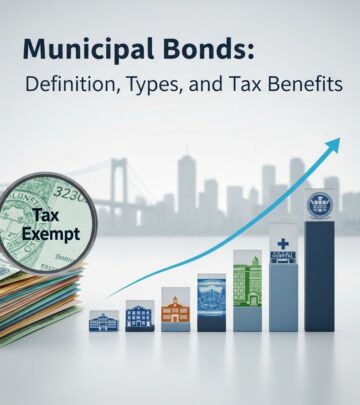
Municipal Bonds Explained
Discover how municipal bonds offer tax-free income and support public projects while balancing risks and rewards for investors.

Municipal bonds, commonly known as munis, represent debt securities issued by local governments, states, counties, and other public entities to raise capital for essential infrastructure and services. Investors purchase these bonds to lend money to issuers, receiving periodic interest payments and the return of principal at maturity in exchange.
Why Governments Issue Municipal Bonds
Local and state governments rely on municipal bonds to finance large-scale projects that benefit communities, such as constructing highways, schools, water treatment facilities, and hospitals. These bonds allow issuers to spread the cost of expensive, long-term initiatives over decades, matching repayment schedules with the useful life of the assets funded.
Unlike general tax revenues, bonds provide upfront capital without immediate fiscal strain. For instance, a city might issue bonds to build a new bridge, using toll revenues or taxes to repay investors over time. This mechanism supports economic growth by improving public infrastructure while offering investors a relatively safe income stream.
Core Mechanics of Municipal Bonds
When you invest in a municipal bond, you act as a lender. The issuer commits to paying interest, typically semiannually, at a fixed rate until the bond matures. At maturity, which can range from one to 30 years or more, the principal—known as the par or face value—is returned, assuming no default.
Bonds may feature call provisions, allowing issuers to redeem them early if interest rates drop, often at a premium. Maturity structures include serial bonds, which mature incrementally each year, and term bonds, which come due in a lump sum after a set period, sometimes with sinking funds for gradual repayment.
Main Categories of Municipal Bonds
Municipal bonds primarily divide into two categories based on repayment sources: general obligation bonds and revenue bonds. Each carries distinct risk profiles and appeals to different investor preferences.
General Obligation Bonds
General obligation (GO) bonds are backed by the issuer’s full faith and credit, including its taxing authority. States, cities, or counties pledge to use general tax revenues, such as property or sales taxes, to meet payments. These bonds do not tie to specific projects, relying instead on the government’s overall financial health.
GO bonds often require voter approval and face debt limits, making them popular for broad public works like parks or schools. Their broad backing typically results in lower yields compared to revenue bonds but higher perceived safety.
Revenue Bonds
Revenue bonds fund specific projects and are repaid from the income those projects generate, such as tolls from bridges, fees from airports, or utility charges. They lack the issuer’s taxing power as security, tying repayment directly to project performance.
Examples include bonds for hospitals, financed by patient fees, or water systems, supported by user rates. If revenues underperform, payments could falter, introducing higher risk and potentially higher yields. Some revenue bonds, like private activity bonds, support private entities through public conduits, such as affordable housing projects.
Tax Advantages That Make Munis Attractive
The hallmark of most municipal bonds is their tax-exempt status. Interest income is generally free from federal income tax, and often state and local taxes if issued in the investor’s state of residence. This feature boosts after-tax yields, especially for those in higher tax brackets.
For example, a 3% tax-free yield might equate to a 5% taxable yield for someone in the 40% bracket. However, certain bonds, like private activity bonds, may trigger the alternative minimum tax (AMT). State-specific funds can offer double tax exemption, enhancing appeal for residents.
| Bond Type | Federal Tax | State Tax (In-State) | AMT Exposure |
|---|---|---|---|
| General Obligation | Exempt | Often Exempt | Usually None |
| Revenue (Standard) | Exempt | Often Exempt | Usually None |
| Private Activity | Exempt | Varies | Possible |
Understanding Risks in Municipal Bond Investing
While municipal bonds are considered low-risk, they are not risk-free. Key risks include:
- Credit Risk: The chance of default if the issuer cannot pay. GO bonds mitigate this via taxes, but revenue bonds depend on project success.
- Interest Rate Risk: Bond prices fall when rates rise, affecting resale value before maturity.
- Call Risk: Early redemption disrupts income streams, often when rates decline.
- Inflation Risk: Fixed payments lose purchasing power over time.
Insured or pre-refunded bonds reduce credit risk; insurers guarantee payments, or escrowed funds secure pre-refunded issues, often trading at premiums with lower yields.
How to Buy and Invest in Municipal Bonds
Investors can buy individual bonds through brokers or access them via mutual funds and ETFs. National muni funds diversify across issuers, offering federal tax exemption but potential state tax exposure. State-specific funds add state tax relief.
Variable rate demand obligations (VRDOs) provide short-term liquidity with periodic rate resets, suitable for conservative portfolios. Consider duration—short-term for less rate sensitivity, long-term for higher yields.
Comparing Municipal Bonds to Other Fixed Income
| Investment | Tax Treatment | Risk Level | Typical Yield |
|---|---|---|---|
| Municipal Bonds | Tax-Exempt | Low-Medium | 2-4% |
| Treasuries | Federal Exempt, State Taxable | Very Low | 2-3% |
| Corporate Bonds | Fully Taxable | Medium-High | 4-6% |
Munis shine for tax-sensitive investors, often matching taxable equivalents of riskier bonds.
Current Market Trends and Considerations
As of recent data, revenue bonds comprise about 58% of issuances, reflecting demand for project-specific financing. Yields adjust with economic conditions; rising rates pressure prices, but tax benefits sustain demand.
Frequently Asked Questions
Are all municipal bonds tax-free?
Most interest is federally tax-exempt, but some private activity bonds may be subject to AMT, and out-of-state bonds could incur state taxes.
What is the average yield on municipal bonds?
Yields vary by maturity and credit quality, typically ranging from 2% to 4% for investment-grade issues.
Can municipal bonds default?
Defaults are rare, historically under 1%, due to issuer commitments and market oversight.
Are municipal bonds a good fit for retirement accounts?
The tax exemption loses value in tax-deferred accounts like IRAs; they’re better for taxable portfolios.
How do I assess municipal bond credit quality?
Ratings from agencies like Moody’s or S&P range from AAA (highest) to junk. Review official statements and EMMA disclosures.
References
- Municipal Bond – Definition, Types, Risks, Tax Benefits — Corporate Finance Institute. 2023. https://corporatefinanceinstitute.com/resources/fixed-income/municipal-bond/
- Municipal bonds explained: How munis work and who should invest — Fidelity. 2024-01-15. https://www.fidelity.com/learning-center/trading-investing/guide-to-municipal-bonds
- What are Municipal Bonds — U.S. Securities and Exchange Commission. 2025-02-10. https://www.sec.gov/munied
- Municipal Bond Basics — Municipal Securities Rulemaking Board. 2024-11-01. https://www.msrb.org/Education/Municipal-Bond-Basics-0
- What are municipal bonds and how are they used? — Tax Policy Center. 2023-06-20. https://taxpolicycenter.org/briefing-book/what-are-municipal-bonds-and-how-are-they-used
- Introduction to municipal bonds: Key concepts and considerations — E*TRADE. 2024-03-05. https://us.etrade.com/knowledge/library/bonds-cds/introduction-to-municipal-bonds
Similar Articles








Read full bio of Sneha Tete