Multiple Linear Regression: Definition, Formula & Applications
Master MLR analysis: Learn how to use multiple linear regression for financial forecasting and data analysis.
What Is Multiple Linear Regression (MLR)?
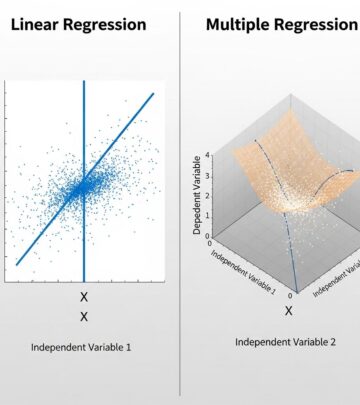
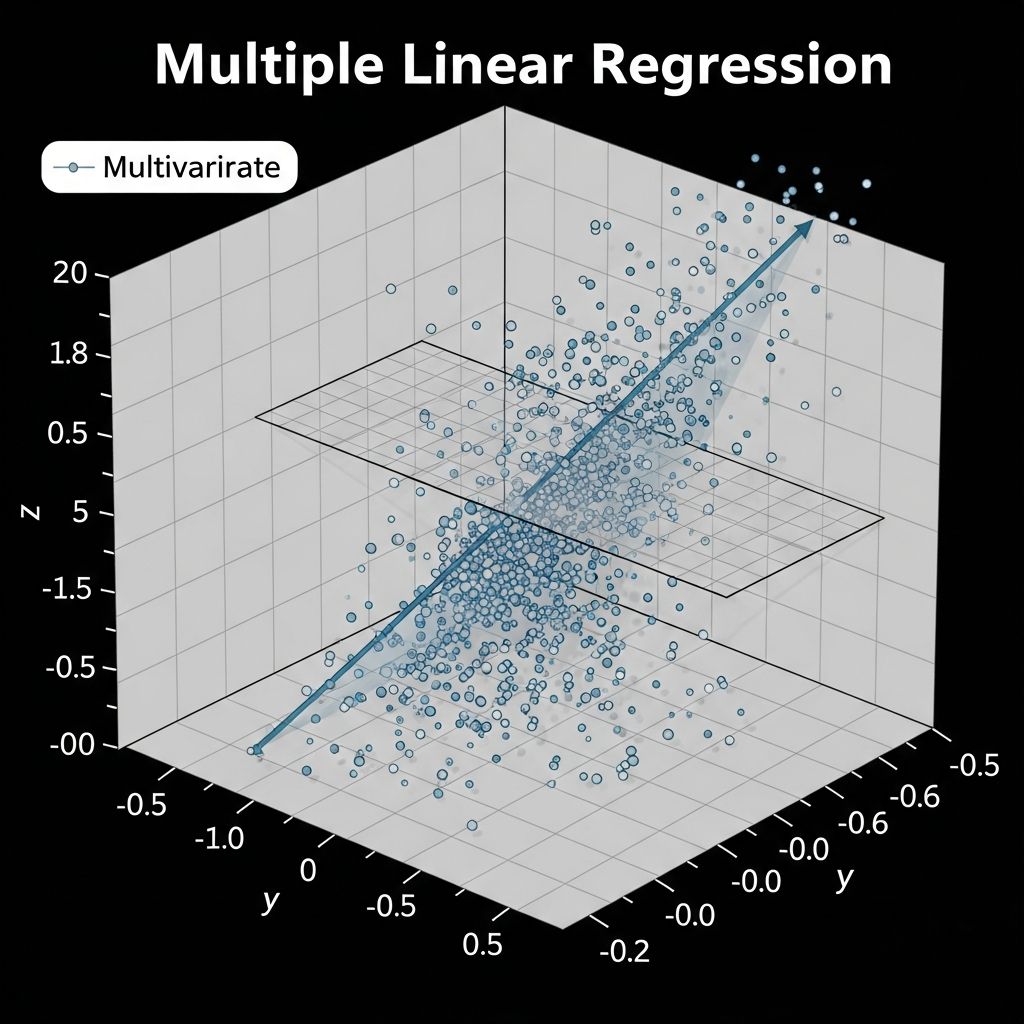
Multiple Linear Regression (MLR) is a statistical technique used to model the relationship between a dependent variable and two or more independent variables. Unlike simple linear regression, which involves only one independent variable, MLR allows analysts to examine how multiple factors simultaneously influence an outcome. This makes it an invaluable tool in finance, economics, business analytics, and scientific research.
The primary goal of MLR is to establish a linear equation that best fits the observed data, enabling researchers and analysts to make predictions, understand relationships between variables, and test hypotheses about cause-and-effect relationships. By incorporating multiple predictors, MLR provides more nuanced and accurate models compared to univariate approaches.
In financial analysis, MLR has become instrumental in predicting stock performance, analyzing earnings per share, evaluating IPO potential, and assessing company valuations. Investors and financial professionals use MLR models to identify significant financial indicators that drive investment returns and market performance.
The Multiple Linear Regression Formula
The mathematical foundation of MLR is expressed through the following equation:
Y = β₀ + β₁X₁ + β₂X₂ + β₃X₃ + … + βₙXₙ + ε
Where:
- Y = the dependent variable (the outcome being predicted)
- β₀ = the y-intercept or constant term
- β₁, β₂, β₃, …, βₙ = the regression coefficients for each independent variable
- X₁, X₂, X₃, …, Xₙ = the independent variables (predictors)
- ε = the error term (residual), representing unexplained variation
Each coefficient represents the change in the dependent variable for a one-unit increase in the corresponding independent variable, holding all other variables constant. This partial relationship is crucial for understanding the individual contribution of each predictor.
Key Assumptions of Multiple Linear Regression
For MLR to produce reliable results, several critical assumptions must be met:
- Linearity: The relationship between dependent and independent variables must be linear.
- Independence: Observations must be independent of one another; no autocorrelation should exist.
- Homoscedasticity: The variance of residuals should be constant across all levels of independent variables.
- Normality: Residuals should follow a normal distribution.
- No Multicollinearity: Independent variables should not be highly correlated with each other.
- No Specification Bias: All relevant variables should be included, and irrelevant variables should be excluded.
Violations of these assumptions can lead to biased estimates, incorrect standard errors, and unreliable inference. Diagnostic tests and remedial measures are essential components of robust MLR analysis.
Applications of MLR in Financial Analysis
MLR serves numerous applications in the financial industry and investment management:
Predicting Company Earnings
Financial analysts use MLR to forecast earnings per share by incorporating variables such as research and development expenditures, depreciation and amortization, market capitalization, and sector classification. Studies have demonstrated that MLR can effectively identify which financial metrics significantly contribute to earnings variations across different market segments.
IPO Performance Assessment
Recent research has successfully employed Multinomial Logistic Regression (an extension of MLR) to predict initial public offering performance. By analyzing prospectus characteristics and financial ratios extracted from IPO documents, researchers achieved 71.4% prediction accuracy in classifying IPO performance into categories such as below-average, average, and above-average returns. The most significant factors affecting IPO returns included subscription quarter, sector code, and net profit margin.
Stock Valuation Models
MLR enables the development of comprehensive stock valuation models that consider multiple fundamental and technical factors. By regressing stock price or returns against variables such as earnings growth, dividend yield, debt-to-equity ratio, and market sentiment indicators, analysts can identify the primary drivers of stock performance.
Risk Assessment
Financial institutions employ MLR to model credit risk, market risk, and operational risk by incorporating relevant economic and firm-specific variables. This helps in pricing securities appropriately and managing portfolio exposure.
How to Build an MLR Model
Step 1: Data Collection and Preparation
Gather historical data for your dependent variable and all potential independent variables. Ensure data quality by handling missing values, outliers, and inconsistencies. Organize data in a structured format suitable for analysis.
Step 2: Variable Selection
Identify which independent variables to include in your model. Consider domain expertise, theoretical relationships, and correlation analysis. Avoid including too many variables, as this can lead to overfitting and multicollinearity issues.
Step 3: Estimation
Use statistical software or programming languages like Python or R to estimate the regression coefficients using ordinary least squares (OLS) or other appropriate methods. The objective is to minimize the sum of squared residuals.
Step 4: Model Evaluation
Assess model performance using metrics such as R-squared, adjusted R-squared, F-statistics, and individual t-statistics for coefficients. Calculate residual plots and conduct diagnostic tests to verify assumption compliance.
Step 5: Interpretation and Prediction
Interpret the estimated coefficients in economic or practical terms. Use the model to make predictions for new observations and establish confidence intervals around predictions.
Model Diagnostics and Assessment Metrics
R-Squared and Adjusted R-Squared
R-squared measures the proportion of variation in the dependent variable explained by the independent variables, ranging from 0 to 1. Adjusted R-squared penalizes the addition of unnecessary variables, making it more reliable for model comparison.
F-Statistic
The F-statistic tests whether the overall regression model is statistically significant. A high F-statistic with a low p-value indicates that at least one independent variable significantly contributes to explaining the dependent variable.
Variance Inflation Factor (VIF)
VIF measures the degree of multicollinearity among independent variables. VIF values close to 1 indicate minimal multicollinearity, while values exceeding 5 or 10 suggest problematic multicollinearity requiring remedial action.
Residual Analysis
Examine residual plots to assess linearity, homoscedasticity, and normality assumptions. A Q-Q plot helps evaluate normality, while scatter plots of residuals against fitted values reveal heteroscedasticity issues.
Advantages and Limitations of MLR
Advantages:
- Captures complex relationships involving multiple variables simultaneously
- Provides interpretable coefficients showing individual variable effects
- Computationally efficient and widely understood across disciplines
- Enables hypothesis testing and statistical inference
- Produces easily explainable results for stakeholders and decision-makers
Limitations:
- Assumes linear relationships, which may not capture non-linear patterns
- Sensitive to multicollinearity, which can inflate coefficient standard errors
- Assumption violations can lead to biased estimates and unreliable inference
- May underperform compared to advanced machine learning algorithms for complex datasets
- Requires careful variable selection to avoid specification bias
MLR Versus Alternative Approaches
| Method | Strengths | Weaknesses |
|---|---|---|
| Multiple Linear Regression | Interpretable, efficient, established methodology | Assumes linearity, sensitive to multicollinearity |
| Ridge Regression | Reduces multicollinearity effects through regularization | Less interpretable, requires tuning parameter selection |
| Machine Learning Models | Captures non-linear patterns, handles complex interactions | Less interpretable, requires larger datasets, prone to overfitting |
| Logistic Regression | Suitable for binary or categorical outcomes | Not appropriate for continuous dependent variables |
Practical Implementation Considerations
When implementing MLR models in practice, several considerations enhance model quality and reliability. First, ensure adequate sample size relative to the number of independent variables—a common rule suggests at least 10-20 observations per variable. Second, conduct thorough exploratory data analysis to understand variable distributions and relationships before modeling. Third, address multicollinearity through variable selection, principal component analysis, or regularization techniques such as ridge regression.
Fourth, validate your model using techniques such as cross-validation or holdout samples to assess generalization performance. Finally, document all modeling decisions, assumptions, and limitations to ensure transparency and reproducibility.
Frequently Asked Questions About Multiple Linear Regression
Q: What is the difference between simple and multiple linear regression?
A: Simple linear regression involves one independent variable predicting a dependent variable, while multiple linear regression incorporates two or more independent variables. MLR provides more comprehensive models by capturing the simultaneous effects of multiple factors.
Q: How do I know if my MLR model meets all necessary assumptions?
A: Conduct diagnostic tests including residual plots, Q-Q plots for normality assessment, variance inflation factor calculations for multicollinearity detection, and Durbin-Watson tests for autocorrelation. Statistical software packages provide automated diagnostic tools for assumption verification.
Q: Can MLR handle categorical variables?
A: Yes, categorical variables can be included through dummy variable encoding. Each category (except one used as reference) receives a binary indicator variable, allowing categorical predictors to function within the MLR framework.
Q: What should I do if my model exhibits multicollinearity?
A: Options include removing highly correlated variables, combining related variables into composite measures, or employing regularization techniques such as ridge regression or Lasso regression to penalize large coefficients.
Q: How is MLR used in financial forecasting?
A: Financial analysts use MLR to predict variables such as earnings per share, stock returns, credit risk, and company valuations by incorporating relevant financial ratios, economic indicators, and market variables as predictors.
Q: What sample size is recommended for MLR analysis?
A: While no strict rule exists, general guidance suggests maintaining at least 10-20 observations per independent variable. Larger samples provide more reliable estimates and better statistical power for hypothesis testing.
References
- Prediction of IPO performance from prospectus using multinomial logistic regression, a machine learning model — Mazin Fahad Alahmadi, Mustafa Tahsin Yilmaz. 2025-01-01. https://www.aimspress.com/article/doi/10.3934/DSFE.2025006
- Application of Regression Techniques on Designed Economic Data — Clemson University Electronic Theses & Dissertations. 2024. https://open.clemson.edu/all_theses/5580
- Understanding Statistical Methods in Finance — Bureau of Labor Statistics. 2025-01-01. https://www.bls.gov/opub/mlr
Similar Articles








Read full bio of Sneha Tete