Moving Average: Definition, Types, and Trading Applications
Master moving averages: Essential technical analysis tool for traders and investors.
What Is a Moving Average?
A moving average is a technical analysis tool used to analyze price trends by calculating the average price of a security over a specified period. The term “moving” refers to the fact that this average is recalculated continuously as new price data becomes available, with the oldest data points being dropped from the calculation. This creates a smooth line on a price chart that helps traders and investors identify the direction of a trend and potential support or resistance levels.
Moving averages are fundamental to technical analysis because they filter out short-term price fluctuations and noise, allowing investors to see the underlying trend more clearly. Rather than reacting to every minor price movement, traders can use moving averages to make more informed decisions based on the broader price direction.
How Moving Averages Work
The calculation of a moving average involves summing the closing prices of a security over a specific number of periods and then dividing by the total number of periods. For example, a 10-day moving average would sum the closing prices of the last 10 days and divide by 10. Each day, the oldest price is removed and the newest price is added, creating a “moving” average.
The primary purpose of moving averages is to smooth out price data and reduce the impact of short-term volatility. By doing this, moving averages make it easier to identify trends and determine when a trend might be changing direction. They also serve as dynamic support and resistance levels, helping traders decide when to enter or exit positions.
Key Characteristics of Moving Averages
- Lagging Indicator: Moving averages are lagging indicators because they are based on historical price data. They reflect past trends rather than predicting future price movements.
- Smoothing Effect: They smooth out price volatility, making it easier to identify the true direction of the market.
- Dynamic Support and Resistance: Price levels often bounce off moving averages, making them useful indicators of support and resistance.
- Trend Confirmation: Moving averages help confirm whether an uptrend or downtrend is in effect.
Types of Moving Averages
There are several types of moving averages, each with different calculations and applications. The most commonly used are the simple moving average and the exponential moving average, though there are other variations as well.
Simple Moving Average (SMA)
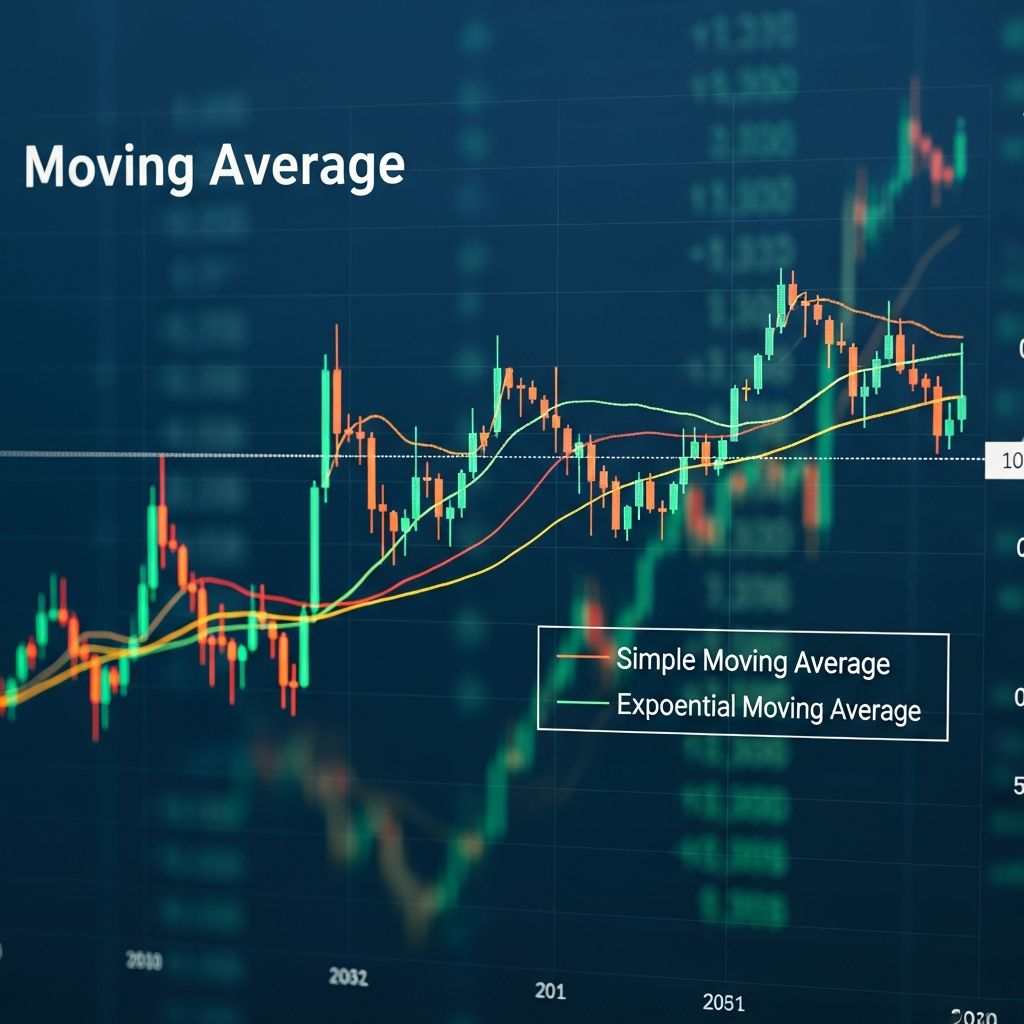
The simple moving average is the most straightforward type of moving average. It is calculated by adding the closing prices over a specified period and dividing by the number of periods. For example, a 50-day simple moving average would sum the closing prices of the last 50 days and divide by 50. The SMA gives equal weight to each price point, making it easy to understand and calculate.
The advantage of the SMA is its simplicity. However, because it gives equal weight to all prices, including older prices that may be less relevant, some traders prefer exponential moving averages that give more weight to recent prices.
Exponential Moving Average (EMA)
The exponential moving average places more weight on recent prices, making it more responsive to current market conditions. The EMA is calculated using a multiplier that gives greater significance to the most recent price data. Because of this weighting, EMAs react more quickly to price changes than SMAs, making them popular among short-term traders.
The formula for EMA is more complex than SMA, but the key difference is that recent prices have a greater impact on the calculation. This responsiveness can be beneficial for identifying trend changes earlier, though it can also result in more false signals in sideways markets.
Other Types of Moving Averages
- Weighted Moving Average (WMA): This assigns decreasing weights to older prices, giving more importance to recent data points.
- Adaptive Moving Average (AMA): This adjusts its sensitivity based on market volatility and trend strength.
- Hull Moving Average (HMA): Designed to reduce lag and improve responsiveness to price changes.
- Triangular Moving Average (TMA): Gives the most weight to prices in the middle of the time period.
Common Moving Average Periods
Traders use various time periods for moving averages depending on their trading style and objectives. Shorter periods are more responsive to price changes, while longer periods provide a smoother, longer-term view of trends.
- Short-term (5-20 days): Used by day traders and swing traders to identify short-term trends and entry/exit points.
- Medium-term (20-50 days): Popular among swing traders for identifying intermediate trends.
- Long-term (100-200 days): Used by position traders and investors to identify major long-term trends.
The 50-day, 100-day, and 200-day moving averages are particularly popular in technical analysis as they correspond to trading periods and seasonal trading patterns.
Moving Averages as Trading Signals
Moving averages generate trading signals in several ways. One common approach is using a crossover strategy, where traders watch for the intersection of two moving averages of different periods.
Moving Average Crossovers
A bullish signal occurs when a faster-moving average (such as a 50-day) crosses above a slower-moving average (such as a 200-day). This is known as a “golden cross” and suggests an uptrend may be forming. Conversely, a bearish signal occurs when a faster-moving average crosses below a slower-moving average, known as a “death cross,” suggesting a downtrend may be beginning.
Price and Moving Average Interaction
Another strategy involves observing when the price itself interacts with the moving average. If the price is trading above a moving average, it suggests an uptrend, while trading below indicates a downtrend. Traders often enter positions when the price bounces off a moving average and exits when it crosses below or above it, depending on the direction of the trade.
Advantages of Using Moving Averages
Moving averages offer numerous benefits for traders and investors:
- Trend Identification: They clearly show the direction and strength of a trend.
- Reduced Noise: They filter out short-term price volatility, making trends easier to see.
- Support and Resistance: They act as dynamic levels where price often finds support or encounters resistance.
- Entry and Exit Signals: They provide clear signals for entering and exiting trades.
- Simplicity: They are easy to understand and implement, making them accessible to traders of all levels.
- Versatility: They work across different time frames, asset classes, and markets.
Limitations and Disadvantages
Despite their usefulness, moving averages have limitations that traders should understand:
- Lagging Indicator: Since they are based on historical data, they can be slow to react to sudden price changes, potentially resulting in late entry or exit signals.
- Whipsaws in Ranging Markets: In sideways or consolidating markets, moving averages may generate false signals, leading to repeated small losses.
- Not Predictive: Moving averages do not predict future price movements; they only confirm historical trends.
- Parameter Selection: Choosing the right period requires experimentation and can be subjective.
- Lag During Reversals: Moving averages may lag significantly during sharp reversals, causing traders to miss optimal exit points.
Practical Applications in Trading Strategies
Traders employ moving averages in various strategies tailored to their objectives and time horizons:
Trend-Following Strategies
Traders use moving averages to identify and follow established trends. A simple approach is to buy when the price is above a long-term moving average and sell when it drops below it. This strategy captures extended trends but may miss reversals early.
Multiple Moving Average Systems
Many traders use two or more moving averages simultaneously. For instance, using a 20-day and 50-day moving average together can provide more robust signals. A bullish setup might occur when the 20-day MA is above the 50-day MA and both are sloping upward.
Volatility-Based Strategies
Some traders combine moving averages with volatility indicators to filter out false signals. By only taking signals when volatility is within certain parameters, traders can improve the quality of their trade setup entries.
Moving Averages in Different Markets
Moving averages are versatile tools that work effectively across different financial markets:
- Stock Market: Traders use moving averages to identify trends in individual stocks and market indices.
- Forex Market: Currency traders rely on moving averages to confirm trends across different currency pairs.
- Cryptocurrency Market: Digital asset traders use moving averages to navigate the high-volatility crypto market.
- Commodities: Commodity traders employ moving averages to track trends in oil, metals, and agricultural products.
Frequently Asked Questions (FAQs)
Q: What is the difference between a simple moving average and an exponential moving average?
A: The primary difference is weighting. A simple moving average gives equal weight to all prices in the period, while an exponential moving average assigns greater weight to recent prices. This makes EMAs more responsive to price changes and preferred by shorter-term traders, while SMAs are smoother and suit longer-term analysis.
Q: How do I choose the right moving average period for my trading?
A: The choice depends on your trading style and time frame. Day traders typically use shorter periods (5-20 days), swing traders use medium periods (20-50 days), and long-term investors use longer periods (100-200 days). Experimentation and backtesting can help determine the best period for your strategy.
Q: Can moving averages be used alone as a complete trading system?
A: While moving averages are powerful tools, most experienced traders recommend using them in combination with other indicators and analysis methods to confirm signals and reduce false entries. They work best as part of a comprehensive trading strategy.
Q: What does it mean when the price crosses above a moving average?
A: When price crosses above a moving average, it typically signals a potential bullish shift or uptrend. Many traders view this as a buy signal, especially if confirmed by other indicators or if the moving average is sloping upward.
Q: Are moving averages better for short-term or long-term trading?
A: Moving averages can be effective for both, but different periods suit different timeframes. Shorter moving averages (5-20 days) work better for short-term trading, while longer averages (100-200 days) are more suitable for identifying long-term trends and positions.
Q: How do I use moving averages to identify support and resistance?
A: Price often bounces off moving averages, creating dynamic support and resistance levels. If the price approaches a moving average from above, it acts as resistance; from below, it acts as support. These levels can be used to set stop-losses or take-profit targets.
Conclusion
Moving averages are indispensable tools in technical analysis that help traders and investors identify trends, generate trading signals, and establish dynamic support and resistance levels. While they have limitations as lagging indicators, their simplicity, versatility, and effectiveness across different markets make them essential components of most trading strategies. By understanding the different types of moving averages, their applications, and their limitations, traders can incorporate them effectively into their decision-making process. The key is to use moving averages in conjunction with other technical and fundamental analysis tools to create a robust and profitable trading approach.
References
- Technical Analysis from A to Z: Covers Every Trading Tool from the Absolute Basics to the Most Advanced — Steven B. Achelis, McGraw-Hill Education. 2001. https://www.mheducation.com/
- The Complete Guide to Technical Analysis — Kirkpatrick, Charles D. and Dahlquist, Julie A., FT Press. 2010. https://www.ftpress.com/
- Investopedia: Moving Average Definition and Uses in Trading — Investopedia. 2025. https://www.investopedia.com/
- A Random Walk Down Wall Street: The Time-Tested Strategy for Successful Investing — Burton G. Malkiel, W.W. Norton & Company. 2019. https://wwnorton.com/
- Market Technicians Association Standards — Market Technicians Association. 2024. https://www.mta.org/
Similar Articles








Read full bio of Sneha Tete