Mortgage Refinancing Expenses: 2026 Guide
Complete breakdown of refinancing costs and strategies to minimize your expenses

Refinancing your mortgage can be a strategic financial decision, but it comes with tangible costs that homeowners must carefully evaluate before proceeding. In 2026, the landscape of refinancing expenses remains significant, requiring thorough analysis to determine whether the potential savings justify the upfront investment. This comprehensive guide explores the various costs associated with mortgage refinancing, provides current market context, and offers strategies to minimize your total expenses.
The Overall Cost Framework for Refinancing
When you decide to refinance your mortgage, you’ll encounter closing costs that typically represent a substantial portion of your new loan amount. According to current market data, most homeowners should anticipate refinancing expenses ranging between 2% and 6% of their new loan balance. To illustrate this range with concrete numbers, a homeowner refinancing a $300,000 mortgage would need to budget between $6,000 and $18,000 in upfront costs.
The actual amount you’ll pay depends on several variables, including your geographic location, the size of your refinance, your credit profile, and the specific lender you select. National data from 2025 shows that average closing costs settled around $2,403, representing approximately 0.72% of the loan amount. This suggests that while the potential range extends to 6%, many borrowers may experience costs on the lower end of this spectrum, particularly with competitive shopping and strong credit profiles.
Breaking Down Individual Refinancing Fees
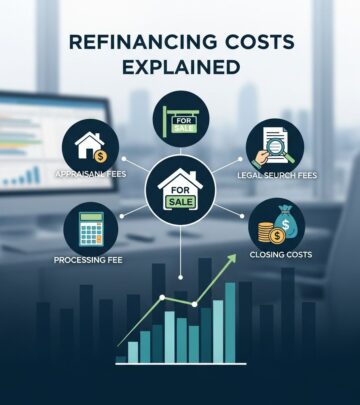
Loan Origination and Underwriting Charges
The origination fee represents the lender’s primary method of compensation for processing your refinance application. This fee typically falls between 0.5% and 1.5% of your total loan amount, though 1% is increasingly common in 2026. For a $200,000 refinance, this translates to a $2,000 charge at the standard rate. Some lenders offer reduced origination fees, but they often compensate by charging higher interest rates, forcing you to decide between paying more upfront or paying more over the life of the loan.
Home Appraisal Expenses
Your new lender will require an independent appraisal to verify your home’s current market value and confirm adequate equity for the loan. Appraisal costs have become increasingly variable, generally ranging from $300 to $1,000 for standard properties. However, the fees can stretch toward $2,000 for larger homes, properties on substantial acreage, or homes in remote locations where appraisers must travel considerable distances. A typical suburban single-family home generally costs between $400 and $600 for appraisal services. Some lenders participate in appraisal waiver programs, potentially eliminating this expense entirely for certain refinance scenarios.
Application and Credit Assessment Fees
Lenders typically charge an application fee to initiate the refinancing process, with this fee capping at approximately $500. Additionally, lenders pull your credit report to assess your creditworthiness, with credit report fees usually ranging from $10 to $100 per borrower. While these individual costs seem modest, they accumulate as part of your total closing cost burden.
Title-Related Services
Your refinance requires a thorough title search to confirm no liens or claims exist against your property, followed by title insurance to protect your lender’s investment. These combined services typically cost between $300 and $2,000, depending on your location and property complexity.
Recording and Documentation Fees
Local governments charge recording fees to document your new mortgage in public records. These fees vary significantly by jurisdiction, ranging from $20 to $250. Some states also require survey fees, which average around $2,300 though they’re not universally mandated.
Professional Services
Depending on your state’s requirements, you may need an attorney or settlement agent to oversee your refinancing transaction. Attorney and settlement fees typically range from $500 to $1,000.
A Comparative View of Refinancing Expenses
| Cost Category | Typical Range | Key Variables |
|---|---|---|
| Origination Fee | 0.5% – 1.5% of loan amount | Lender competition, credit score |
| Appraisal Fee | $300 – $2,000 | Property size, location, complexity |
| Application Fee | Up to $500 | Lender policies |
| Credit Report Fee | $10 – $100 | Number of borrowers |
| Title Services | $300 – $2,000 | Location and title complexity |
| Recording Fee | $20 – $250 | Local government rates |
| Survey Fee | $2,300 average | State requirements, property size |
| Attorney/Settlement Fee | $500 – $1,000 | State requirements |
Current Market Conditions and Interest Rate Environment
The 2026 refinancing landscape presents a mixed picture for homeowners. Current mortgage rates for 30-year fixed refinances hover around 6.15% to 6.21%. While this represents a welcome decline from the nearly 7% rates seen in previous years, these rates remain substantially higher than the historically low rates available during the pandemic. This elevated rate environment makes the break-even analysis particularly crucial before you commit to refinancing.
Shorter-term refinances show more favorable rates in 2026. Fifteen-year fixed refinances currently sit around 5.42%, while 10-year terms also feature 5.42% rates. Twenty-year refinances come in around 6.45%. These variations allow borrowers to strategically choose terms that balance their monthly payment goals with overall interest savings.
Calculating Your Break-Even Point
Before committing to a refinance, you must determine when your monthly savings will offset your upfront closing costs. The break-even analysis follows a straightforward formula: divide your total closing costs by your monthly payment savings to determine how many months you need to remain in the loan for the refinance to become financially worthwhile.
For example, imagine your current mortgage payment is $2,150 monthly. If refinancing would reduce this to $1,950, you’re saving $200 per month. With $6,000 in closing costs, your break-even point arrives after 30 months (36 months = $6,000 ÷ $200). This means you’d need to stay in the home for at least 2.5 years to realize a financial benefit from the refinance.
This calculation becomes critically important in 2026’s environment. With closing costs potentially reaching $18,000 for larger refinances, the break-even period could extend well beyond three years. If you anticipate selling your home or refinancing again within your break-even window, the refinance may not make financial sense despite potential monthly savings.
Strategies to Reduce Your Refinancing Expenses
Shopping Across Multiple Lenders
Different lenders charge varying origination fees and may offer different terms regarding which costs they cover. Obtaining quotes from at least three to five lenders allows you to compare total closing costs rather than focusing solely on interest rates. A lender offering a slightly higher rate but substantially lower closing costs might produce better long-term results.
Improving Your Credit Profile
Your credit score significantly influences the fees lenders quote. Borrowers with excellent credit typically qualify for lower origination fees and better interest rates. If your credit score has improved since your original mortgage, a refinance could yield immediate benefits through fee reductions alone.
Negotiating Closing Costs
Many closing costs remain negotiable, particularly origination fees and application fees. Lenders often have flexibility to adjust these charges, especially when facing competition or when refinancing existing customers. Don’t hesitate to negotiate or ask about options to reduce specific fees.
Exploring Appraisal Waivers
Some lenders offer appraisal waivers for refinances, particularly when your current loan-to-value ratio remains favorable. By eliminating the appraisal fee, you can reduce total closing costs by $300 to $2,000 depending on your property.
Considering No-Cost Refinancing Options
Some lenders offer no-cost refinancing programs where they cover your closing costs in exchange for a higher interest rate. While you’ll pay more over the loan’s lifetime, this approach eliminates upfront expenses and could benefit borrowers who plan to stay in their homes for extended periods.
Additional Considerations and Potential Extra Costs
Depending on your specific circumstances, your refinancing costs might exceed standard closing cost ranges. If your loan-to-value ratio exceeds 80%, you may need to purchase private mortgage insurance (PMI), adding to your monthly payments. If your current loan includes a prepayment penalty, your refinancing costs will increase by that penalty amount, potentially adding hundreds or thousands of dollars.
Your geographic location also influences costs significantly. Some states require attorney involvement in real estate transactions, automatically adding $500 to $1,000 to your expenses. Properties with title issues or properties in rural areas requiring surveys face additional charges beyond standard closing costs.
Frequently Asked Questions About Refinancing Costs
What’s the average cost to refinance in 2026?
Most borrowers should expect to pay between 2% and 6% of their loan amount. For a $300,000 refinance, this translates to $6,000 to $18,000. However, national averages suggest many borrowers pay closer to 1% or less when obtaining competitive quotes.
Can I refinance without paying closing costs?
Yes, some lenders offer no-cost refinancing where they cover your closing costs in exchange for charging you a higher interest rate. This approach makes sense if you plan to keep the loan long-term, as the higher rate compounds over time.
Should I roll closing costs into my new loan?
Rolling closing costs into your new loan balance eliminates the upfront expense but increases your total loan amount and the interest you’ll pay over the loan’s lifetime. This strategy only makes sense if the monthly savings from refinancing sufficiently outweigh the additional long-term interest costs.
How long do I need to stay in my home for refinancing to make sense?
This depends on your break-even point, calculated by dividing total closing costs by monthly payment savings. If your break-even point extends beyond your anticipated time in the home, refinancing may not be advantageous.
Are any refinancing costs tax-deductible?
Generally, refinancing costs cannot be deducted as mortgage interest. However, if you refinance to extract equity for home improvements or other purposes, some fees may be deductible. Consult a tax professional for your specific situation.
Making Your Refinancing Decision
Refinancing your mortgage represents a significant financial decision that extends beyond simply comparing interest rates. The closing costs associated with refinancing can substantially impact whether the refinance delivers genuine financial benefits. In 2026’s environment of relatively higher interest rates, the break-even analysis becomes even more critical.
Start by obtaining quotes from multiple lenders, comparing their total closing costs alongside interest rates. Calculate your break-even point based on your anticipated monthly savings. Consider your timeline—if you might move or refinance again soon, the break-even period may extend beyond your remaining time in the home. Finally, explore all available options for reducing costs, from negotiating fees to pursuing appraisal waivers.
By thoroughly understanding the complete cost picture of mortgage refinancing, you’ll make an informed decision that aligns with your financial goals and timeline.
References
- What Are the Typical Costs of Refinancing a Mortgage in 2026? — NORA Real Estate. 2026. https://www.noradarealestate.com/blog/what-are-the-typical-costs-of-refinancing-a-mortgage-in-2026/
- How Much Does It Cost To Refinance A Mortgage? — Bankrate. 2026. https://www.bankrate.com/mortgages/how-much-it-costs-to-refinance/
- How Much Does It Cost to Refinance in 2026? 12 Fees Explained — AmeriSave. 2026. https://www.amerisave.com/learn/how-much-does-it-cost-to-refinance-in-fees-explained
- Current refi mortgage rates report for March 12, 2026 — Fortune. 2026-03-12. https://fortune.com/article/current-refi-mortgage-rates-03-12-2026/
- Mortgage rate today: Are current refinance rates March 2026 worth locking in now as average 30-year fixed refi rate sits at 6.60% — Economic Times. 2026. https://economictimes.com/news/international/us/mortgage-rate-today-are-current-refinance-rates-march-2026-worth-locking-in-now-as-average-30-year-fixed-refi-rate-sits-at-6-60/articleshow/129846537.cms
Similar Articles








Read full bio of medha deb