Mortgage Payment Structure: Components and How They Work
Understand mortgage payment components, amortization, and how your monthly payments are calculated and applied.
Understanding Mortgage Payment Structure
When you take out a mortgage to purchase a home, your monthly payment encompasses far more than just repaying the loan amount. Your mortgage payment is composed of several distinct components that work together to cover your borrowing costs, property obligations, and lender protections. Understanding the structure of your mortgage payment is essential for budgeting, making informed financial decisions, and recognizing how your money is being allocated each month. By breaking down each component, you can gain clarity on what you’re paying for and how it contributes to building equity in your home.
The Main Components of a Mortgage Payment
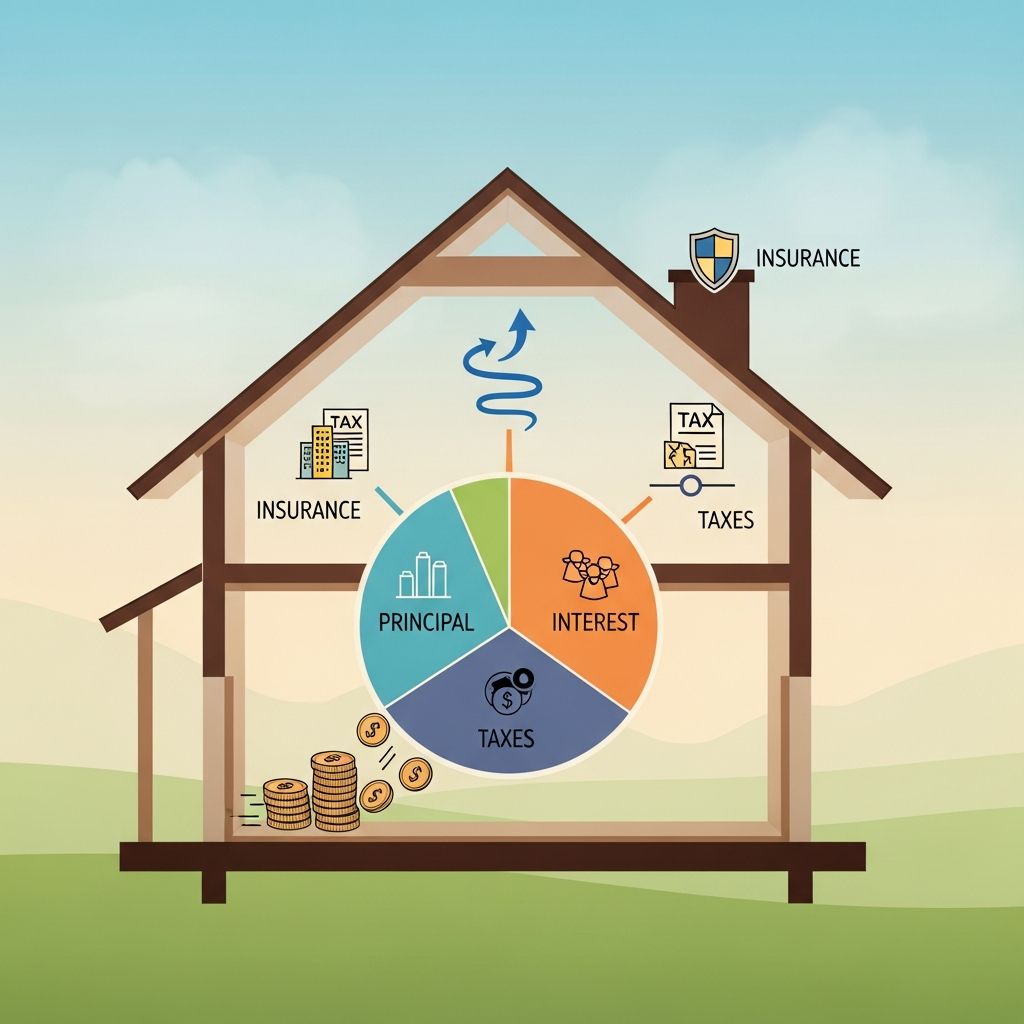
Your monthly mortgage payment typically includes four primary components, commonly remembered by the acronym PITI: Principal, Interest, Taxes, and Insurance. Some payments may also include additional costs such as mortgage insurance and homeowners association fees. Let’s examine each component in detail.
Principal
Principal is the amount of money you originally borrowed to purchase your home. When you make your monthly mortgage payment, a portion of it goes directly toward paying down this principal balance. The amount applied to principal increases over time as you progress through your loan term. Early in the mortgage, most of your payment covers interest rather than principal, but as you continue making payments and reduce your loan balance, more of each payment is directed toward paying down the principal. This portion of your payment directly builds equity in your home, meaning you’re gradually increasing your ownership stake.
Interest
Interest is the cost the lender charges you for borrowing money. It is typically expressed as a percentage of your loan balance and is the price you pay for the privilege of financing your home purchase. The amount of interest you pay each month varies depending on your loan balance, interest rate, and the remaining term of your loan. In the early stages of your mortgage, interest comprises the majority of your monthly payment because your loan balance is at its highest. As your principal balance decreases over time, the amount of interest you owe each month also decreases, allowing more of your payment to go toward principal.
Property Taxes
Most mortgage payments include an amount set aside for property taxes. These taxes are typically collected by your lender through an escrow account and paid on your behalf to your local government. Property tax amounts vary significantly depending on your location and the assessed value of your property. Your lender estimates your annual property tax obligation and divides it by twelve to determine the monthly amount included in your mortgage payment.
Homeowners Insurance
Your monthly mortgage payment typically includes an amount for homeowners insurance, which protects your home and personal belongings against damage or loss. Like property taxes, this amount is usually collected through an escrow account. Your lender requires this insurance to protect their investment in your property. The cost of homeowners insurance varies based on factors such as the age and location of your home, the coverage limits you choose, and your claims history.
Additional Payment Components
Depending on your specific mortgage, your payment may also include mortgage insurance, homeowners association fees, or condominium fees. Mortgage insurance is required when your down payment is less than twenty percent of the home’s purchase price. Homeowners association or condominium fees apply if you live in a community with shared amenities or common areas that require maintenance and upkeep.
How Escrow Works in Your Mortgage Payment
Escrow is a financial arrangement where your lender holds funds in a separate account to pay property taxes and homeowners insurance on your behalf. This system benefits borrowers by spreading annual tax and insurance expenses across twelve monthly payments rather than requiring large lump-sum payments. According to the Real Estate Settlement Procedures Act (RESPA), your minimum escrow balance should equate to approximately two months of escrow payments.
At closing, lenders may collect up to one-sixth of estimated annual real estate taxes and insurance payments. After closing, you remit one-twelfth of the annual amount with each monthly mortgage payment. For example, if your annual property taxes are $2,400 and your annual insurance is $600, your monthly escrow contribution would be approximately $250. Without escrow, you would need to save $3,000 annually and pay it in large chunks, which is often impractical for homeowners.
Your lender may increase your monthly mortgage payment if there are insufficient funds in your escrow account to cover property taxes and homeowners insurance. Conversely, you may receive an escrow balance refund soon after a loan payoff if your account contains excess funds.
Understanding Mortgage Amortization
Mortgage amortization is the process by which your loan is paid down over its term through regular monthly payments. An amortization schedule is a detailed breakdown showing how much of each payment goes toward principal and how much goes toward interest. Lenders use a standard mathematical formula to calculate the monthly payment amount that ensures the loan will be paid off precisely at the end of the loan term.
The amortization process creates an interesting dynamic in how your payments are allocated. In the beginning of your mortgage term, you owe more interest because your loan balance is still high. Most of your monthly payment is applied to the interest you owe, and only a small remainder is applied to paying off the principal. Over time, as you pay down the principal, you owe less interest each month because your loan balance is lower. This means that progressively, more of your monthly payment goes to paying down the principal. Near the end of the loan, you owe much less interest, and most of your payment goes to pay off the last of the principal.
To illustrate this concept, consider a $200,000, 30-year conventional mortgage at 4% interest. Your estimated monthly payment for principal and interest would be approximately $955. After one year of payments, only 31% of your money goes toward principal, while 69% covers interest. After ten years, approximately 45% goes toward principal. By year twenty, 67% of your payment is directed toward principal. Over the entire 30-year period, you would pay a total of approximately $343,739 in principal and interest combined.
Mortgage Payment Timing and Arrears
Unlike most loans, mortgage principal and interest are paid in arrears, meaning they are paid after interest is accrued rather than before. When you close on your mortgage, your first payment is typically due at the beginning of the first full month after closing. If you close on April 10th, your first payment would not be due until June 1st.
However, at closing, the lender collects interest on all remaining days of the month in which you close. If you close on the 15th of a 30-day month, there would be 16 days of interest collected—the number of days remaining in the month, including the 15th. This ensures that all subsequent monthly payments remain the same amount. The closer your closing date is to the end of the month, the less interest you owe that particular month, since interest is prorated by day.
Types of Mortgage Repayment Structures
Different mortgages may have different repayment structures that affect how your payments are applied. The most common structure is a standard amortizing loan where you pay off both principal and interest over the loan term through regular monthly payments. This means that by the end of your loan term, assuming you maintain consistent payments, you will have fully paid off the loan.
An alternative structure is an interest-only mortgage, where your monthly payments cover only the interest accrued on the amount lent. With this type of mortgage, by the end of the loan term, you are required to pay back the entire capital in full. Interest-only mortgages are less common because they require a separate arrangement for how the capital will be paid back, and they are typically more expensive since interest is calculated on the entire amount lent rather than a gradually decreasing balance.
Fixed-Rate vs. Variable-Rate Mortgage Payments
The type of interest rate you choose affects how your mortgage payments work. With a fixed-rate mortgage, your principal and interest payment remains the same throughout the entire loan term, providing predictability and stability in your monthly budget. Even though the payment amount stays constant, the portion allocated to principal versus interest changes over time due to amortization.
With variable-rate mortgages, such as tracker mortgages, your payments may change in response to fluctuations in interest rates. If the Bank of England base rate increases, your monthly payments will rise accordingly. Conversely, if rates decrease, your payments may decrease. This type of mortgage introduces uncertainty into your budgeting but may offer lower initial rates. After an initial fixed or tracker rate period ends, you may move onto a Standard Variable Rate unless you remortgage to a new fixed or tracker rate.
How Equity Building Works
One of the most important aspects of mortgage payments is that they contribute to building equity in your home. The portion of your payment that goes toward principal reduces the amount you owe on the loan and directly builds your equity—your ownership stake in the property. The portion that goes toward interest does not reduce your balance or build equity; it simply compensates the lender for providing the loan. This distinction is crucial because it means the equity you build in your home is considerably less than the sum of all your monthly payments over the loan term, particularly in the early years when most payments go toward interest.
Calculating Your Monthly Payment
Your lender uses a standardized formula to calculate your monthly mortgage payment based on three primary factors: the loan amount (principal), the interest rate, and the loan term (typically measured in years). This formula ensures that your payment amount allows for precisely the right distribution between principal and interest to pay off the entire loan by the end of the term. Your Loan Estimate, which you receive early in the mortgage application process, provides a detailed breakdown of your estimated monthly payment, including all components such as principal, interest, taxes, insurance, and escrow.
Frequently Asked Questions
Q: What is the difference between principal and interest in my mortgage payment?
A: Principal is the amount you borrowed and are repaying; it builds equity in your home. Interest is the cost of borrowing money from your lender; it does not build equity. Both are included in your monthly payment, with the allocation between them changing over time due to amortization.
Q: Why do my payments go more toward interest at the beginning?
A: At the start of your loan, your principal balance is at its highest, so the interest calculated on that balance is substantial. As you pay down the principal over time, less interest accrues, allowing more of each payment to go toward principal.
Q: What happens to my escrow account after I pay off my mortgage?
A: After you pay off your mortgage, any excess funds remaining in your escrow account should be refunded to you by your lender, typically within a specified timeframe.
Q: Can I pay extra toward my principal to pay off my mortgage faster?
A: Yes, most lenders allow you to make additional principal payments without penalty. This can significantly reduce the total interest you pay and shorten your loan term. Check with your lender about their specific policies on extra payments.
Q: How does mortgage insurance factor into my monthly payment?
A: If your down payment is less than 20%, your lender typically requires private mortgage insurance (PMI). This cost is added to your monthly payment and protects the lender if you default. PMI can usually be removed once you’ve built sufficient equity.
Q: Why might my mortgage payment increase even with a fixed-rate loan?
A: While your principal and interest payment remains fixed, increases in property taxes or homeowners insurance can cause your total mortgage payment to increase. Your lender may also adjust your escrow account if there are shortfalls in covering these expenses.
References
- How do payments on a mortgage work? — NatWest. Accessed November 2025. https://www.natwest.com/mortgages/mortgage-guides/how-do-mortgages-work.html
- How does paying down a mortgage work? — Consumer Finance Protection Bureau. https://www.consumerfinance.gov/ask-cfpb/how-does-paying-down-a-mortgage-work-en-1943/
- Mortgage Payments Explained: Principal, Escrow, and More — American Financing. https://www.americanfinancing.net/mortgage-basics/mortgage-payment-explained
- The Components of a mortgage payment — Wells Fargo. https://www.wellsfargo.com/mortgage/learn/components-of-a-mortgage-payment/
- How mortgage repayments and interest work — Equifax UK. https://www.equifax.co.uk/resources/mortgage/how-mortgage-repayments-work.html
- The 7 Parts of a Mortgage Payment — Freddie Mac. https://myhome.freddiemac.com/blog/homeownership/20210917-7-parts-mortgage-payment
- Different types of mortgages and how they work — Sorted. https://sorted.org.nz/guides/home-buying/mortgage-types/
Similar Articles








Read full bio of medha deb