Mortgage Options Without Credit History
Discover how to secure home financing even without a traditional credit score through specialized loans and strategies.

Securing a mortgage without a traditional credit score is feasible through government-backed programs and alternative evaluation methods. Lenders assess reliability via payment histories from rent, utilities, and other bills rather than FICO scores.
Understanding the Challenge of No Credit History
A lack of credit history, often termed ‘credit invisible,’ affects millions who pay in cash or avoid debt. This differs from bad credit, where past issues lower scores. Without scores, automated approvals fail, shifting to manual reviews where underwriters scrutinize finances manually.
Lenders prioritize stability: steady income, low debt, and on-time payments elsewhere. Recent changes, like Fannie Mae’s Desktop Underwriter update effective November 2025, eliminate minimum score requirements for conventional loans, using holistic assessments including nontraditional data.
Government-Backed Loan Programs for Credit-Invisible Buyers
Several federal programs accommodate applicants without scores, focusing on alternative credit data.
- FHA Loans: Backed by the Federal Housing Administration, these allow manual underwriting for no-score applicants. Lenders compile nontraditional merged credit reports (NTMCR) from rent, utilities, and insurance. Minimum score isn’t mandatory if alternatives prove reliability; typically need 3.5% down with 580+ score or 10% with 500-579, but no-score cases proceed via documentation.
- VA Loans: For eligible veterans and service members, no minimum score set by VA, though lenders often want 620+. No-credit applicants qualify with strong payment histories and manual review.
- USDA Loans: For rural properties, these accept nontraditional credit. Lenders require proof of consistent payments; scores around 580+ preferred but not always needed.
| Loan Type | Min Down Payment (No Score) | DTI Limit | Key Flexibility |
|---|---|---|---|
| FHA | 10% typical | 31-43% | Nontraditional credit accepted |
| VA | 0% | Varies | No VA min score |
| USDA | 0% | 41% | Rural focus, alt credit |
The Manual Underwriting Process Explained
Manual underwriting involves human review of your full financial picture, bypassing algorithms. Expect to submit extensive documents: 12-24 months of rent receipts, utility bills, bank statements, tax returns (2 years), pay stubs (30 days), and employment verification.
For self-employed, provide profit/loss statements. Lenders verify no delinquencies in nontraditional sources. This process takes longer—weeks versus days—but succeeds for disciplined applicants. Debt-to-income (DTI) ratios cap at 36% without scores, versus higher with them.
Building and Proving Nontraditional Credit
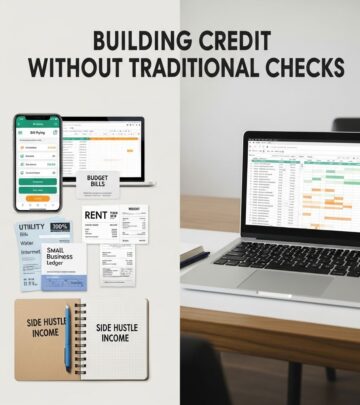
Nontraditional credit includes verifiable recurring payments. Lenders seek 3+ references showing 12+ months of on-time history, per Fannie Mae guidelines.
- Rent payments via checks or landlord statements
- Utility bills (electric, water, gas)
- Cell phone, streaming services, insurance premiums
- Store cards or rent-reporting services (e.g., Experian Boost)
Services like Experian Boost add positive utility/rent payments to your file, potentially creating a score. Fannie Mae requires checking all three bureaus first to confirm no traditional history exists.
Strategies to Strengthen Your Application
Beyond basics, these tactics boost approval odds:
- Larger Down Payment: 10-20% signals commitment, reducing lender risk.
- Co-Signer or Co-Borrower: A creditworthy partner shares responsibility. Co-signer backs payments without ownership; co-borrower gets title rights.
- Low DTI: Keep housing costs under 31% of income; total DTI under 36-43%.
- Reserves: Show 6+ months’ savings. No reserves needed if housing history documented.
- Homebuyer Education: Required in some cases post-2025 DU updates.
Recent Policy Shifts Opening Doors
As of November 2025, Fannie Mae’s DU no longer mandates 620 scores, assessing risk via income, assets, payment patterns, and nontraditional profiles. This aids cash-paid adults; lenders build profiles from rent/utilities. Applicable until at least 2026, per updates.
FHA rules prohibit denying based solely on no history, mandating NTMCR reviews. These evolutions make conventional loans viable alongside government options.
Potential Drawbacks and Costs
No-credit mortgages aren’t free rides. Manual processes delay closings and may incur fees. FHA requires mortgage insurance premiums (MIP) for loan life or 11 years (10%+ down). Higher down payments and stricter DTI strain budgets. Interest rates might exceed those for scored borrowers, though strong profiles mitigate this.
Compare: Conventional loans post-2025 may offer better rates without MIP, but require holistic strength.
Step-by-Step Guide to Applying
- Check Bureaus: Pull free reports from AnnualCreditReport.com to confirm no score.
- Gather Docs: Compile 12-24 months payments, income proof, assets.
- Find Lenders: Seek FHA/VA/USDA specialists or DU-enabled conventional providers.
- Prequalify: Discuss manual underwriting upfront.
- Boost Profile: Use rent-reporting apps.
- Apply Jointly: If needed, add co-signer.
FAQs: Mortgages Without Credit
Is manual underwriting guaranteed?
No, but FHA/VA/USDA lenders must consider it for eligible applicants.
What’s the lowest down payment possible?
VA/USDA: 0%; FHA: 3.5% with score, 10% typical no-score.
Can self-employed qualify?
Yes, with 2 years’ tax docs and nontraditional credit.
How long does approval take?
30-60 days due to manual review.
Does building credit help faster?
Yes; 580+ score unlocks 3.5% FHA down payments.
Long-Term Advice: From No Credit to Strong Profile
Post-purchase, build credit via secured cards, auto-payments. Monitor via free tools. Aim for 620+ within years for refinancing into better terms, dropping MIP. Homeownership builds wealth; start small if needed.
References
- Can You Get a Mortgage With No Credit History? — Redfin. 2024. https://www.redfin.com/blog/mortgage-with-no-credit-history/
- Can You Get a Mortgage With No Credit? — Experian. 2024. https://www.experian.com/blogs/ask-experian/can-you-get-a-mortgage-with-no-credit/
- Can You Buy a House With No Credit? — Zillow. 2024. https://www.zillow.com/learn/buying-a-house-with-no-credit/
- Can you buy a house with no credit? — Rocket Mortgage. 2024. https://www.rocketmortgage.com/learn/can-you-buy-a-house-with-no-credit
- Can You Buy a House with No Credit? — Chase. 2024. https://www.chase.com/personal/mortgage/education/financing-a-home/can-you-buy-a-house-with-no-credit
- Buying a Home Without a Credit Score? New Rules Make It Possible — Luminate Bank. 2025. https://www.luminate.bank/buying-home-without-credit-score
- Eligibility Requirements for Loans with Nontraditional Credit — Fannie Mae Selling Guide (B3-5.4-01). 2025-11-05. https://selling-guide.fanniemae.com/sel/b3-5.4-01/eligibility-requirements-loans-nontraditional-credit
Similar Articles








Read full bio of medha deb