Mortgage Interest Costs Explained
Discover how mortgage interest is determined, calculated, and minimized to save thousands over your loan's lifetime.

Mortgage interest represents a substantial portion of a home loan’s total cost, often exceeding the principal borrowed over time. Understanding its mechanics empowers borrowers to make informed decisions that can save tens of thousands of dollars.
Core Elements Driving Mortgage Interest Rates
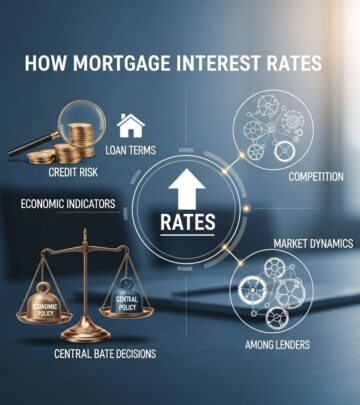
Several borrower-specific and market-driven factors dictate the interest rate lenders assign to mortgages. These elements reflect perceived risk and broader economic conditions.
- Credit scores: Higher scores signal reliability, leading to lower rates as lenders anticipate timely repayments.
- Down payment size: Larger down payments reduce lender risk, typically yielding better rates; 20% or more often avoids private mortgage insurance (PMI).
- Loan-to-value (LTV) ratio: Lower LTV means less borrowing relative to home value, correlating with favorable rates.
- Debt-to-income (DTI) ratio: Borrowers with lower DTI—monthly debt under 43% of income—secure preferable terms.
- Property details: Single-family primary residences get lower rates than condos, investment properties, or multi-family units.
Market forces, including Federal Reserve policies and inflation, also influence baseline rates available to all applicants.
How Lenders Compute Your Personal Rate
Lenders blend these factors into a customized rate via risk assessment models. Advertised rates often assume ideal profiles—top credit, ample down payment—making real quotes higher for most. Tools like the Consumer Financial Protection Bureau’s Explore Interest Rates help simulate personalized scenarios by inputting credit range, home price, and down payment.
| Factor | Impact on Rate | Example |
|---|---|---|
| Credit Score | 760+ FICO: Lowest rates | 0.5%-1% better than sub-680 |
| Down Payment | 20%+: Optimal | Avoids PMI, lowers rate by 0.25%-0.5% |
| DTI Ratio | <36%: Best | Higher DTI adds 0.25%-0.75% adjustment |
| Property Type | Single-family primary | Investment adds 0.5%-1% |
Mastering Mortgage Interest Calculations
Interest accrues daily on the outstanding principal but is paid monthly in arrears. For a fixed-rate loan, each payment covers interest first, with the remainder reducing principal—a process called amortization.
The monthly payment formula is:
[ M = P frac{i(1 + i)^n}{(1 + i)^n – 1} ]
Where:
- ( M ): Monthly payment
- ( P ): Principal
- ( i ): Monthly interest rate (annual rate / 12)
- ( n ): Total payments (term in years × 12)
Example: $200,000 loan at 4% over 30 years yields ( M = $954.83 ). First month’s interest: ( $200,000 × (0.04 / 12) = $666.67 ); principal reduction: $288.16.
Total simple interest (non-amortizing approximation): ( Principal × Rate × Years = $200,000 × 0.04 × 30 = $240,000 ). Actual amortized total exceeds this due to compounding effects, reaching about $143,739 in interest.
Total Interest Across Loan Scenarios
The principal amount amplifies total interest; doubling the loan size at the same rate doubles interest paid. Term length matters too: shorter terms mean higher monthly payments but far less total interest.
| Loan Amount | Rate | Term | Monthly P&I | Total Interest |
|---|---|---|---|---|
| $200,000 | 4% | 30 years | $954.83 | $143,739 |
| $200,000 | 3% | 30 years | $843.21 | $103,554 |
| $200,000 | 4% | 15 years | $1,479.35 | $66,354 |
Note: Payments exclude taxes, insurance. A 1% rate drop on $200,000/30-year saves ~$40,000 in interest.
Strategies to Minimize Lifetime Interest
- Boost credit score: Pay debts on time, reduce utilization below 30% for 3-6 months pre-application.
- Maximize down payment: Aim for 20% to sidestep PMI and unlock lower rates.
- Shop multiple lenders: Rates vary; compare total costs, not just advertised APR.
- Opt for shorter terms: 15-year loans cut interest by over 50% despite higher monthlies.
- Buy discount points: Prepay interest (1 point = 1% of loan) for permanent rate reduction.
- Extra principal payments: Accelerate payoff, slashing total interest via reduced balance.
Fixed vs. Adjustable-Rate Mortgages
Fixed-rate loans lock your rate for the term, shielding against hikes. Adjustable-rate mortgages (ARMs) start lower but fluctuate with indices, suiting short-term owners. ARMs risk higher future payments if rates rise.
Hidden Costs Impacting Effective Rates
PMI for down payments under 20% inflates monthly costs until 20% equity. Closing costs, loan origination fees also factor into true borrowing expense. Always evaluate APR, which includes fees, over raw interest rate.
Frequently Asked Questions
How is daily mortgage interest calculated?
Daily interest = Outstanding balance × (annual rate / 365). Added to next payment.
Does refinancing lower total interest?
Yes, if new rate/term reduces costs and fees; calculate break-even point.
What’s a good mortgage rate in 2026?
Varies by profile; check current averages via CFPB tools.
Can I deduct mortgage interest?
Yes, for qualified primary/secondary homes up to $750,000 debt (post-2017 tax law).
How does loan size affect my rate?
Jumbo loans (>$766,550 in most areas) often carry premiums due to risk.
Practical Tools for Borrowers
Use amortization calculators to project payments. Factor tables simplify: monthly payment per $1,000 borrowed at given rate/term. Example: 4% 30-year ≈ $4.77/$1,000.
Pre-qualify with lenders to gauge rates without credit dings. Monitor economic indicators like 10-year Treasury yields, which track mortgage rates.
References
- Seven factors that determine your mortgage interest rate — Consumer Financial Protection Bureau. 2023. https://www.consumerfinance.gov/about-us/blog/7-factors-determine-your-mortgage-interest-rate/
- Understanding Interest Rates & How They Are Calculated — Cohen Mortgage. 2023. https://www.cohenmortgage.com/blog/238642/purchasing-a-home/understanding-interest-rates-how-they-are-calculated
- How to calculate interest rate — Rate.com. 2023. https://www.rate.com/mortgage/resource/interest-rate-formula
- How Does Mortgage Interest Work? A Guide to Monthly Payments — BMO. 2024. https://www.bmo.com/en-us/articles/mortgages/how-does-mortgage-interest-work/
- How Does Mortgage Interest Work? — Experian. 2024. https://www.experian.com/blogs/ask-experian/how-mortgage-interest-works/
Similar Articles








Read full bio of Sneha Tete