Mortgage Explanation Letter Guide
Master the art of crafting a mortgage letter of explanation to overcome underwriting hurdles and secure your home loan approval.
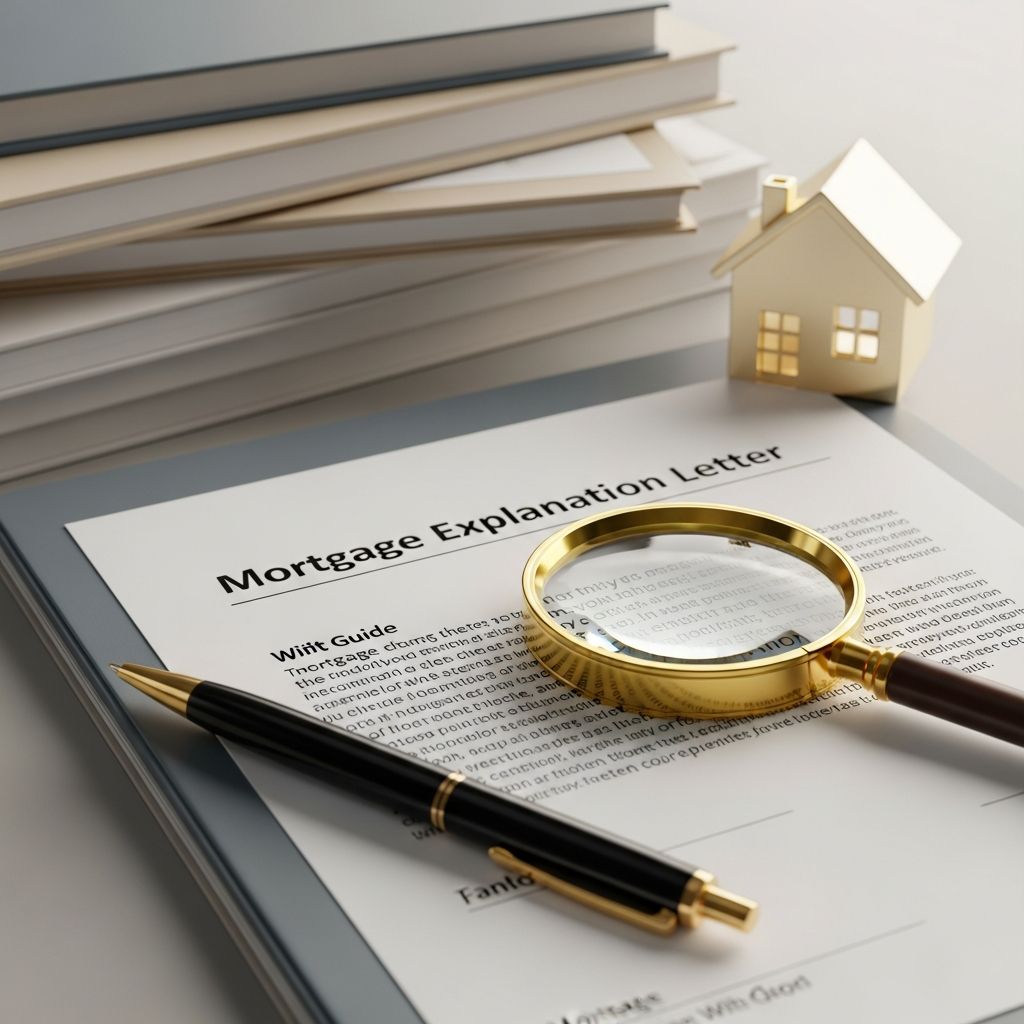
A letter of explanation serves as a vital tool in the mortgage approval process, allowing borrowers to clarify unusual aspects of their financial profile that might otherwise raise concerns for lenders. These documents provide context for discrepancies in credit history, employment, or banking activity, helping underwriters assess risk more accurately.
Understanding the Role of Explanation Letters in Home Financing
During mortgage underwriting, lenders scrutinize every detail of an applicant’s financial background to ensure repayment capability. Underwriters review bank statements, tax returns, pay stubs, credit reports, and employment records. Any irregularity can prompt a request for additional documentation, including a letter of explanation (LOE). This letter bridges gaps in standard paperwork, offering a narrative that traditional documents cannot convey.
Secondary market players like Fannie Mae, Freddie Mac, FHA, and VA often impose strict guidelines requiring such clarifications for certain loan types, especially jumbo loans exceeding conforming limits. By proactively addressing potential red flags, borrowers demonstrate transparency and financial responsibility.
Common Triggers Requiring a Mortgage LOE
Lenders request LOEs for various reasons tied to perceived risks. Recognizing these triggers early allows applicants to prepare effectively.
- Credit Report Irregularities: Late payments, collections, bankruptcies, foreclosures, or multiple inquiries signal potential instability. An LOE explains extenuating circumstances, such as medical emergencies or job loss, and outlines recovery steps.
- Employment Disruptions: Recent job changes, gaps in work history, or self-employment require assurance of income stability. For remote workers buying distant properties, confirmation of work arrangements is essential.
- Bank Account Anomalies: Large, unexplained deposits or withdrawals prompt questions about fund sources. Gift funds for down payments need accompanying gift letters from donors.
- Income Fluctuations: Variable earnings from commissions, freelancing, or business losses on tax returns necessitate proof of ongoing affordability.
- High Debt Levels: Elevated credit card balances or recent new accounts can impact debt-to-income ratios and interest rates.
- Rent-Free Living: If residing without housing payments, a landlord’s letter verifies this arrangement and its duration.
| Issue Type | Example | Typical LOE Response |
|---|---|---|
| Credit | Late payments | Explain cause (e.g., illness) and show on-time payments since. |
| Employment | Job gap | Detail reasons and current stable position. |
| Banking | Large deposit | Provide source docs like inheritance statements. |
| Income | Tax losses | Demonstrate recent profitability. |
Essential Components of an Effective LOE
A strong letter is concise, factual, and professional, typically one page. It must include specific identifiers and supporting evidence to build credibility.
- Header Information: Lender’s name and address, your full name as on the application, loan number, contact details, submission date, and estimated closing date.
- Subject Line: Clearly state “RE: [Your Name] Mortgage Application – Letter of Explanation”.
- Introduction: Briefly identify the issue and purpose, e.g., “This letter explains the employment gap from [date] to [date].”
- Body: Provide chronological details, reasons, impacts, and resolutions. Use dates, amounts, and account numbers. Highlight positive changes, like improved credit scores or steady income.
- Closing: Reaffirm commitment to repayment, express enthusiasm for the home, and invite questions. Sign with full name and spouse’s if co-applicant.
- Attachments: Include bank statements, pay stubs, divorce decrees, or medical bills as backups.
Step-by-Step Guide to Drafting Your LOE
- Gather Documentation: Collect all relevant records before writing to ensure accuracy.
- Outline the Narrative: Structure as problem, explanation, resolution, and future stability.
- Write Concisely: Aim for 4-6 paragraphs; avoid emotional language or excuses—focus on facts.
- Proofread Thoroughly: Check for errors; have a trusted advisor review.
- Submit Promptly: Respond to underwriter requests quickly to avoid delays.
Sample Template:
[Your Address]
[Date]
[Lender Name and Address]RE: [Your Name], Loan # [Number] – Explanation for [Specific Issue]
Dear [Underwriter/Lender],
I am writing to clarify [briefly state issue, e.g., a 30-day employment gap in 2024]. [Explain what happened, why, with dates and details].
To address this, [steps taken, e.g., secured new role with higher pay]. Attached are [list docs].
My finances are now stable, with [current positives]. I am excited about this home and committed to payments.
Sincerely,
[Your Signature]
[Printed Name]
Pro Tips for Maximizing LOE Impact
- Be Honest and Specific: Vague statements undermine trust; precise details reassure.
- Emphasize Positives: Always tie explanations to current strengths, like debt reduction.
- Anticipate Requests: For jumbo or government-backed loans, prepare LOEs in advance.
- Use Professional Tone: Treat it as a business communication—no slang or defensiveness.
- Follow Up: Confirm receipt and offer more info if needed.
Frequently Asked Questions
What if I need multiple LOEs for one application?
Address each issue in separate letters or clearly sectioned ones for clarity. Underwriters appreciate organization.
Does an LOE guarantee approval?
No, but it resolves concerns, improving odds. Combine with strong overall qualifications.
How long should the letter be?
One page maximum; brevity shows confidence.
Who signs the LOE for co-borrowers?
All applicants on the loan.
Can I type or handwrite it?
Type for professionalism; print on plain paper unless specified.
Navigating Underwriting with Confidence
Understanding LOEs empowers borrowers to tackle application hurdles head-on. By providing clear, documented explanations, you transform potential obstacles into opportunities to showcase resilience. Stay organized, respond swiftly, and maintain open communication with your lender to smooth the path to homeownership.
References
- How To Write A Letter Of Explanation For A Mortgage — Bankrate. 2023. https://www.bankrate.com/mortgages/letter-of-explanation-for-mortgage/
- Letter of explanation: Why it’s important and how to write one — Rocket Mortgage. 2023. https://www.rocketmortgage.com/learn/letter-of-explanation
- Letter of Explanation: What is it and When Do You Need One? — Chase. 2023. https://www.chase.com/personal/mortgage/education/financing-a-home/letter-of-explanation
- What is a Letter of Explanation for a Mortgage? — DSLD Mortgage. 2023. https://www.dsldmortgage.com/blog/what-is-a-letter-of-explanation-for-a-mortgage/
Similar Articles








Read full bio of Sneha Tete