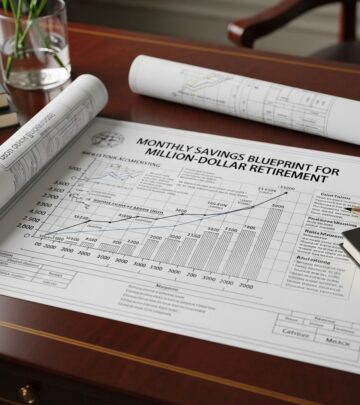
Monthly Savings Needed for Retirement at 65
Discover the exact monthly amount you need to save today to achieve a comfortable retirement by age 65, based on proven financial calculators and strategies.

Retiring at age 65 requires disciplined saving over decades, factoring in compound growth, inflation, and other income sources like Social Security. Financial calculators from trusted institutions show that saving 10-15% of pretax income monthly can build substantial wealth, but exact amounts depend on your current age, income, and goals.
Key Factors Influencing Your Retirement Savings Target
Several variables determine how much you must set aside each month. Understanding these helps tailor a plan to your situation.
- Current Age and Time Horizon: Starting early leverages compounding. For instance, contributions from age 30 grow far more than those from age 50 due to extended investment periods.
- Expected Income Replacement: Most aim for 70-85% of pre-retirement income to maintain lifestyle, adjusted for lower expenses like commuting.
- Investment Returns: Pre-retirement rates often assume 6%, dropping to 5% post-retirement for conservative portfolios.
- Inflation Rate: A standard 3% annual rate erodes purchasing power, so savings must outpace it.
- Other Income Streams: Social Security, pensions, or part-time work reduce the savings burden, calculated on income-based scales.
Life expectancy assumptions typically extend to age 95, ensuring funds last through extended retirements.
How Retirement Calculators Estimate Monthly Needs
Tools from NerdWallet, Bankrate, and AARP simplify projections by inputting personal data. They estimate total savings needed and reverse-engineer monthly contributions.
For a household earning $80,000 annually today, aiming to replace 80% of income at 65, calculators project needs around $1-2 million, depending on assumptions. Monthly savings might range from $500 in your 30s to $2,000+ if starting later.
| Age Starting | Annual Income | Monthly Save (10-15%) | Est. Nest Egg at 65 (6% Return) |
|---|---|---|---|
| 30 | $80,000 | $667-$1,000 | ~$1.5M |
| 40 | $80,000 | $667-$1,000 | ~$900K |
| 50 | $80,000 | $667-$1,000 | ~$400K |
This table illustrates compounding power; earlier savers need less monthly due to growth. Assumptions: 2% salary growth, 3% inflation.
Building a Realistic Savings Plan Step-by-Step
Start by assessing current savings in 401(k)s, IRAs, and other accounts. Add employer matches, which effectively boost contributions.
- Define Retirement Goals: Estimate annual expenses, often 70-90% of current spending.
- Input into Calculators: Use pre-tax income, monthly contributions as % or fixed amount, and retirement age 65.
- Account for Raises: 2% annual increases compound salary and savings potential.
- Project Withdrawals: Safe rates like 4% annually, adjusted for inflation, sustain funds to age 95.
Ameriprise and Vanguard tools allow scenario testing, showing impacts of higher returns or delayed retirement.
Investment Strategies to Maximize Growth
To hit targets, invest wisely. Pre-retirement portfolios blend stocks (for growth) and bonds (for stability), targeting 6% returns.
- 401(k) and IRAs: Tax-advantaged growth; max employer matches for free money.
- Diversification: Index funds reduce risk while matching market returns.
- Rebalancing: Shift conservative in later years, e.g., 5% return assumption post-65.
Merrill Edge calculators model average vs. poor markets, stressing diversified approaches.
Common Pitfalls and How to Avoid Them
Underestimating inflation or over-relying on Social Security leads to shortfalls. Calculators include sliding-scale SS estimates, but benefits average $1,900/month max.
Avoid withdrawing early; penalties erode principal. Instead, build emergency funds separately.
Case Studies: Real-World Projections
Consider a 35-year-old earning $100,000, saving 12% monthly ($1,000). With 6% returns and 3% inflation, they could amass $2.1M by 65, supporting $84,000/year withdrawals.
A 55-year-old at same income needs $3,500/month to reach $1M, highlighting urgency.
Frequently Asked Questions
How much should I save monthly if starting at 40?
Aim for 10-15% of income, e.g., $800-$1,200 on $100K salary, per NerdWallet guidelines.
Does Social Security count toward my total?
Yes, calculators factor it in, reducing savings needs by 20-40% typically.
What if markets underperform?
Use conservative 5% returns; tools like Merrill’s show ‘poor market’ scenarios.
Can I retire earlier than 65?
Possible with higher savings; test via AARP calculator, starting earlier amplifies results.
Inflation’s impact?
At 3%, $1M today needs $2.4M in 30 years; all models adjust for this.
Actionable Tips to Boost Savings Today
Increase contributions annually with raises. Automate transfers. Review progress yearly using free tools. Consult advisors for personalized tweaks.
By saving consistently, retirement at 65 becomes achievable. Use these insights to run your numbers now.
References
- Retirement Calculator – NerdWallet — NerdWallet. 2023. https://www.nerdwallet.com/investing/calculators/retirement-calculator
- Retirement Calculator: Estimate How Much You Need To Save — Bankrate. 2023. https://www.bankrate.com/retirement/retirement-plan-calculator/
- Retirement Calculator From AARP – How Much to Save? — AARP. 2023. https://www.aarp.org/money/retirement/retirement-calculator/
- Retirement Calculator: How Much Do I Need To Retire? – Merrill Edge — Merrill Edge. 2023. https://www.merrilledge.com/retirement/personal-retirement-calculator
- Retirement monthly income calculator – Ameriprise Financial — Ameriprise. 2023. https://www.ameriprise.com/financial-news-research/financial-calculators/retirement-income-calculator
Similar Articles








Read full bio of Sneha Tete