Understanding Your Monthly Housing Payment in 2026
Explore what impacts your mortgage payment and how costs vary nationwide
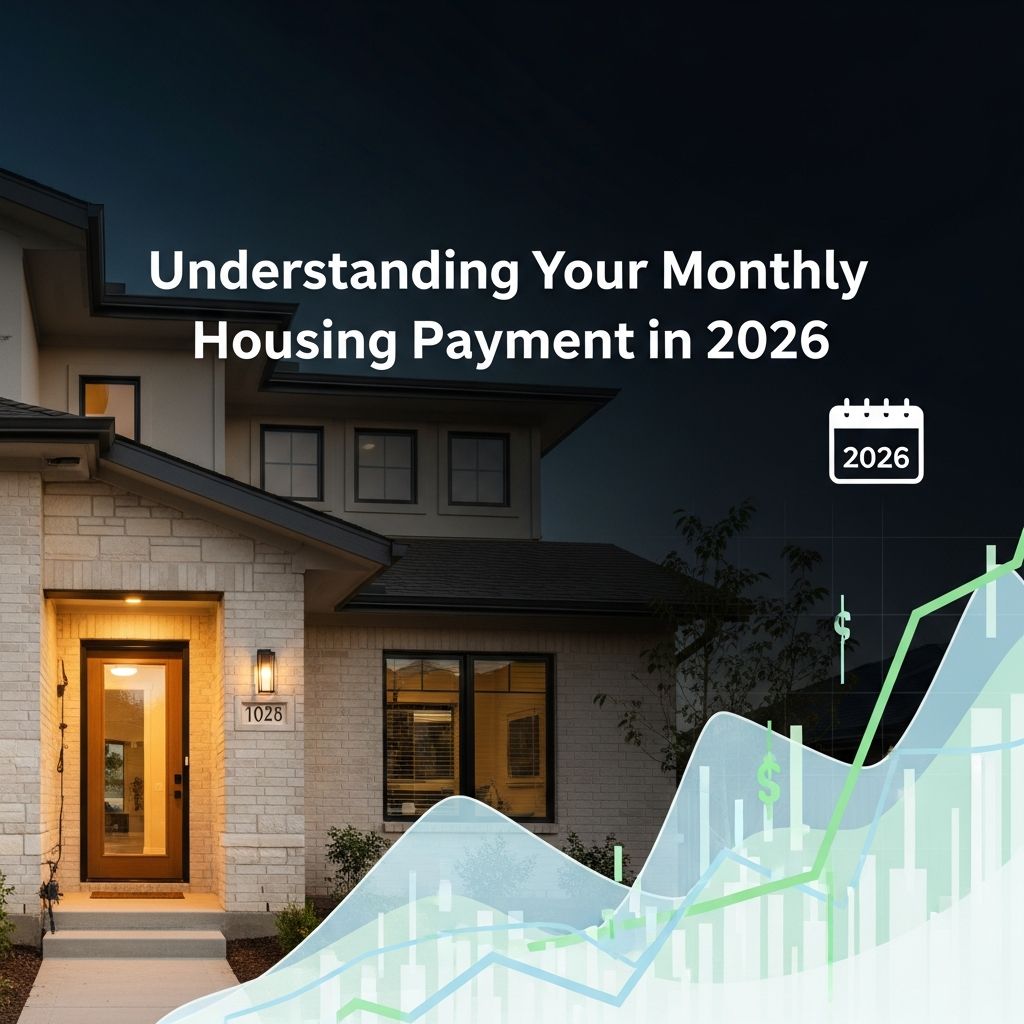
When you’re ready to purchase a home, understanding how your monthly mortgage payment is determined becomes essential. Your payment isn’t simply about the interest rate—it involves multiple layers of costs that together create your complete housing expense. This comprehensive guide breaks down the components of a mortgage payment and explains the factors that influence what you’ll actually pay each month.
The Core Components of Your Monthly Housing Costs
Your total monthly housing payment typically includes four distinct components, often abbreviated as PITI. Understanding each piece helps you budget accurately and avoid surprises after closing.
Principal and Interest (P&I) form the foundation of your mortgage payment. Principal is the amount you borrowed to purchase your home, while interest is what the lender charges for lending you that money. When you make a monthly payment on a 30-year mortgage, roughly the first 5 years sees most of your payment going toward interest rather than reducing what you owe. As you progress through your loan, this balance gradually shifts, with more of each payment going toward principal. For example, in the first year of a 30-year loan, you might pay $1,594 in interest while only $336 goes toward principal. By year 15, the split becomes more balanced at approximately $1,376 in interest and $554 in principal.
Property Taxes vary dramatically depending on where you live. These taxes fund local schools, infrastructure, and government services. Some states have extremely low effective property tax rates—Hawaii averages just 0.28%, while California’s Proposition 13 keeps rates at 0.71%. In contrast, Illinois imposes an average effective rate of 1.95%. This variation creates substantial payment differences. For instance, New Jersey residents pay approximately $743 monthly in property taxes on an average home, while Hawaii residents pay only $93 monthly for the same home value—a $650 difference.
Homeowners Insurance protects your property investment and is typically required by lenders. The national average homeowners insurance costs around $1,428 annually, or $119 monthly. However, this varies significantly by location and risk factors. Oklahoma has the highest average at $293 monthly, while Hawaii’s lowest is $39 monthly. Areas prone to natural disasters or considered high-risk may see rates exceeding $183 monthly.
HOA Fees and Other Costs may apply to your property, particularly in condominiums or planned communities. These fees cover common area maintenance and amenities but can add hundreds to your monthly obligations.
How Home Price Impacts Your Payment
The purchase price directly determines your loan amount, which significantly affects your monthly payment. Consider these scenarios with a 6.68% interest rate on a 30-year mortgage:
A $300,000 home purchase with 20% down ($60,000) requires borrowing $240,000. At current rates, this creates a monthly P&I payment of approximately $1,546. If you increase that home price to $350,000 with the same down payment percentage, you’re now borrowing $280,000, resulting in a monthly payment of around $1,803. That $50,000 difference in home price adds $258 to your monthly payment, or more than $3,000 annually.
The relationship between down payment percentage and monthly payment is equally important. A larger down payment reduces your loan amount proportionally. Putting down 20% versus 10% on a $400,000 home creates a significant difference in monthly obligations, as you’re borrowing $80,000 less.
The Geographic Reality: Where You Live Matters Most
Perhaps the most striking factor influencing mortgage payments is location. The same home price in different areas can result in vastly different monthly payments due to property taxes, insurance rates, and local market conditions.
San Diego County leads the nation with the highest average monthly payment at $4,701, translating to $56,412 annually for principal and interest alone. Compare this to Dallas County at $1,831 monthly, and you understand why many Californians relocating to Texas experience significant sticker shock. Even within California, variation is substantial—Los Angeles County averages $3,984 monthly while San Diego reaches $4,701, a $717 monthly difference within the same state.
California’s high average payment of $3,672 stems from several factors. Home prices exceed $750,000 on average, compared to the national average of approximately $420,000. Strong job markets, limited housing inventory, and desirable weather keep prices elevated. Additionally, California’s property tax structure under Proposition 13 remains uniquely favorable, helping keep that portion manageable despite high home values.
Conversely, more affordable markets like parts of Texas and the Midwest allow homebuyers to maintain significantly lower monthly obligations. This geographic arbitrage explains migration patterns where people relocate to areas offering better housing affordability.
Current Interest Rates and Their Trajectory
Interest rates fluctuate based on broader economic conditions, Federal Reserve policy, and inflation. As of February 2026, the 30-year fixed-rate mortgage averaged 6.11%, with the 15-year option at 5.50%. These rates represent a cooling from 2023 peaks but remain elevated compared to the pandemic-era lows of 2.65% seen in 2021.
Historically, from April 1971 through January 2026, 30-year fixed mortgages averaged 7.70%. The lowest point occurred in 2016 at 3.65%, when a $200,000 mortgage required only $915 monthly—$553 less than long-term averages. Even in 2020-2021, rates dipped to around 2.65%, offering unprecedented affordability.
Industry forecasts suggest rates will remain in the mid-6% range throughout 2026, with only modest downward pressure expected. The Fed may make adjustments based on inflation and economic conditions, but dramatic rate declines aren’t anticipated. This stability allows borrowers to plan with reasonable confidence in their payment estimates.
The Complete Picture: National Averages in Context
The average mortgage payment across the United States in 2025 was $2,329 monthly for principal and interest. This represents a 21% increase from 2023’s average of $1,924—meaning the typical borrower pays nearly $5,000 more annually for housing than just two years prior.
However, treating the national average as a target is misleading. The $2,329 figure represents a blend of expensive California markets and affordable Midwest housing. Your actual payment depends on three variables: where you buy, how much you borrow, and your loan terms.
A $2,000 monthly payment provides useful context for evaluating affordability. It sits slightly below the national average, making it reasonable for households with median incomes. Yet the same payment creates different burdens for different families—$2,000 monthly represents 34% of annual income for someone earning $70,000 but only 16% for someone earning $150,000. Financial advisors traditionally recommend housing payments not exceed 28-30% of gross household income.
Recent data shows modest improvements in this metric. The national median mortgage payment for conventional loan applicants was $2,025 in December 2025, down from $2,128 in December 2024. This decline of $102 year-over-year, combined with potential income growth, suggests the typical mortgage payment may account for less than 30% of household income for the first time since 2022.
Comparing Loan Terms and Their Long-Term Cost
The choice between a 30-year and 15-year mortgage dramatically affects both monthly payment and total interest paid. Consider a $400,000 loan at 6.75% interest on a 30-year term. Your monthly P&I payment reaches approximately $2,675, but you’ll pay roughly $533,981 in total interest over the life of the loan.
Taking that same $400,000 at a lower 15-year rate of 5.75% requires a higher monthly payment of approximately $3,170, but total interest drops to $207,577—a savings of more than $326,000. The 15-year option requires stronger monthly cash flow but builds equity faster and costs substantially less overall.
Tools for Calculating Your Specific Payment
Understanding the math behind mortgage calculations empowers you to verify quotes and estimate payments accurately. The standard mortgage payment formula uses these variables:
- Loan amount (principal)
- Interest rate (expressed as a monthly decimal)
- Number of payments (loan term in years × 12)
For a $280,000 loan at 6.68% annual interest over 30 years, the monthly rate becomes 0.00557 (6.68% divided by 12), and total payments equal 360. Using these inputs with the standard amortization formula yields the exact monthly P&I payment.
Multiple online calculators simplify this process, allowing you to adjust variables and immediately see payment impacts. However, remember that calculators show only P&I—your complete monthly obligation includes property taxes, insurance, and potentially HOA fees.
Making Your Payment Work for Your Budget
Before committing to a mortgage, ensure the total payment fits your financial situation. Calculate your complete housing cost by adding P&I, estimated property taxes for your specific location, homeowners insurance quotes, and any HOA fees. Divide this by your gross monthly income to determine the percentage of earnings dedicated to housing.
Compare this percentage against your other financial obligations. If your housing payment plus car loans, student loans, and other debts exceed 43% of gross income, you may struggle with approval or face cash flow challenges. Building a safety buffer ensures you can handle unexpected expenses without sacrificing other financial goals.
Consider also your down payment strategy. While 20% down eliminates private mortgage insurance (PMI), putting down less may still make sense if it preserves emergency savings or allows investment of preserved capital elsewhere. Run scenarios with different down payments to understand the tradeoffs.
References
- Average Mortgage Payment in 2026: What Home Buyers Are Really Paying — Amerisave. February 2026. https://www.amerisave.com/learn/average-mortgage-payment-in-what-home-buyers-are-really-paying
- Mortgage Rates – Freddie Mac Primary Mortgage Market Survey — Freddie Mac. February 5, 2026. https://www.freddiemac.com/pmms
- Mortgage Rate History Chart & Trends Over Time 2026 — The Mortgage Reports. February 2026. https://themortgagereports.com/61853/30-year-mortgage-rates-chart
- Housing Market Pulse for Lenders in 2026 — Radian. January 2026. https://www.radian.com/insights/Housing-Market-Pulse-for-Lenders-in-2026
- Median Mortgage Payments Decline, Driving Modest Affordability Gains — National Mortgage Professional. January 2026. https://nationalmortgageprofessional.com/news/median-mortgage-payments-decline-driving-modest-affordability-
- 2026 Mortgage Industry Outlook: Key Trends Impacting Home Ownership — First National Bank of Omaha. January 2026. https://www.fnbo.com/insights/mortgage/2026/2026-mortgage-industry-outlook-key-trends-impacting-home-ownership
- Mortgage Application Payments Decreased in December — Mortgage Bankers Association. January 29, 2026. https://www.mba.org/news-and-research/newsroom/news/2026/01/29/mortgage-application-payments-decreased-in-december
Similar Articles








Read full bio of Sneha Tete