Money Supply: Definition, Types, and Economic Impact
Understanding money supply: Explore definitions, measurement types, and central bank control mechanisms.

What Is Money Supply?
In macroeconomics, money supply (also called money stock) refers to the total volume of money held by the public at a particular point in time. Money supply is a critical indicator that central banks monitor and attempt to control through various monetary policy tools. Understanding money supply is essential for comprehending how economies function, inflation develops, and interest rates fluctuate.
The money supply encompasses more than just physical currency. Standard measures of money supply typically include currency in circulation—physical cash such as banknotes and coins—along with demand deposits, which are the easily accessible funds that depositors maintain at financial institutions. In modern economies, bank deposits actually represent the largest component of money supply, while physical currency issued by central banks comprises only a small fraction of the total.
Understanding the Components of Money Supply
Money supply is not a single, uniform measure but rather a spectrum of monetary aggregates, each defined to capture different aspects of the money available in an economy. These aggregates range from the narrowest definitions focusing solely on the most liquid assets to broader measures encompassing various forms of savings and investment vehicles.
Currency and Bank Deposits
The foundation of money supply consists of two primary components: currency and bank deposits. Currency refers to physical money—banknotes and coins—that circulates within the public and commercial sectors. Bank deposits are funds held in checking accounts, savings accounts, and other deposit accounts at financial institutions. These deposits are considered part of the money supply because they can be readily accessed and spent.
Interestingly, in developed economies, bank deposits far outweigh physical currency. For instance, in the United Kingdom as of 2010, the total money supply (M4) measured £2.2 trillion, while actual notes and coins in circulation totaled only £47 billion—representing just 2.1% of the total money supply. This demonstrates that the modern economy functions primarily through digital money stored in bank accounts rather than physical cash.
Monetary Aggregates: Different Measures of Money Supply
Central banks and economists use several standardized measures to define and track money supply. Each measure includes different types of assets, progressing from the most liquid to less liquid forms of money. Understanding these aggregates is crucial for analyzing economic conditions and monetary policy effectiveness.
M0: The Monetary Base
M0, often called the monetary base or base money, represents the most fundamental measure of money supply. It includes all physical currency in circulation and the reserves that commercial banks hold at the central bank. M0 is essentially the money that the central bank has directly created and controls.
M1: Transaction Money
M1 encompasses M0 plus demand deposits and other highly liquid assets. Specifically, M1 includes:
- Cash and coins outside the private banking system
- Demand deposits (checking accounts)
- Traveler’s checks
- Other checkable deposits
- Most savings accounts
M1 is considered the narrowest measure of money that remains relevant for transaction purposes. These assets can be spent immediately without any restrictions or time delays.
M2: Near Money
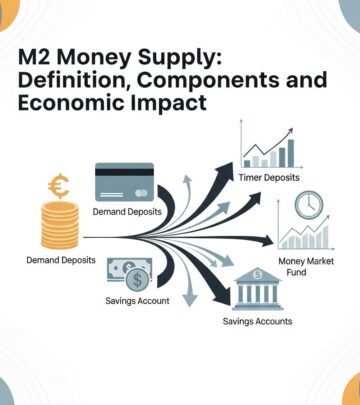
M2 includes all components of M1 plus additional less-liquid assets that can be converted to transaction money relatively quickly. M2 encompasses:
- All M1 components
- Money market accounts
- Retail money market mutual funds
- Small-denomination time deposits (certificates of deposit under $100,000)
M2 represents a broader picture of the money supply by including assets that are easily convertible to cash but may require a short waiting period or minor transaction costs.
M3: Broad Money
M3 represents the broadest concept of money supply in many economies, encompassing M1 plus several additional components. M3 includes time deposits with the banking system and is calculated as net bank credit to the government plus bank credit to the commercial sector, plus the net foreign exchange assets of the banking sector and the government’s currency liabilities to the public, less the net non-monetary liabilities of the banking sector. The scope of M3 varies significantly by country and economic context.
M4: The Widest Measure
M4 is the broadest measure of money supply used in some economies, particularly the United Kingdom. M4 includes:
- Cash outside banks (in circulation with the public and non-bank firms)
- Private-sector retail bank and building society deposits
- Private-sector wholesale bank and building society deposits
- Certificates of deposit
M4 captures virtually all forms of money and near-money in the economy, providing the most comprehensive picture of monetary liquidity.
How Money Supply Is Created
A fundamental principle of modern economies is that commercial banks create money whenever they issue loans. This process occurs because when a bank provides a loan, it simultaneously creates a matching deposit in the borrower’s account. The borrower now has newly created money to spend, expanding the total money supply. Conversely, when borrowers repay their loans, money is destroyed as the principal is removed from the borrower’s account.
This mechanism means that the money supply depends heavily on two factors: the decisions of commercial banks to supply loans and the public’s demand for currency and bank deposits. These decisions are not made in isolation but are heavily influenced by the monetary policy decisions of central banks, particularly their setting of interest rates and their management of the monetary base.
Central Bank Control of Money Supply
Central banks exercise significant control over the money supply through various monetary policy tools. These mechanisms allow central banks to influence economic growth, inflation, and employment levels.
Open Market Operations
One primary method central banks use to control money supply is open market operations (OMOs). Through OMOs, central banks can increase or decrease the money supply by trading government securities.
Expanding Money Supply: When a central bank wants to increase the money supply, it purchases government securities such as government bonds or treasury bills from commercial banks and the public. These purchases inject liquidity into the banking system by converting illiquid securities into liquid deposits at the central bank. This increased demand for securities causes their prices to rise and interest rates to fall, encouraging greater borrowing and spending.
Contracting Money Supply: Conversely, when a central bank wants to tighten the money supply, it sells securities on the open market. This action withdraws liquid funds from the banking system. As the supply of securities increases, their prices fall and interest rates rise, which discourages borrowing and reduces the money supply.
Reserve Requirements
Central banks can also influence money supply by adjusting reserve requirements—the percentage of deposits that commercial banks must hold in reserve rather than lend out. Lowering reserve requirements allows banks to lend more, expanding the money supply, while raising reserve requirements has the opposite effect.
Discount Rate Adjustments
The discount rate is the interest rate at which central banks lend to commercial banks. Lowering the discount rate makes borrowing cheaper for banks, encouraging them to borrow more and lend more to the public, thereby increasing the money supply. Raising the discount rate has the reverse effect.
The Money Multiplier Effect
Economists use the concept of the money multiplier to understand the relationship between the monetary base and the total money supply. In some economics textbooks, the supply-demand equilibrium in the markets for money and reserves is represented by a simplified money multiplier relationship between the monetary base of the central bank and the resulting money supply including commercial bank deposits.
The money multiplier illustrates how an initial injection of money into the economy can lead to a larger ultimate increase in the money supply through the process of banks lending and re-lending deposits. However, this is a simplified model that disregards several other factors determining commercial banks’ reserve-to-deposit ratios and the public’s money demand.
The Equation of Exchange
The relationship between money supply and the broader economy can be expressed through the equation of exchange, a fundamental concept in monetary economics. This equation is expressed as:
M × V = P × Q
Where:
- M is the total dollars in the nation’s money supply
- V is the velocity of money (the number of times per year each dollar is spent)
- P is the average price of all goods and services sold during the year
- Q is the quantity of assets, goods, and services sold during the year
This equation demonstrates that the money supply, combined with how rapidly it circulates through the economy, equals the total value of all economic transactions.
Bank Reserves and Money Creation
Understanding bank reserves is essential to grasping how money supply works in practice. In the United States, a bank’s reserves consist of U.S. currency held by the bank (vault cash) plus the bank’s balances in Federal Reserve accounts. For monetary purposes, vault cash and Federal Reserve balances are interchangeable, as both represent obligations of the Federal Reserve.
Reserves come from various sources, including the federal funds market, deposits by the public, and borrowing from the Federal Reserve itself. As of April 2013, the monetary base stood at $3 trillion while M2, considered the broadest measure of money supply, was $10.5 trillion. This substantial difference illustrates how the money multiplier effect magnifies the initial monetary base into a much larger total money supply.
Factors Influencing Money Supply Changes
Money supply is not static but changes constantly based on several interconnected factors. The public’s demand for currency and bank deposits, commercial banks’ willingness to supply loans, and central banks’ monetary policy decisions all influence money supply dynamics. These complex interactions mean that money supply ultimately results from decisions made across three levels: non-banks (the general public and businesses), commercial banks, and central banks working together in a coordinated system.
Frequently Asked Questions
Q: Why do central banks care about money supply?
A: Central banks monitor money supply because it directly affects inflation, interest rates, and economic growth. By controlling money supply, central banks can influence economic conditions and pursue their mandates of price stability and full employment.
Q: What is the difference between M1 and M2?
A: M1 includes only the most liquid forms of money—cash and checking accounts—while M2 includes M1 plus less liquid assets like savings accounts, money market accounts, and small-denomination time deposits.
Q: How do banks create money?
A: When a commercial bank makes a loan, it creates both the loan and a matching deposit in the borrower’s account. This newly created deposit represents new money in the economy, expanding the total money supply.
Q: What happens when the central bank increases the money supply?
A: An increase in money supply typically lowers interest rates, making borrowing cheaper and encouraging spending and investment. However, if excessive, it can lead to inflation.
Q: Why is physical currency such a small part of the total money supply?
A: In modern economies, most transactions occur electronically through bank transfers and card payments. Physical currency is mainly used for small, everyday transactions, while the vast majority of the money supply exists as digital bank deposits.
References
- Money Supply — Wikipedia. Accessed November 2025. https://en.wikipedia.org/wiki/Money_supply
Similar Articles








Read full bio of Sneha Tete