Money Market vs Savings Accounts
Discover key differences between money market and savings accounts to optimize your savings strategy with better rates and access.
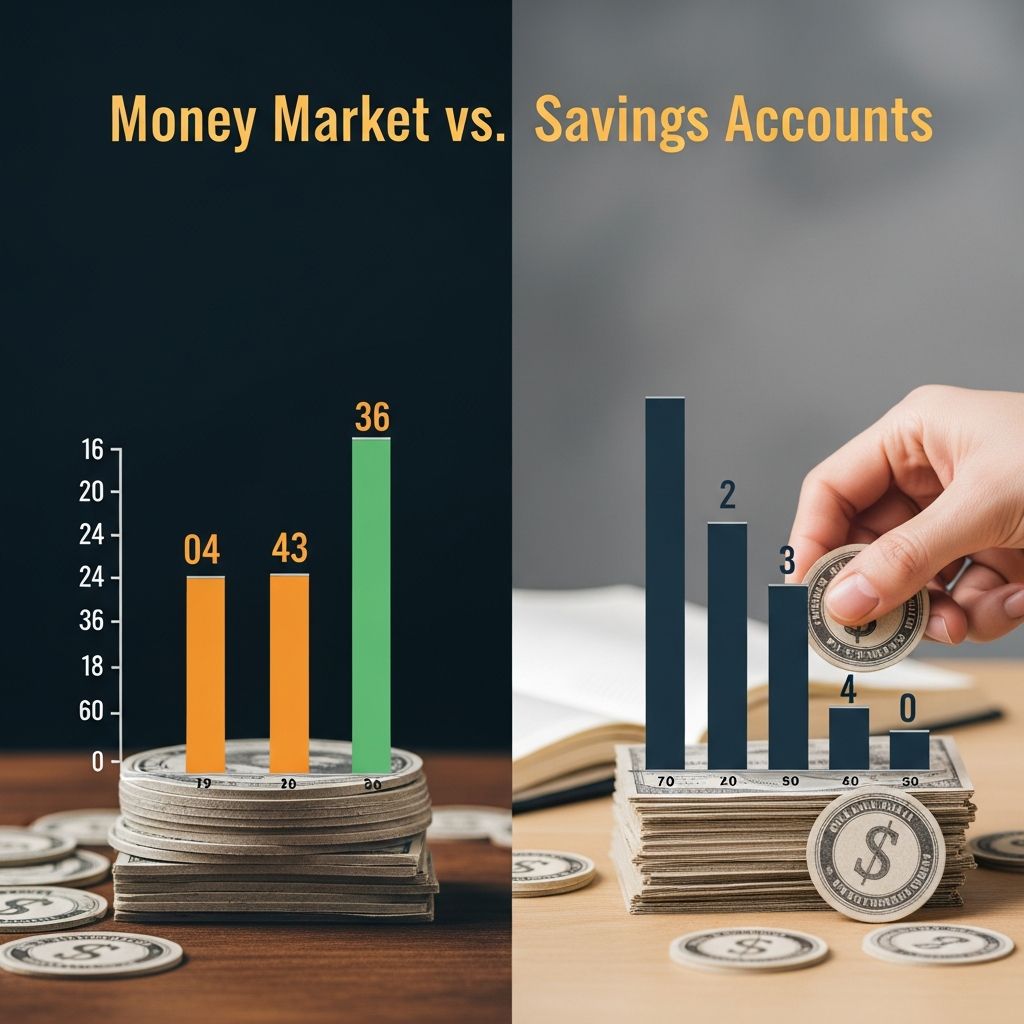
Money market accounts (MMAs) and savings accounts both help grow your money safely, but they differ in access, rates, and requirements. MMAs blend savings growth with limited checking features, while savings accounts prioritize simplicity and often higher yields for pure saving.
Understanding Savings Accounts
Savings accounts provide a secure spot for cash reserves, earning interest over time. Traditional ones from brick-and-mortar banks yield low rates around 0.01% APY, but online high-yield versions offer 4.00%-4.20% APY as of recent data. They suit emergency funds or goal-based saving without temptation to spend.
- Easy online access for deposits and transfers.
- No check-writing or debit cards to avoid routine spending.
- Low or zero minimum balances at many online banks.
Post-2020 regulatory changes removed federal transaction limits, though banks may impose their own. Interest compounds daily or monthly, paid out regularly.
Exploring Money Market Accounts
MMAs function like enhanced savings accounts, investing deposits in short-term securities for competitive yields. They often match high-yield savings rates (4.00%-4.20% APY) but require higher balances for top tiers. Key perks include limited check-writing (typically 3-6 per month) and debit cards at select institutions.
- Higher minimums, like $1,000-$10,000, to unlock best rates.
- ATM access and occasional bill payments without transfers.
- Ideal for buffers between checking and long-term savings.
Both account types remain low-risk due to FDIC or NCUA insurance up to $250,000 per depositor per institution.
Feature Comparison Table
| Feature | Savings Account | Money Market Account |
|---|---|---|
| APY Range | 4.00%-4.20% (high-yield); 0.01% (traditional) | 4.00%-4.20% (competitive); 0.44% average |
| Check-Writing | No | Limited (3-6/month) |
| Debit Card | No | Often available |
| Minimum Balance | $0 or low | $1,000-$10,000 |
| Monthly Fees | $0 online; $5-12 traditional | $0 online; balance-based |
| FDIC Insured | Yes | Yes |
| Best Use | Pure saving/emergencies | Flexible access |
This table highlights why MMAs appeal to those needing occasional access, while savings excel in ease.
Interest Rates and Earnings Potential
Current high-yield savings lead with 4.00%-4.20% APY, rivaled by top MMAs. Traditional MMAs average 0.44% APY nationally, per FDIC data. Banks invest MMA funds in low-risk instruments like CDs or Treasury bills, enabling slightly elevated rates. Rates fluctuate with Fed policy; shop online banks for best yields.
Example: $10,000 at 4.25% APY yields about $425 annually, compounded monthly. MMAs may tier rates—higher balances earn more.
Fees, Minimums, and Accessibility
Savings accounts minimize fees, especially online ($0 common), but traditional ones charge $5-12 monthly if balances dip. MMAs often waive fees above minimums but penalize shortfalls. Transaction rules: up to 6 convenient transfers monthly (e.g., electronic), unlimited in-person/ATM.
Online platforms like Ally or Capital One offer no-fee high-yield options. MMAs from credit unions may have lower thresholds.
Which Account Fits Your Needs?
Opt for savings if simplicity rules: no transaction lures, top rates, zero minimums. Perfect for untouched emergency pots or vacation funds. Choose MMAs for hybrid use—write checks for insurance or taxes, earn solid interest.
Three-step decision guide:
- Need checks/debit? MMA.
- Low balance (<$5,000)? Savings.
- Pure saving vs. flexible buffer? Savings or MMA accordingly.
Common Pitfalls to Avoid
Don’t chase marginal rate differences—focus on net yields after fees. Verify FDIC status via FDIC BankFind. Confuse MMAs with money market funds (no FDIC, brokerage-based). Exceed transaction limits to dodge fees.
Real-World Use Cases
Emergency Fund: High-yield savings—separate from spending, max APY.
Home Down Payment: Savings for discipline.
Quarterly Bills: MMA for direct payments.
Business Float: MMA as checking alternative.
Couples often pair both: savings for goals, MMA for liquidity.
Current Market Trends (2026)
As of 2026, online rates hover 4.00%-4.25% amid stable Fed policy. Credit unions compete via lower fees. Inflation erodes low-yield traditional accounts—migrate to high-yield options.
Frequently Asked Questions
Are MMAs safer than savings?
Equally safe with FDIC/NCUA coverage up to $250,000.
Can I lose money in these accounts?
No principal risk, unlike stocks or funds.
Do rates change often?
Yes, variable with market conditions; MMAs adjust daily-ish.
Best high-yield banks?
Compare Ally, Marcus, Discover for top APYs.
Tax implications?
Interest is taxable; municipal MMAs/funds may offer exemptions.
Steps to Switch or Open
- Assess balance and needs.
- Research rates via Bankrate or NerdWallet.
- Verify FDIC/NCUA.
- Open online (10 mins).
- Transfer funds, set autopay.
Monitor quarterly for better deals.
References
- Money Market Account Vs. Savings Account: What’s The Difference? — Bankrate. 2024. https://www.bankrate.com/banking/money-market-account-vs-savings-account/
- Money market vs. savings account: What’s the difference? — Fidelity. 2024. https://www.fidelity.com/learning-center/investment-products/money-market-vs-savings-account
- Money Market Account vs. Savings Account: Key Differences — CCU. 2024. https://www.ccu.com/learn/banking-basics/money-market-account-vs-savings-account/
- Money Market vs Savings Account: What’s The Difference? — Citi. 2024. https://www.citi.com/banking/personal-banking-guide/basic-finance/money-market-account-vs-savings-account
- Money Market Vs Savings Account — Santander Bank. 2024. https://www.santanderbank.com/personal/resources/checking-savings/money-market-vs-savings
Similar Articles








Read full bio of Sneha Tete