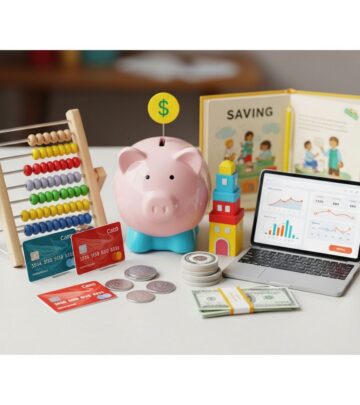
Money Lessons For Kids: 5 Practical Ways To Save
Teach your children smart money habits early to build lifelong financial success and security.

Teaching children about money from an early age sets the foundation for a lifetime of financial responsibility and success. A 2019 survey by The Penny Hoarder revealed that only 13% of Americans discussed their family’s finances growing up, and one-third never talked about personal finance topics at all. Shockingly, those without early financial education are more likely to have no savings (40% vs. 17%), earn lower incomes (31% under $50,000 vs. 18%), and lack financial goals (nearly 40% vs. 82%). These statistics underscore the critical need for parents to introduce money concepts early, using simple, engaging methods that make learning fun and relatable.
In today’s digital world, where cash is increasingly rare, hands-on tools like piggy banks remain powerful for imparting tangible money lessons. This article explores proven strategies to foster financial literacy in kids, drawing from expert advice and survey insights. By incorporating everyday experiences, goal-setting, and positive attitudes toward money, parents can equip their children with skills to thrive financially.
Why Early Financial Education Matters
Financial literacy—or the ability to understand and manage money effectively—doesn’t come naturally. The Penny Hoarder’s survey of over 1,500 U.S. adults showed stark differences based on childhood exposure to money talks. Among key findings:
- 32%-36% of Americans never discussed personal finance topics growing up.
- Less than half learned about saving’s importance.
- Only 20% heard about credit scores, and 28% about smart shopping.
- Those with early discussions are far more likely to budget (60% vs. fewer without) and set goals like debt payoff (39% top goal).
Certified financial planners emphasize starting young because attitudes toward money form early. Kids who see parents excited about saving develop positive outlooks, leading to better habits like using spreadsheets (30% of budgeters) or apps (10%). Without this, adults struggle with income, savings, and goals, perpetuating cycles of financial stress.
Tip 1: Use a Piggy Bank to Save
The simplest yet most effective tool for young children is a piggy bank. It doesn’t need a specific goal initially; the thrill of watching coins accumulate builds the saving habit. Place it visibly on a shelf or dresser, and encourage deposits from allowances, gifts, or chores. For toddlers, the physical act of dropping money in reinforces delayed gratification—a core financial skill.
Expand this by labeling sections: one for spending, saving, and giving. This introduces the 50/30/20 rule adapted for kids (50% spend, 30% save, 20% charity). Parents report kids as young as 4 understanding ‘money grows when you save it.’ Pair with matching contributions: for every dollar saved, add one from parents to amplify excitement.
Why piggy banks over apps? Tangibility. Digital balances feel abstract; coins clink and stack, making savings real. Surveys confirm hands-on methods stick better, reducing the 40% no-savings rate among underserved groups.
Tip 2: Play Money for Goals and Experiences
If real cash feels risky, use play money—printed dollars or Monopoly bills work perfectly. Assign values to chores: $1 for making bed, $2 for dishes. Set a goal chart: $3 for movie night choice, $5 for ice cream. This gamifies budgeting without financial loss.
For school-age kids, create a ‘store’ at home with toys priced in play dollars. They earn, save, and ‘buy,’ learning opportunity cost—what they skip to afford something else. Tie to real rewards like picking family dinner, blending fun with lessons.
Play money bridges to real finance. Transition by exchanging earned play bucks for actual allowance, showing value equivalence. This method engages math-loving kids, turning abstract concepts into concrete play, much like video games but with real-world ties.
Tip 3: Share Real-Life Shopping Experiences
Grocery runs or online carts are goldmines for lessons. At checkout, ask: ‘How much is that? Can we afford it?’ Point out prices, totals, and change. For older kids, hand them the list and budget: ‘Stay under $50.’
Discuss choices: generic vs. brand (save 20-30%), needs vs. wants. Online? Show cart totals rising, abandoned for savings. These moments demystify transactions, countering digital payment invisibility.
Pro tip: Pre-shop planning. Review sales flyers together, clip coupons. Kids see strategy in action, understanding budgeting beats impulse. Surveys show only 28% learned smart shopping young—fill that gap hands-on.
Tip 4: Share Your Family’s Savings Goals
Open up about big goals: college funds, emergency savings. Show statements (redact sensitive info): ‘See how $100 grew to $110 with interest?’ Let them track quarterly. This demystifies long-term saving.
For teens, discuss 529 plans or Roth IRAs simply: ‘Money for your future house.’ Involve in deposits, celebrating growth. Kids journey alongside, witnessing compounding magic—key since few families shared finances (13%).
Age-adapt: Little ones draw goal posters; tweens use apps to log progress. Result? They internalize purpose, boosting their own goal-setting (82% with early talks have goals).
Tip 5: Set Shared Family Goals
Family vacations, new car, or holiday fund—make it collaborative. Clip coupons together; track in a jar. Weekly check-ins: ‘We’re 20% to Disney!’ Kids contribute chores or ideas, seeing effort pay off.
This builds teamwork and resilience. If goals slip, discuss adjustments transparently—no shame, just learning. Incorporate budgeting tools: jars for vacation categories (flights, hotel). Ties to survey’s budgeting stats—30% use spreadsheets, scalable for kids.
Additional Strategies for Money-Savvy Kids
Beyond basics, leverage holidays: Cash gifts? Divide into jars. Chores-for-pay teaches earning. Board games like Monopoly simulate investing, debts.
| Age Group | Best Activities | Key Lesson |
|---|---|---|
| 3-5 years | Piggy bank, play money | Saving excitement |
| 6-9 years | Shopping trips, goal charts | Budgeting basics |
| 10-13 years | Family accounts, coupons | Long-term planning |
| 14+ years | Apps, part-time jobs | Investing, credit |
Talk like adults: Positive, excited tones shape attitudes. Avoid down-talk; explain real stakes.
Frequently Asked Questions (FAQs)
What age to start money lessons?
Age 3-4 with piggy banks; build complexity by 6-7 with goals and shopping.
Real money or play money first?
Play for safety, transition to real for tangibility. Both effective per experts.
How to handle kids wanting everything?
Use jars: limit spending funds. Teach waiting builds more.
Digital tools for older kids?
Apps like Greenlight after basics; prioritize cash lessons first.
Proof it works?
Survey: Early learners have 2x savings, higher income, goals.
Implement these tips consistently. Financial freedom starts at home—your child’s future self thanks you.
References
- Financial Literacy For Kids in 5 Easy Steps — The Penny Hoarder (YouTube). 2019-04-23. https://www.youtube.com/watch?v=oDKkT8C_z7c
- The Penny Hoarder’s Survey Finds 1 Out of 3 Americans Who Did Not Have Early Financial Education Earn Less Money — GlobeNewswire / The Penny Hoarder. 2019-04-23. https://www.globenewswire.com/news-release/2019/04/23/1808241/0/en/The-Penny-Hoarder-s-Survey-Finds-1-Out-of-3-Americans-Who-Did-Not-Have-Early-Financial-Education-Earn-Less-Money.html
- Family Budgeting Strategy for Youth — The Penny Hoarder Community. Undated (post-2019). https://community.thepennyhoarder.com/t/family-budgeting-strategy-for-youth/982
- Why Cash and Piggy Banks Offer the Best Money Lessons for Kids — The Penny Hoarder. Undated (refs 2019 survey). https://www.thepennyhoarder.com/budgeting/money-lessons-for-kids/
- What Should You Do When Your Kids Get Cash Gifts for Christmas? — Citizens National Bank (excerpt Penny Hoarder). 2022-12-06. https://www.cnbohio.com/tag/student-checking/
Similar Articles








Read full bio of Sneha Tete