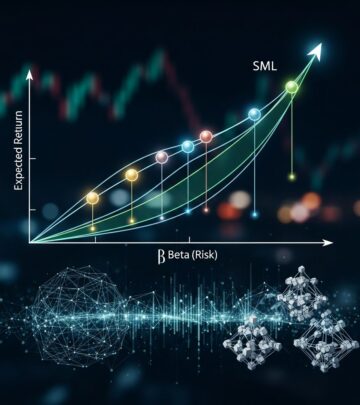
Modern Portfolio Theory: Risk and Return Optimization
Master diversification and optimize your portfolio using Modern Portfolio Theory principles.

Understanding Modern Portfolio Theory
Modern Portfolio Theory (MPT), also known as mean-variance analysis, is a mathematical framework that fundamentally changed how investors approach portfolio construction and risk management. At its core, MPT demonstrates that the expected return of any given portfolio is the average of the expected returns of the individual assets within that portfolio. However, the theory’s true power lies in its ability to show how diversification can limit the overall risk for an investment portfolio, allowing investors to achieve better risk-adjusted returns than they could by investing in individual securities alone.
Since its introduction in 1952, Modern Portfolio Theory has become one of the most popular and influential investing strategies among financial advisors, investment fund managers, and individual investors worldwide. The theory revolutionized investment practice by providing the first rigorous mathematical framework for quantifying the best method of building an investment portfolio based on a given level of risk. This shift from intuitive investing to evidence-based portfolio construction marked a turning point in financial history.
The Origins and Evolution of Modern Portfolio Theory
Modern Portfolio Theory was pioneered by American economist Harry Markowitz, who published his groundbreaking work in the Journal of Finance in 1952. While Markowitz was not the first person to recognize the importance of diversification when investing, his theory was revolutionary because it was the first to quantify mathematically the optimal method for building an investment portfolio based on a specific risk level. His pioneering work transformed investment management from an art into a science.
The significance of Markowitz’s contribution was widely recognized by the academic and investment communities. For his efforts—which were quickly adopted and applied by economists and investment professionals throughout the world—he was awarded the Nobel Prize for Economics in 1990. This prestigious recognition underscored the fundamental importance of his theory and its lasting impact on modern finance.
Core Principles of Modern Portfolio Theory
Risk and Expected Return
Modern Portfolio Theory operates on several fundamental assumptions about investor behavior and market dynamics. The theory assumes that investors are risk averse, meaning that when presented with two portfolios offering the same expected return, investors will consistently prefer the less risky option. This preference for safety, all else being equal, reflects the rational economic principle that investors demand compensation for taking on additional risk.
Under this framework, an investor will only take on increased risk if compensated by higher expected returns, and conversely, an investor who wants higher expected returns must accept more risk. However, it’s important to recognize that the exact trade-off between risk and return varies among individual investors based on their personal risk aversion characteristics and financial circumstances. A young professional just beginning their investment journey may have a much higher risk tolerance than someone approaching retirement, for example.
The Fundamental Insight
A critical insight of Modern Portfolio Theory is that an asset’s risk and return should not be assessed in isolation, but rather by how it contributes to the portfolio’s overall risk and return profile. This represents a paradigm shift from traditional analysis. Rather than simply selecting the “best” individual stocks, investors should focus on how different assets interact within their complete portfolio. An asset that appears risky on its own might actually reduce overall portfolio risk if it moves in the opposite direction of existing holdings.
Practical Application for Investors
Asset Risk Categories
To help investors understand their investment options, assets are commonly grouped into three primary risk categories:
- High-risk assets: Options, futures, and collectibles—these investments offer the potential for substantial gains but carry significant downside risk
- Medium-risk assets: Mutual funds and stocks—these balance growth potential with moderate volatility
- Low-risk assets: Government bonds, real estate, certificates of deposit (CDs), and money market accounts—these prioritize capital preservation and steady income
Constructing Your Portfolio
Modern Portfolio Theory provides specific formulas and methodologies for constructing portfolios that maximize returns at a given risk level. Consider a practical example: suppose an individual owns stock in two companies—Company A and Company B. If Company A’s stock provides an annual return of 5% while Company B averages 15%, and the investor seeks a 10% annual return, they would need to invest approximately evenly in both companies. If instead the investor seeks a 12% return, they would need to increase their Company B shares while lowering their Company A position. MPT provides the mathematical tools to calculate these precise allocations.
The Efficient Frontier Concept
Understanding Optimal Portfolios
One of the most important concepts in Modern Portfolio Theory is the efficient frontier. The efficient frontier represents a set of optimal portfolios that offers the highest expected return for a defined level of risk or, conversely, the lowest risk for a given level of expected return. This concept is visualized in a two-dimensional chart where the vertical axis represents expected rate of return and the horizontal axis represents risk tolerance, typically measured by standard deviation or variance.
The mathematical representation of this concept involves plotting every possible combination of risky assets in a “return-standard deviation space.” The collection of all possible portfolios defines a region in this space, where the left boundary forms a hyperbolic curve. The upper portion of this hyperbolic boundary is the efficient frontier, sometimes called “the Markowitz bullet.”
Sub-Optimal Portfolio Identification
Understanding the efficient frontier allows investors to identify sub-optimal portfolios. Portfolios that lie below the efficient frontier curve are sub-optimal because they fail to provide sufficient return for their level of risk. For the same degree of risk, investors could achieve greater returns with a portfolio closer to the frontier. Similarly, portfolios that cluster to the right of the efficient frontier are also sub-optimal because they carry a higher level of risk for their defined rate of return.
Consider Chris’s investment situation: he currently owns Portfolio A, which generates a combined yield of 8% but carries substantial risk. However, according to the efficient frontier analysis, Chris could achieve the same 8% return with Portfolio B, which has considerably less risk. By understanding this principle, investors can make more informed decisions about repositioning their holdings.
Advanced Concepts in Modern Portfolio Theory
The Two Mutual Fund Theorem
An elegant result of MPT analysis is the two mutual fund theorem, which states that any portfolio on the efficient frontier can be generated by holding a combination of any two given portfolios also on the frontier. This theorem has profound practical implications, suggesting that investors can achieve any desired efficient portfolio by combining holdings of just two mutual funds that are themselves on the efficient frontier.
Risk-Free Assets and Portfolio Construction
The introduction of risk-free assets into the portfolio construction framework further enhances the range of risk-expected return combinations available to investors. A risk-free asset, such as U.S. Treasury securities, has no variance in returns and provides a guaranteed rate of return. In this enhanced model, an investor can achieve a linear efficient frontier by combining allocations of a risk-free asset with a specific tangency portfolio of risky assets.
This tangency point represents the optimal combination of risky assets. Portfolios below this optimal risky portfolio on the efficient frontier combine both the risk-free asset and the tangency portfolio. Points beyond the tangency point represent leveraged portfolios where investors borrow at the risk-free rate to invest more than 100% of their capital in the risky asset portfolio.
Limitations and Practical Considerations
Diversification Complexity
While Modern Portfolio Theory emphasizes the importance of diversification, investors should understand that true diversification is more complex than simply owning funds from two separate companies. If you own two exchange-traded funds from two companies operating in highly correlated industries, they may have the same level of risk as owning funds from only a single company. This demonstrates the importance of correlation analysis in effective portfolio construction.
The correlation between assets—how they move in relation to each other—is crucial to understanding portfolio risk. Assets that are negatively correlated or uncorrelated provide better diversification benefits than those that move together. Investors must carefully analyze not just the individual assets but also their relationships within the broader portfolio context.
Modern Portfolio Theory in Practice
Portfolio Construction Strategies
Financial advisors using Modern Portfolio Theory typically follow a systematic process: First, they assess the desired level of risk an investor is willing to take. This assessment considers factors including age, investment timeline, financial goals, and personal circumstances. A young investor saving for retirement decades in the future can typically tolerate more volatility than someone needing to access funds in the near term.
Second, advisors identify a basket of securities that positions the portfolio as close as possible to the efficient frontier for that specific risk level. This requires analyzing the expected returns, volatility, and correlations of various assets to determine optimal allocations. Third, advisors implement the portfolio and establish a monitoring and rebalancing schedule to ensure the portfolio remains aligned with the investor’s risk profile as market conditions and individual circumstances change.
Frequently Asked Questions
Q: What is the main benefit of Modern Portfolio Theory?
A: The primary benefit is that MPT demonstrates how diversification can reduce overall portfolio risk while maintaining or improving expected returns. By understanding how different assets interact, investors can construct portfolios that are more efficient than simply picking individual investments.
Q: How does the efficient frontier help investors?
A: The efficient frontier helps investors identify the optimal risk-return combinations available to them. It allows investors to see which portfolios are sub-optimal and should be avoided, and helps financial advisors construct portfolios that maximize returns for a given risk level.
Q: Is correlation important in Modern Portfolio Theory?
A: Yes, correlation is crucial. The correlation between assets determines how well they diversify together. Assets with low or negative correlation provide better diversification benefits than highly correlated assets from similar industries.
Q: How does Modern Portfolio Theory account for risk-free assets?
A: MPT incorporates risk-free assets like U.S. Treasury securities as a portfolio component. The addition of risk-free assets expands the range of available portfolios and allows investors to create a linear efficient frontier by combining the risk-free asset with an optimal risky asset portfolio.
Q: Can individual investors use Modern Portfolio Theory?
A: Yes, individual investors can apply MPT principles to their portfolio construction. Many robo-advisors and portfolio management tools now use MPT algorithms to help individual investors build diversified, optimized portfolios aligned with their risk tolerance and investment goals.
References
- What Is Modern Portfolio Theory? — Northern Kentucky University Online Degrees. 2024. https://onlinedegrees.nku.edu/programs/business/mba/what-is-modern-portfolio-theory/
- Modern Portfolio Theory — Wikimedia Foundation, Inc. 2024. https://en.wikipedia.org/wiki/Modern_portfolio_theory
- Efficient Frontier Explained — Investopedia. October 25, 2013. https://www.investopedia.com/terms/e/efficientfrontier.asp
Similar Articles








Read full bio of Sneha Tete