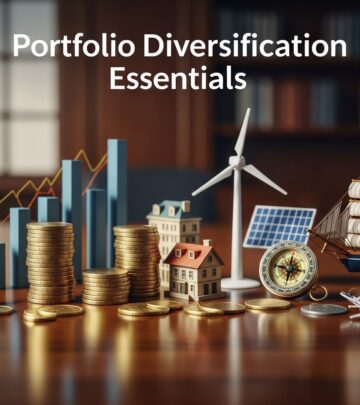
Minimum Variance Portfolio: A Comprehensive Overview and Guide
Learn how the minimum variance portfolio can minimize risk through diversification and efficient asset allocation.

Understanding the Minimum Variance Portfolio
The minimum variance portfolio (MVP) is an investment strategy designed to reduce overall portfolio risk by carefully selecting and allocating assets to minimize the variance — or volatility — of portfolio returns. This concept originates from modern portfolio theory (MPT), introduced by Harry Markowitz in 1952, which demonstrated how diversification and the correlation between asset returns can lower risk while maintaining returns.
At its core, the minimum variance portfolio aims to find the combination of risky assets that yields the lowest possible portfolio variance for a given expected return. This approach is particularly valuable for investors who prioritize risk reduction and seek steady, less volatile performance rather than maximizing returns at all costs.
Key Concepts in Minimum Variance Portfolio Construction
- Portfolio Variance and Volatility: Variance measures the dispersion of returns around the expected return, and the square root of variance is volatility or standard deviation, which investors use as a proxy for risk.
- Asset Correlation and Covariance: The degree to which asset returns move in relation to one another, indicated by correlation, is critical for achieving risk reduction through diversification.
- Efficient Frontier and Global Minimum Variance Portfolio: The minimum variance portfolio lies on the efficient frontier’s leftmost point, representing the portfolio with the lowest risk possible among all risky asset combinations.
- Weight Optimization: Assigning portfolio weights to individual assets such that the overall portfolio variance is minimized based on the covariance between assets.
How Does the Minimum Variance Portfolio Work?
The philosophy behind the minimum variance portfolio is the interaction of assets with different volatilities and correlations. By combining assets that exhibit low or even negative correlations, the portfolio as a whole experiences less fluctuation in value, because the risks of individual assets partially offset one another.
For example, an investor may combine stocks, bonds, and other securities with varying risk profiles and correlation levels. Losses in one asset could be offset by gains or less severe losses in others, which reduces the overall portfolio risk.
Mathematical Foundation and Formula
The portfolio variance calculation integrates each asset’s variance and the covariance between pairs of assets. The basic formula for a two-asset portfolio’s variance is:
Minimum Variance = W1² × σ1² + W2² × σ2² + 2 × W1 × W2 × Cov(1,2)Where:
W1, W2are the weights of asset 1 and asset 2 in the portfolio.σ1², σ2²are the variances of the returns of asset 1 and asset 2.Cov(1,2)is the covariance between asset 1 and asset 2 returns.
For portfolios with more assets, this expands into matrix mathematics where weights vector, covariance matrix, and asset variance vectors are used with optimization algorithms to minimize portfolio variance.
Optimization Process
- Identify expected returns of assets.
- Calculate individual variances and covariances between assets.
- Use quadratic programming or other mathematical optimization techniques to find weights minimizing portfolio variance subject to constraints (e.g., weights sum to 100%, no short selling).
Minimum Variance Portfolio in Modern Portfolio Theory (MPT)
The minimum variance portfolio is a cornerstone concept in modern portfolio theory, which shows how risk-averse investors can construct portfolios to optimize returns for a given level of risk. The MVP specifically represents the portfolio with the least risk (variance) among all possible risky portfolios.
This portfolio sits on the bottom left of the efficient frontier curve, distinct from other portfolios that maximize return for a given risk or maximize the Sharpe ratio. It provides the best risk reduction but may offer lower returns compared to other optimized portfolios, making it suitable particularly for conservative investors.
Operational Mechanics and Implementation
Constructing a minimum variance portfolio involves the following key steps:
- Asset Selection: Choose a diverse group of assets, such as stocks across different sectors, bonds, commodities, or geographic regions, preferably with low or negative correlations.
- Data Collection: Gather historical data on asset returns to calculate variances and covariances.
- Covariance Matrix Construction: Build a covariance matrix that quantifies how asset returns move relative to each other.
- Weight Optimization: Use mathematical optimization methods to determine asset weights that minimize the portfolio’s overall variance.
This process typically requires computational tools or financial software, given the complex matrix calculations involved, especially for portfolios with many assets.
Benefits of a Minimum Variance Portfolio
- Reduced Volatility: By minimizing variance, the portfolio experiences fewer dramatic swings, making it more stable.
- Improved Risk-Adjusted Returns: Although absolute returns may be lower, the MVP can provide a better return-to-risk ratio, which appeals to risk-averse investors.
- Diversification Efficiency: The approach leverages diversification benefits by selecting assets with varying correlations.
- Resistance in Market Turbulence: MVP portfolios tend to be more resilient during market downturns due to their lower overall risk.
Limitations and Considerations
- Dependence on Historical Data: MVP construction relies on historical returns and covariances, which may not accurately predict future relationships.
- Lower Expected Returns: Focusing on minimizing variance can result in portfolios that sacrifice potential higher returns.
- Estimation Errors: Small inaccuracies in estimating covariance or expected returns can significantly distort MVP weights.
- Exclusion of Risk-Free Assets: MVP typically includes only risky assets and does not incorporate risk-free assets which can change portfolio efficiency.
Frequently Asked Questions (FAQs) About Minimum Variance Portfolios
What is a minimum variance portfolio?
A minimum variance portfolio is one that offers the lowest possible risk (variance or volatility) among all possible portfolios composed of a given set of assets. It aims to minimize fluctuations in returns through diversification and asset allocation optimization.
How is a minimum variance portfolio different from an efficient portfolio?
While all minimum variance portfolios lie on the efficient frontier, the minimum variance portfolio specifically refers to the portfolio with the lowest variance (risk). Efficient portfolios balance risk and return optimally but may have higher risk than the minimum variance portfolio.
Why use a minimum variance portfolio?
Investors use MVPs to reduce portfolio risk, especially if they are risk-averse and willing to accept lower returns for stability. It helps mitigate large losses during market downturns by capitalizing on diversification.
Can minimum variance portfolios eliminate risk entirely?
No, MVPs minimize portfolio variance but cannot entirely eliminate risk, particularly systematic risk that affects the whole market. They are most effective in reducing unsystematic risk through diversification.
What types of assets are suitable for a minimum variance portfolio?
A diverse mix of assets such as stocks from different industries and countries, bonds of various maturities and credit qualities, commodities, and other instruments with low to negative correlations are used to build an MVP.
Summary Table: Minimum Variance Portfolio vs Other Portfolio Types
| Portfolio Type | Primary Objective | Risk Level | Expected Return | Typical Investor Profile |
|---|---|---|---|---|
| Minimum Variance Portfolio | Minimize portfolio variance (risk) | Lowest among risky portfolios | Moderate to low | Risk-averse investors |
| Maximum Sharpe Ratio Portfolio | Maximize risk-adjusted returns | Moderate | Moderate to high | Risk-tolerant but return-seeking investors |
| Maximum Return Portfolio | Maximize expected return | High | Highest | Aggressive investors |
Implementation Example
Consider an investor looking to build a minimum variance portfolio using a combination of:
- Stocks from different sectors like technology, healthcare, and consumer goods
- Government bonds and corporate bonds
- International equities and commodities such as gold
By analyzing historical return data and correlations, the investor optimizes the weights so that assets with lower correlation receive higher allocations. This portfolio would experience lower volatility than an equally weighted portfolio or one concentrated in a single asset class.
Conclusion
The minimum variance portfolio provides a systematic approach to risk management in investing. By leveraging diversification and statistical modeling, it enables investors to construct portfolios that minimize risk while maintaining reasonable returns. Although it may not maximize gains, it offers an appealing strategy for those seeking stability and capital preservation in uncertain markets.
References
- Minimum Variance Portfolio – Overview and Strategy — The Balance. 2024. https://www.thebalancemoney.com/minimum-variance-portfolio-overview-4155796
- Minimum Variance Portfolio – Meaning, Formula, Calculation — WallStreetMojo. 2024. https://www.wallstreetmojo.com/minimum-variance-portfolio/
- Minimum-Variance Portfolio | Meaning, Construction, Applications — Finance Strategists. 2024. https://www.financestrategists.com/wealth-management/investment-management/minimum-variance-portfolio/
- Minimum Variance Portfolio Strategy for Low-Risk Investing — The Trading Analyst. 2025. https://thetradinganalyst.com/minimum-variance-portfolio/
- Minimum-Variance Portfolios | CFA Level 1 — AnalystPrep. 2024. https://analystprep.com/cfa-level-1-exam/portfolio-management/minimum-variance-portfolios/
Similar Articles








Read full bio of medha deb