Microeconomics vs Macroeconomics: Key Differences
Understand the fundamental differences between microeconomics and macroeconomics and how they shape economic policy.

Understanding Microeconomics and Macroeconomics
Economics is a broad social science that examines how goods and services are produced, distributed, and consumed throughout society. To make this vast subject more manageable, economists typically divide the field into two complementary branches: microeconomics and macroeconomics. While these disciplines are interconnected and share fundamental principles, they operate at different scales and focus on distinct economic phenomena. Understanding the differences between these two approaches is essential for anyone seeking to comprehend how economies function, from individual purchasing decisions to national policy implementation.
The distinction between micro and macro economics isn’t merely academic—it has profound implications for business strategy, government policy, and personal financial planning. Microeconomics provides insights into how individual actors make decisions, while macroeconomics reveals the broader patterns that shape entire economies. Together, these perspectives offer a comprehensive framework for analyzing economic behavior at all levels.
What is Microeconomics?
Microeconomics is the study of economics at the individual, household, or firm level. The prefix “micro” literally means small, and this branch of economics focuses on the decisions and behaviors of individual economic actors. Microeconomists examine how consumers, workers, and businesses allocate their limited resources to make purchasing, production, and investment decisions.
At its core, microeconomics addresses fundamental questions: How do consumers decide what to buy? What prices should businesses charge for their products? How do firms determine how many workers to hire? What factors influence wages and employment in specific industries? These questions reveal that microeconomics is ultimately about understanding human choice and resource allocation in specific markets.
Key Focus Areas of Microeconomics
Microeconomics concentrates on several core areas that directly affect individual economic actors:
- Supply and Demand: The fundamental forces that determine prices in specific markets and how consumers and producers respond to price changes.
- Consumer Behavior: How individuals make purchasing decisions based on preferences, income constraints, and available alternatives.
- Production and Costs: How businesses decide what to produce, how much to produce, and what production methods to employ based on cost considerations.
- Pricing Strategy: How firms set prices for goods and services to maximize profits or achieve other objectives.
- Market Structures: Analysis of different market types, including perfect competition, monopolistic competition, oligopoly, and monopoly.
- Factor Pricing: How wages, interest rates, and rental prices are determined in markets for labor and capital.
- Market Failures: Situations where free markets fail to allocate resources efficiently, such as externalities or information asymmetries.
The Bottom-Up Approach
Microeconomics employs a “bottom-up” analytical approach. This methodology starts with individual decisions and aggregates them to understand market outcomes. By examining how one person’s choice to buy a car, or one firm’s decision to hire workers, microeconomists can predict broader market trends. This approach assumes that rational individuals and businesses seek to maximize their own well-being or profits, and that their aggregate choices produce market equilibrium.
What is Macroeconomics?
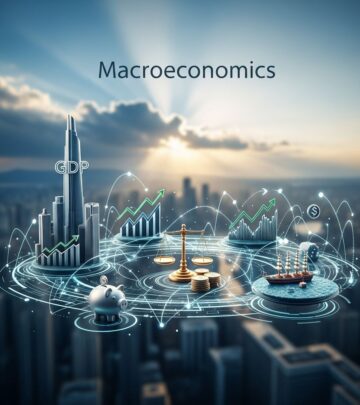
Macroeconomics, by contrast, is the study of the economy as a whole, typically at the national, regional, or global level. The prefix “macro” means large, reflecting this branch’s focus on economy-wide phenomena. Macroeconomists study aggregate economic indicators and broad trends rather than individual markets or actors. They investigate questions like: What determines the total level of economic output? Why do unemployment rates fluctuate? What causes inflation? How does international trade affect domestic prosperity?
Macroeconomics emerged as a distinct discipline during the Great Depression of the 1930s, when economists recognized that aggregate economic phenomena couldn’t be fully explained by simply adding up microeconomic observations. National economies exhibit patterns and problems that require their own theoretical framework and analytical tools.
Key Focus Areas of Macroeconomics
Macroeconomists concentrate on large-scale economic indicators and phenomena:
- Gross Domestic Product (GDP): The total value of goods and services produced within a country during a specific period, the primary measure of economic output.
- Unemployment: The percentage of the labor force without jobs, a critical indicator of economic health and social well-being.
- Inflation: The rate at which the general price level of goods and services rises over time, affecting purchasing power and economic stability.
- Economic Growth: The increase in productive capacity and output over time, typically measured by GDP growth rates.
- International Trade: The exchange of goods, services, and capital across national borders and its impact on domestic economies.
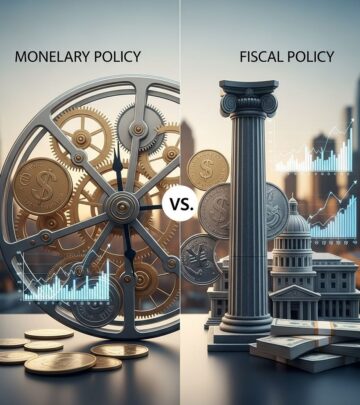
- Fiscal Policy: Government decisions about taxation, spending, and budget management to influence overall economic activity.
- Monetary Policy: Central bank decisions about interest rates and money supply to achieve economic objectives.
- Business Cycles: The recurring patterns of expansion and contraction in economic activity.
The Top-Down Approach
Macroeconomics employs a “top-down” analytical approach that starts with the aggregate economy and works downward to understand components. Rather than assuming that summing individual decisions fully explains macro outcomes, macroeconomists recognize that system-wide factors—like central bank policies, international events, or technological shocks—can create economic conditions that individual actors must navigate.
Key Differences Between Microeconomics and Macroeconomics
| Aspect | Microeconomics | Macroeconomics |
|---|---|---|
| Focus | Individual consumers, businesses, and specific markets | National economy, regional economy, or global economy |
| Scale | Small-scale economic activity | Large-scale, aggregate economic activity |
| Primary Variables | Prices, quantities, wages, employment in specific sectors | GDP, unemployment rate, inflation, economic growth |
| Analytical Approach | Bottom-up, starting with individual actors | Top-down, starting with aggregate economy |
| Typical Applications | Business pricing decisions, consumer choice analysis, industry structure | Government economic policy, fiscal stimulus, monetary policy |
| Time Horizon | Often focuses on short-term market dynamics | Examines both short-term fluctuations and long-term growth |
| Assumption | Markets tend toward equilibrium through individual rational choices | Aggregate demand and supply determine overall economic activity |
Scope and Scale
The most fundamental difference between these disciplines is their scope. Microeconomics examines specific markets and economic actors—a particular industry, a single firm, or individual consumers. When a microeconomist studies the automobile industry, they analyze how car prices are determined, why different manufacturers exist, and how competition affects pricing and quality. Macroeconomics, conversely, looks at the entire economy or major segments of it. A macroeconomist studying automobiles would focus on how the auto industry contributes to GDP, how employment in the sector affects overall unemployment rates, and how international trade in vehicles influences the nation’s balance of payments.
Variables of Interest
Microeconomists and macroeconomists track different variables. Microeconomists care about prices of specific goods, quantities demanded and supplied in particular markets, wages in certain occupations, and employment levels in specific industries. Macroeconomists focus on aggregate measures: the overall price level (inflation), total employment and unemployment rates, total national output (GDP), and overall economic growth rates.
Policy Applications
The practical applications of these fields diverge significantly. Microeconomic analysis informs decisions about pricing strategies, hiring practices, market entry, and regulatory policies affecting specific industries. Business managers use microeconomic principles when deciding whether to raise prices or increase production. Governments apply microeconomic analysis when setting minimum wage laws or considering industry-specific regulations. Macroeconomic analysis, conversely, guides broad-based economic policies. Central banks use macroeconomic models to decide whether to raise or lower interest rates. Governments employ macroeconomic reasoning when deciding whether to implement stimulus spending or increase taxes during different phases of the business cycle.
How Microeconomics and Macroeconomics Are Connected
Despite their differences, microeconomics and macroeconomics are deeply interconnected and mutually reinforcing. Individual decisions aggregated across millions of actors create macroeconomic outcomes. When consumers reduce spending, the aggregate decline in demand can trigger a recession. When businesses become pessimistic about future profits and reduce investment, this can slowdown overall economic growth. Conversely, macroeconomic conditions shape the environment within which individual economic actors operate. During recessions, individual consumers face higher unemployment risk and may reduce spending. During periods of rapid inflation, businesses face uncertainty about future costs and may postpone investment decisions.
Modern economic analysis increasingly recognizes this interconnection. Economists now understand that successful macroeconomic policy must account for microeconomic realities—how individuals and businesses actually respond to policy changes. Similarly, understanding specific markets requires awareness of macroeconomic conditions. A firm cannot succeed by optimizing its internal operations if the national economy is in deep recession.
Similarities Between Microeconomics and Macroeconomics
Beyond their differences, microeconomics and macroeconomics share important common ground. Both disciplines address the fundamental economic problem: how to allocate scarce resources among competing uses. Both employ similar analytical tools, including supply and demand analysis, optimization techniques, and empirical testing of theories. Both require mathematical and statistical skills for rigorous analysis. Both microeconomists and macroeconomists develop models—simplified representations of economic relationships—to understand how the world works and predict how it might respond to changes in conditions or policies.
Additionally, both fields grapple with questions of efficiency and welfare. Microeconomists ask whether markets allocate resources efficiently and whether government intervention might improve outcomes. Macroeconomists ask similar questions about the overall economy: whether market forces produce full employment and stable prices, or whether policy intervention is necessary. Both disciplines recognize that economic outcomes involve tradeoffs—achieving one goal may require sacrificing another.
Real-World Applications
Microeconomic Applications
Microeconomics shapes countless daily decisions throughout the economy. When a coffee shop owner decides whether to raise prices, they’re applying microeconomic reasoning—considering how price increases might affect customer demand. When a worker decides whether to accept a job offer, they’re weighing personal preferences and income constraints according to microeconomic principles. When a government considers raising the minimum wage, it’s applying microeconomic analysis to predict effects on employment and business behavior.
Macroeconomic Applications
Macroeconomics informs major policy decisions with economy-wide implications. Central banks use macroeconomic models to set interest rates, balancing objectives of price stability and full employment. Governments implement fiscal stimulus or austerity measures based on macroeconomic analysis of business cycles. International organizations monitor macroeconomic indicators to assess global economic health and predict future crises.
Frequently Asked Questions (FAQs)
Q: Do I need to study both microeconomics and macroeconomics?
A: Most comprehensive economics education covers both disciplines. They provide complementary perspectives—microeconomics explains how individual decisions aggregate, while macroeconomics reveals how system-wide factors shape individual opportunities. Many universities offer both courses to ensure students understand economics from multiple angles.
Q: Which is more important for business decision-making?
A: Both are important, but in different ways. Microeconomics directly informs operational decisions about pricing, production, and markets. However, businesses cannot ignore macroeconomic conditions. A strong microeconomic strategy will fail if implemented during a severe recession or period of rapid inflation. Successful businesses monitor macroeconomic conditions and adjust strategies accordingly.
Q: Can I understand one without understanding the other?
A: You can gain basic understanding of either field independently. However, complete economic literacy requires understanding both. Microeconomics without macroeconomics leaves you unable to understand economy-wide phenomena. Macroeconomics without microeconomics lacks the foundation showing how aggregate outcomes result from individual choices.
Q: How do economists choose between micro and macro perspectives?
A: The choice depends on the question being asked. Questions about specific industries, firm strategy, or consumer behavior call for microeconomic analysis. Questions about overall economic performance, inflation, unemployment, or policy effectiveness require macroeconomic analysis. Many complex economic questions benefit from both perspectives applied together.
Q: Are there careers focused exclusively on one or the other?
A: Yes. Microeconomists work in business consulting, industry analysis, and antitrust enforcement. Macroeconomists work at central banks, international organizations like the IMF, and in government economic policy roles. However, many economics careers require understanding both fields.
Conclusion
Microeconomics and macroeconomics represent two complementary lenses through which to view economic phenomena. Microeconomics focuses on individual actors and specific markets, employing a bottom-up analytical approach to understand how prices emerge, firms make decisions, and resources get allocated. Macroeconomics adopts a top-down perspective, examining aggregate economic phenomena like national output, employment, inflation, and growth. While these disciplines operate at different scales and emphasize different variables, they are deeply interconnected. Individual decisions cascade upward to create macroeconomic outcomes, while macro conditions shape the environment within which micro actors operate. Understanding both perspectives is essential for anyone seeking genuine economic literacy, whether as a student, business professional, investor, or engaged citizen.
References
- The Difference Between AP Macroeconomics and AP Microeconomics — College Board. 2024. https://blog.collegeboard.org/difference-between-ap-macroeconomics-and-ap-microeconomics
- Differences Between Macroeconomics and Microeconomics — LibreTexts Economics. 2024. https://socialsci.libretexts.org/Bookshelves/Economics/Introductory_Comprehensive_Economics/Economics_(Boundless)/01:_Principles_of_Economics/1.06:_Differences_Between_Macroeconomics_and_Microeconomics
- Microeconomics vs. Macroeconomics: Understanding the Differences — Wilson Online. 2024. https://online.wilson.edu/resources/microeconomics-vs-macroeconomics/
- Micro and Macro: The Economic Divide — International Monetary Fund. 2024. https://www.imf.org/en/publications/fandd/issues/series/back-to-basics/micro-and-macro
- Microeconomics & Macroeconomics | Definitions, Differences and Applications — Inomics. 2024. https://inomics.com/advice/microeconomics-vs-macroeconomics-which-class-should-i-take
Similar Articles








Read full bio of Sneha Tete