Median vs Average: Understanding Key Differences
Learn the crucial differences between median and average to make better financial decisions.
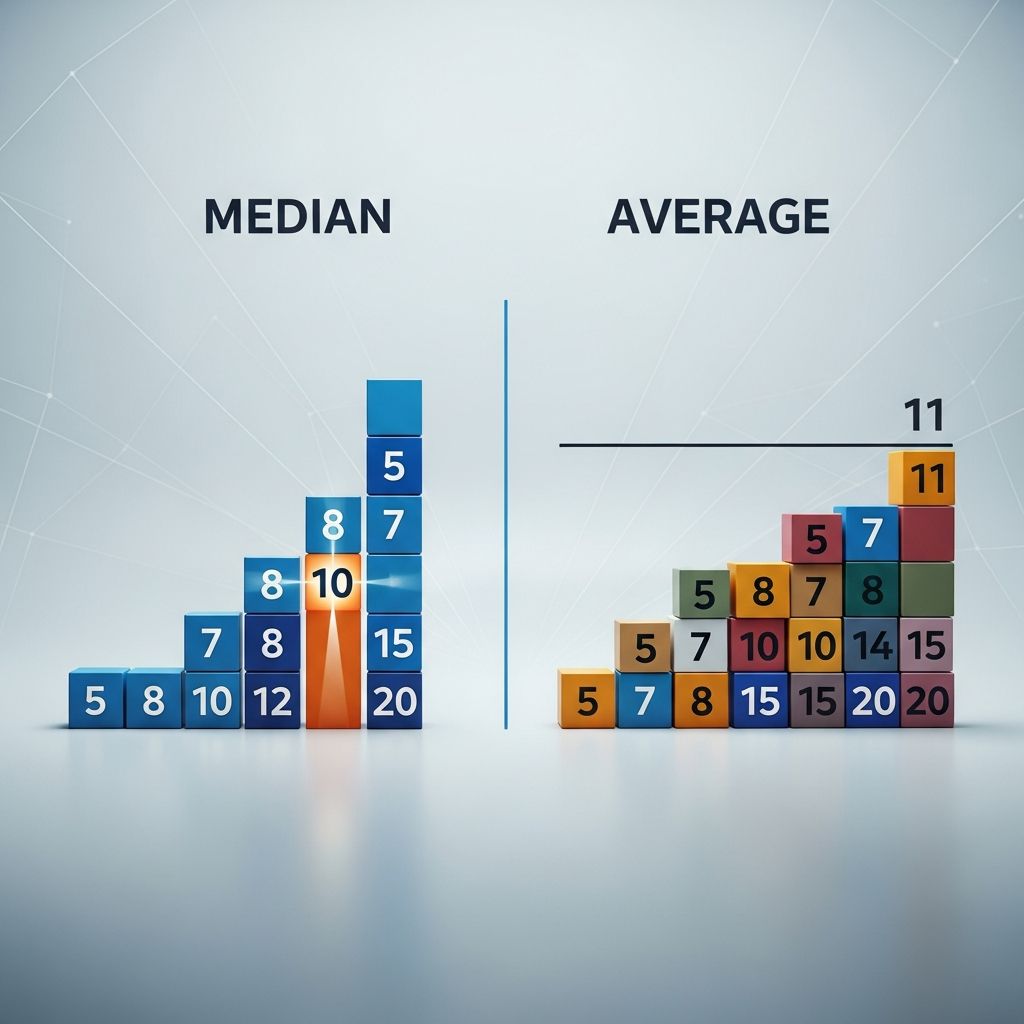
Understanding Median vs Average: Essential Distinctions for Financial Analysis
When analyzing financial data, income levels, home prices, or investment returns, two statistical measures frequently emerge: the median and the average (also called the mean). While these terms are often used interchangeably in casual conversation, they represent fundamentally different ways of understanding numerical data. Understanding the distinction between these two measures is crucial for making informed financial decisions, interpreting economic reports, and avoiding misleading conclusions from data analysis.
The average, or arithmetic mean, is calculated by adding all values in a dataset and dividing by the number of values. The median, by contrast, is simply the middle value when all numbers are arranged in order from smallest to largest. These two measures can tell very different stories about the same dataset, particularly when extreme values are present. This article explores the key differences between median and average, when each should be used, and why choosing the right measure matters for financial planning and decision-making.
The Basic Definitions
What Is the Average (Mean)?
The average, or arithmetic mean, represents the sum of all values divided by the total number of values in a dataset. It is perhaps the most commonly used measure of central tendency because it incorporates every data point in its calculation. The formula for calculating average is straightforward: add all the numbers together and divide by how many numbers you have.
For example, if five people earn $30,000, $40,000, $50,000, $60,000, and $70,000 respectively, the average income would be ($30,000 + $40,000 + $50,000 + $60,000 + $70,000) ÷ 5 = $50,000.
What Is the Median?
The median is the middle value in an ordered dataset that divides the numbers into two equal halves. To find the median, arrange all values from lowest to highest (or highest to lowest) and identify the middle number. If there is an even number of values, the median is the average of the two middle values.
Using the same income example, the five values arranged in order are: $30,000, $40,000, $50,000, $60,000, $70,000. The median is $50,000, which happens to coincide with the average in this symmetrical dataset. However, this alignment does not always occur.
Key Differences Between Median and Average
| Characteristic | Median | Average |
|---|---|---|
| Definition | Middle value in an ordered dataset | Arithmetic mean of all values |
| Calculation Method | Order values and find middle point | Sum all values and divide by count |
| Sensitivity to Outliers | Not sensitive to extreme values | Highly sensitive to outliers |
| Best Use | Skewed distributions and outlier-prone data | Normal distributions without outliers |
| Financial Application | Real estate, income distribution | Portfolio returns, expense tracking |
Sensitivity to Extreme Values
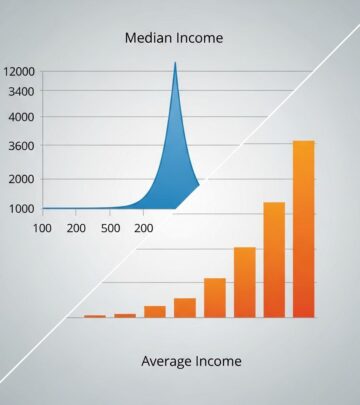
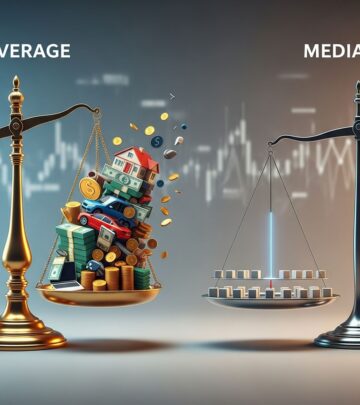
The most significant difference between median and average lies in how they handle extreme values or outliers. The average is highly sensitive to outliers because every value contributes equally to the calculation. A single extremely large or small value can dramatically shift the average, potentially misrepresenting the typical data point.
Consider a neighborhood with five home prices: $300,000, $325,000, $350,000, $375,000, and $1,500,000. The average home price would be $550,000, heavily influenced by the luxury estate. However, the median would be $350,000, better representing the typical home in the neighborhood. This demonstrates why real estate professionals often cite median prices—they provide a more accurate picture of the housing market for typical buyers.
The median remains unaffected by extreme values because it depends only on position, not magnitude. Whether the most expensive home costs $1,500,000 or $5,000,000, the median stays at $350,000.
When to Use Average
Normal Distributions
The average is most appropriate when data follows a normal distribution, a bell-shaped curve where values are symmetrically distributed around a central point. In normal distributions, the average provides an accurate representation of the typical value because extreme values are rare and balanced on both sides.
When Outliers Are Absent
When a dataset contains no extreme values or outliers, the average reliably represents the central tendency. For instance, if measuring employee test scores in a company where most scores cluster between 70 and 90, the average score accurately reflects typical performance.
Financial Applications
The average is useful for calculating portfolio returns, average monthly expenses, and other financial metrics where all values contribute meaningfully to the analysis. Investment professionals often use average returns to assess historical performance, though they may supplement this with other measures for comprehensive analysis.
When to Use Median
Skewed Distributions
The median excels in skewed distributions where data clusters toward one end with a tail extending toward extreme values. Income distribution in many countries exhibits positive skew, with most people earning moderate incomes and a smaller group earning substantially more. In such cases, the median income better represents the typical earner than the average, which is pulled upward by high earners.
Presence of Outliers
Whenever datasets contain outliers or extreme values, the median provides a more robust measure of central tendency. Healthcare costs, real estate prices, and salary information frequently contain outliers that make the median more representative than the average.
Real-World Financial Scenarios
Financial planners often recommend using median values when evaluating:
– Home prices in real estate markets- Household income and wealth- Employee salaries within industries- Asset values in investment portfolios- Healthcare expenditures- Student test scores
Practical Examples Illustrating the Difference
Example 1: Household Income
Consider a small company with seven employees earning: $35,000, $38,000, $42,000, $45,000, $48,000, $52,000, and $250,000 (the CEO).
Average income: ($35,000 + $38,000 + $42,000 + $45,000 + $48,000 + $52,000 + $250,000) ÷ 7 = $72,714
Median income: When arranged in order, the middle value (4th position) is $45,000
The average is inflated by the CEO’s salary and doesn’t represent typical employee earnings. The median of $45,000 better reflects what most employees actually earn.
Example 2: Home Values
A neighborhood contains eight homes valued at: $250,000, $265,000, $280,000, $295,000, $310,000, $325,000, $340,000, and $2,100,000 (waterfront mansion).
Average home value: $495,625
Median home value: ($295,000 + $310,000) ÷ 2 = $302,500
For a potential buyer evaluating the neighborhood, the median provides a more realistic picture of typical property values. Real estate listing sites prominently display median prices for this reason.
Statistical Properties and Relationships
Normally Distributed Data
In perfectly normal distributions, the mean (average) and median are identical or extremely close. This symmetry indicates that extreme values are balanced on both sides, and the average accurately represents the center.
Positively Skewed Data
When data exhibits positive skew (a tail extending toward higher values), the average exceeds the median. This occurs frequently with financial data such as income, wealth, and real estate prices, where a subset of individuals or properties have exceptionally high values.
Negatively Skewed Data
In negatively skewed distributions (a tail extending toward lower values), the average falls below the median. This pattern appears in datasets like test scores where most people perform well but a few score very low.
Frequently Asked Questions
Q: Can median and average ever be the same?
A: Yes. In perfectly symmetrical, normally distributed datasets without outliers, the median and average are identical or nearly identical. This occurs when values are evenly distributed around a central point with no extreme outliers skewing the distribution.
Q: Which measure is used in official government statistics?
A: Government agencies typically report both metrics, but they choose based on the data’s characteristics. For income and housing data, which often contain outliers, median values are frequently emphasized. For other metrics like test scores or temperature, averages may be highlighted.
Q: Why do news reports sometimes cite different income figures?
A: Different sources may report either average or median household income. Since income distributions are positively skewed, median income is typically lower than average income. Using the appropriate measure depends on what the report aims to communicate about the general population.
Q: How do outliers affect investment returns analysis?
A: When analyzing investment returns, outliers can make average returns appear unrealistically high or low. Using median returns alongside average returns provides a more complete picture. However, average returns remain standard in the investment industry because they incorporate all performance data.
Q: Is one measure always better than the other?
A: Neither measure is universally better. The appropriate choice depends on the data distribution and analysis purpose. For normally distributed data without outliers, the average is suitable and commonly understood. For skewed distributions or data containing outliers, the median provides more accurate central tendency representation.
Making Better Financial Decisions
Understanding when to use median versus average empowers more informed financial decision-making. When evaluating investment opportunities, comparing career options, or assessing property values, consider the data distribution. Request median figures alongside averages from financial advisors and analysts to gain complete perspective. Be skeptical of reports using only average values when outliers are likely present, as this may misrepresent typical conditions.
In personal finance, these concepts matter when setting budgets (comparing average vs. median spending), evaluating market conditions (real estate, salaries), and assessing investment performance. Sophisticated financial analysis employs both measures and understands their complementary roles in revealing different aspects of data.
The distinction between median and average, though seemingly technical, has profound implications for financial literacy and decision-making. By mastering these concepts, you develop the foundation for sophisticated financial analysis and protect yourself against misleading statistical presentations.
References
- Mean, Median, and Mode: Measures of Central Tendency — Shiksha Online. 2025. https://www.shiksha.com/online-courses/articles/average-vs-median/
- Median vs Average: Know the Difference Between Them — Science Notes. 2025. https://sciencenotes.org/median-vs-average-know-the-difference-between-them/
- The Average Or Mean VS The Median — NWEA Connection. 2025. https://connection.nwea.org/s/article/What-is-the-difference-between-mean-and-median
Similar Articles








Read full bio of medha deb