Median: Definition, Calculation, and Statistical Applications
Understanding the median: A comprehensive guide to this essential statistical measure and how it differs from mean and mode.

Understanding the Median: A Complete Guide to This Essential Statistical Measure
The median represents one of the three primary measures of central tendency in statistics, alongside the mean and mode. It serves as a critical tool for analyzing data distribution and understanding the true middle point of any dataset. Whether you’re working in finance, research, or data analysis, understanding the median is fundamental to making informed decisions based on numerical information.
The median is defined as the middle value in a set of numbers when arranged in order, representing the 50th percentile of a dataset. In practical terms, when you organize your numbers from smallest to largest, the median is the point where exactly half of the values fall below it and half fall above it. This simple yet powerful definition makes the median an invaluable tool for anyone working with data.
What Is the Median?
The median serves as the midpoint of a dataset, providing a measure of central tendency that is often more representative than other averages in certain situations. When you have a collection of numbers, the median identifies the value that divides the dataset into two equal halves. This characteristic makes it particularly useful when dealing with skewed data or datasets containing outliers that might distort other measures.
For instance, consider a simple dataset: (8, 6, 9, 5, 8, 23, 4). To find the median, you first arrange these numbers in ascending order to get (4, 5, 6, 8, 8, 9, 23). Since there are seven numbers—an odd quantity—the median is simply the middle value, which is the fourth number in this case: 8. This straightforward approach works whenever you have an odd number of values.
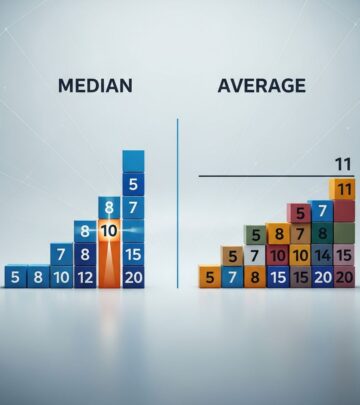
The median differs fundamentally from the mean, which is often what people casually refer to as the “average.” The mean for this same dataset would be calculated by adding all values and dividing by the count: (4+5+6+8+8+9+23)/7 = 63/7 = 9. Notice how the median of 8 and the mean of 9 produce different results, with the mean being pulled higher by the outlier value of 23.
How to Calculate the Median
Calculating the median depends on whether your dataset contains an odd or even number of values. Understanding both scenarios is essential for accurate statistical analysis.
Median for Odd-Numbered Datasets
When your dataset contains an odd number of values, finding the median is straightforward. After sorting the numbers in ascending order, the median is the value at position (n+1)/2, where n represents the total count of numbers.
For example, with the dataset (4, 5, 6, 8, 8, 9, 23) containing 7 values:
Position = (7+1)/2 = 8/2 = 4
The median is the 4th value in the sorted list, which is 8. This method ensures you always land on an actual value from your dataset when working with odd-numbered collections.
Median for Even-Numbered Datasets
When you have an even number of values, the calculation becomes slightly more complex because there is no single middle value. Instead, you identify the two middle values and calculate their average.
Consider the dataset (7, 3, 10, 2, 9, 2, 1, 4). After sorting in ascending order: (1, 2, 2, 3, 4, 7, 9, 10). With 8 values, the two middle positions are:
Position 1 = 8/2 = 4 (the 4th value: 3)Position 2 = (8/2) + 1 = 5 (the 5th value: 4)
The median is then calculated as: (3+4)/2 = 3.5
Notice that the median (3.5) differs from the mean of this dataset, which is 4.75, calculated as (1+2+2+3+4+7+9+10)/8 = 38/8 = 4.75. This difference illustrates how the median can provide a different perspective on your data’s center point.
Median vs. Mean: Understanding the Difference
One of the most common sources of confusion in statistics involves distinguishing between the median, mean, and mode. Each measure of central tendency serves different purposes and can yield vastly different results when analyzing the same dataset.
The Mean (Average): Calculated by summing all values and dividing by the count, the mean represents the arithmetic average. While intuitive and widely used, the mean is highly susceptible to influence from outliers and extreme values.
The Median: The middle value in an ordered dataset, the median is more resistant to the effects of outliers. It provides a better representation of the “typical” value when your data contains extreme values.
The Mode: The most frequently occurring value in a dataset, the mode is useful for identifying the most common occurrence but may not exist in some datasets or may not represent central tendency well in others.
Why the Median Matters in Skewed Data
The median’s greatest strength emerges when analyzing skewed datasets—those containing outliers or values at the extremely high or extremely low end of the distribution. In these situations, the median often provides a more realistic and meaningful representation of the data’s center than the mean.
Consider a practical example from website performance analysis. Imagine measuring page load times for a server: (2 seconds, 3 seconds, 2.5 seconds, 2.8 seconds, 3.2 seconds, 45 seconds). The single outlier of 45 seconds significantly skews the mean, which would be 7.45 seconds. However, the median—the middle value between 2.8 and 3.2 seconds—is 3 seconds, which better represents typical server performance.
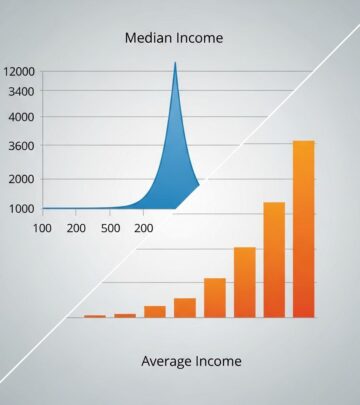
This characteristic makes the median invaluable in fields like real estate (where property prices can be highly skewed by luxury properties), income analysis (where extremely high earners can distort average income figures), and quality control (where occasional defective products shouldn’t dominate the analysis).
Practical Applications of the Median
The median finds widespread application across numerous industries and analytical contexts:
Financial Analysis: Investment professionals use the median to analyze income distributions, housing prices, and market returns, where outliers can misrepresent typical conditions.
Medical Research: Researchers employ the median when studying patient outcomes, survival times, and treatment efficacy, particularly when some extreme cases exist.
Economic Reporting: Government agencies and economists prefer median income over mean income because median better represents the typical household, unaffected by extremely high earners.
Real Estate: Property valuations often rely on median home prices rather than average prices to avoid distortion from luxury properties.
Quality Control: Manufacturing and service industries use medians to understand typical performance without letting rare defects dominate their analysis.
Common Mistakes and Misconceptions
Understanding what the median is not proves just as important as knowing what it is. The most prevalent error involves conflating the median with the mean or mode without recognizing their distinct calculations and applications.
Another frequent mistake occurs when people forget to sort their data before calculating the median. The median’s definition explicitly requires the numbers to be arranged in order—attempting to find the median of an unsorted dataset will yield incorrect results.
Additionally, some analysts misapply the median by using it in situations where the mean would be more appropriate, or vice versa. Understanding your data’s distribution and the presence of outliers helps determine which measure best suits your analytical needs.
Median in Different Fields
Healthcare: Medical professionals use median survival times for disease prognosis, as these better reflect patient outcomes than mean survival times that might be skewed by a few long-term survivors.
Education: Schools and universities often report median test scores and grade distributions to provide accurate representations of student performance.
Technology: Software companies analyze median response times and latency metrics to ensure typical user experiences meet standards, unaffected by occasional system hiccups.
Environmental Science: Researchers use median pollution levels and environmental measurements to characterize typical conditions while ignoring temporary spikes.
Frequently Asked Questions
Q: What is the difference between median and average?
A: The average (mean) is calculated by summing all values and dividing by the count. The median is the middle value when data is sorted. While the mean can be heavily influenced by outliers, the median remains stable and representative even with extreme values in your dataset.
Q: Why is the median important in statistics?
A: The median provides a robust measure of central tendency that accurately represents the typical value in a dataset, especially when outliers are present. It’s often more meaningful than the mean in skewed distributions.
Q: Can the median be a decimal number?
A: Yes, the median can be a decimal when you have an even number of values. In such cases, you calculate the average of the two middle values, which often results in a decimal number that doesn’t appear in your original dataset.
Q: When should I use median instead of mean?
A: Use the median when your dataset contains outliers, is skewed, or when you need to understand the typical value. Use the mean when you need the arithmetic average or when working with normally distributed data without extreme outliers.
Q: How do I find the median of a large dataset?
A: For large datasets, use statistical software or spreadsheet programs like Excel with the MEDIAN function. These tools automatically sort the data and calculate the median, whether your dataset has an odd or even number of values.
Q: Is the median always the middle number?
A: For odd-numbered datasets, the median is always the middle number. For even-numbered datasets, the median is the average of the two middle numbers, which may not be a value that appears in your original data.
References
- Median – StatPearls — National Center for Biotechnology Information (NCBI). 2024. https://www.ncbi.nlm.nih.gov/books/NBK470533/
Similar Articles








Read full bio of medha deb