20/10 Debt Rule: How To Calculate Limits And Stay On Track
Discover how the 20/10 rule simplifies debt management, keeps borrowing in check, and boosts your path to financial freedom with practical steps and examples.

The 20/10 rule offers a straightforward guideline for handling consumer debt responsibly. It advises keeping total debt balances under 20% of your annual after-tax income while ensuring monthly payments do not exceed 10% of your monthly take-home pay. This approach helps prevent debt from overwhelming your budget and supports long-term financial wellness.
Understanding the Core Principles of the 20/10 Guideline
At its heart, the 20/10 rule focuses on consumer debt, such as credit cards, auto loans, student loans, personal loans, and buy-now-pay-later plans. It excludes mortgage or housing-related obligations, allowing individuals to concentrate on non-housing borrowing. By imposing these caps, the rule encourages mindful spending and borrowing decisions, reducing the risk of overextension.
This guideline emerged as a practical benchmark in personal finance discussions, providing a quick self-assessment tool. Unlike complex debt-to-income ratios used by lenders, the 20/10 rule empowers everyday users to monitor their own debt levels without needing advanced financial knowledge.
Step-by-Step Guide to Applying the 20/10 Rule
Implementing the 20/10 rule requires basic math based on your net income—the amount you receive after taxes and deductions. Here’s how to calculate your limits:
- Determine monthly take-home pay: Check your pay stub or bank deposits for the after-tax amount.
- Calculate monthly payment cap: Multiply monthly net income by 0.10 (10%).
- Compute annual income: Multiply monthly net by 12.
- Find total debt cap: Multiply annual net income by 0.20 (20%).
Consider this real-world scenario: If your monthly take-home pay is $4,000, your monthly debt payment limit is $400 ($4,000 × 0.10). Annually, that’s $48,000, so your total debt should stay below $9,600 ($48,000 × 0.20).
| Income Level | Monthly Net Pay | Monthly Debt Limit (10%) | Annual Debt Limit (20%) |
|---|---|---|---|
| Low | $3,000 | $300 | $7,200 |
| Medium | $5,000 | $500 | $12,000 |
| High | $8,000 | $800 | $19,200 |
This table illustrates how limits scale with income, making the rule adaptable across earnings brackets.
Practical Tools and Calculators for the 20/10 Rule
While manual calculations work, digital tools streamline the process. Budgeting apps like those from major financial platforms allow input of income and debt details to instantly check compliance. Some even track changes over time, alerting you if you’re approaching limits. Spreadsheets or simple online calculators can also automate the math, freeing you to focus on action steps.
Benefits of Adopting the 20/10 Framework
Following the 20/10 rule yields several advantages for financial health:
- Improved credit profiles: Lower debt levels often translate to better credit scores, as utilization ratios drop and payment history strengthens.
- Reduced stress: Predictable debt burdens leave room for savings and unexpected costs.
- Goal alignment: It creates space for priorities like emergency funds or investments by curbing unnecessary borrowing.
- Lender appeal: A debt profile fitting the 20/10 rule signals responsibility to banks, potentially unlocking better rates.
Over time, users report greater confidence in financial decisions, as the rule fosters discipline without extreme restrictions.
Common Pitfalls and How to Avoid Them
While effective, the 20/10 rule isn’t flawless. High earners with elevated living costs might find the caps too tight, prompting a need for adjusted thresholds. It also doesn’t prioritize savings explicitly, so pair it with dedicated emergency or retirement contributions. Additionally, it applies only to consumer debt—monitor housing separately to avoid blind spots.
To sidestep issues:
- Review limits quarterly as income fluctuates.
- Exclude minimum payments already baked into essentials.
- Combine with broader budgets for holistic oversight.
Real-Life Examples: Putting 20/10 into Action
Imagine Sarah, earning $60,000 annually after taxes ($5,000 monthly). Her limits: $500 monthly payments and $12,000 total debt. Currently at $15,000 debt with $600 payments, she exceeds both. Her plan: Pay down $3,000 extra over six months via side income, dropping payments below $500 and total under $12,000.
Another case: Mike, a freelancer with variable pay averaging $4,167 monthly ($50,000 yearly). Limits: $417 payments, $10,000 debt. He uses the rule to decline a new car loan, instead clearing existing balances, boosting his score by 50 points in a year.
Comparing 20/10 to Other Popular Budgeting Rules
The 20/10 rule zeroes in on debt, differing from comprehensive systems:
| Rule | Needs/Expenses | Savings/Debt | Other |
|---|---|---|---|
| 20/10 | N/A (debt-focused) | ≤20% total debt, ≤10% payments | N/A |
| 70/20/10 | 70% | 20% savings | 10% debt/donations |
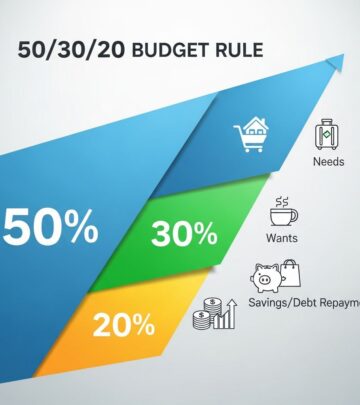
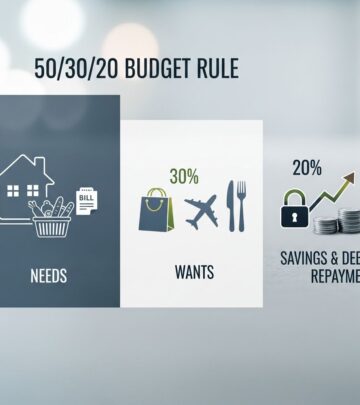
| 50/30/20 | 50% needs | 30% wants | 20% savings/debt |
70/20/10 allocates 70% to spending (including minimum debts), 20% to savings/investments, and 10% to extra debt or giving—ideal for balanced lifestyles. 20/10 suits those tackling high debt first, while others fit varied priorities.
Strategies to Get Back on Track if You Exceed Limits
Exceeding 20/10? Start with a debt inventory: list balances, rates, payments. Prioritize high-interest items via avalanche (highest rate first) or snowball (smallest balance first) methods. Boost income through gigs or cut non-essentials. Refinance where possible for lower rates. Track progress monthly, aiming for compliance within 6-12 months.
Long-Term Financial Growth Beyond the 20/10 Rule
Once compliant, leverage freed cash for wealth-building: automate savings, max retirement matches, invest in low-cost index funds. The rule’s discipline builds habits extending to all finances, like maintaining under 30% credit utilization for optimal scores. Regularly reassess as life changes—raises, family growth, or relocations.
Frequently Asked Questions (FAQs)
What counts as consumer debt under the 20/10 rule?
Credit cards, auto loans, student loans, personal loans, payday loans, and BNPL—but not mortgages or utilities.
Does the rule apply to gross or net income?
Strictly net (after-tax) take-home pay.
Can high earners ignore the 20/10 limits?
It scales with income, but customize if lifestyle demands more flexibility.
How does 20/10 affect my credit score?
Lower debt improves utilization and DTI, often raising scores.
Is there a 20/10 calculator app?
Yes, budgeting apps integrate this; search for debt ratio tools.
Advanced Tips for Debt Mastery
Integrate 20/10 with zero-based budgeting: assign every dollar a job, debt payments first within limits. Negotiate rates with creditors showing compliance progress. Build a sinking fund for future large purchases to avoid new debt. For couples, calculate jointly using combined net income for shared limits.
In corporate finance analogs, similar ratios guide business lending; individuals borrowing this mindset enhance personal outcomes. Studies from financial regulators emphasize low DTI for stability, aligning with 20/10’s conservative stance.
References
- What Is the 20/10 Rule: Definition and How to Use — The Muse. 2023. https://www.themuse.com/advice/20-10-rule
- What Is the 20/10 Rule of Thumb? — Experian. 2024-02-06. https://www.experian.com/blogs/ask-experian/what-is-the-20-10-rule/
- 70-20-10 Rule: Effective Budgeting Strategy — Business Insider. 2024. https://www.businessinsider.com/personal-finance/banking/70-20-10-budget
- What is the 70-20-10 Budget in Personal Finance? — Marietta Wealth. 2023. https://www.mariettawealth.com/what-is-the-70-20-10-budget-in-personal-finance/
- Fidelity’s easy budgeting guideline — Fidelity Investments. 2025. https://www.fidelity.com/learning-center/personal-finance/spending-and-saving
Similar Articles








Read full bio of Sneha Tete