Undefined Guide To Mastering Your Checkbook Reconciliation
Discover proven strategies to accurately reconcile your checking account and maintain precise financial control every month.

Reconciling your checking account remains a cornerstone of sound financial hygiene, even as digital banking dominates. This process ensures your personal records align perfectly with your bank’s figures, helping you detect errors, prevent overdrafts, and gain clarity on your spending habits. By routinely comparing your checkbook register or digital ledger against official bank statements, you empower yourself to make informed decisions and safeguard your funds.
Why Reconciling Your Account Matters Today
In an era of mobile apps and instant notifications, many overlook manual reconciliation, yet it provides unmatched precision. Bank statements might miss pending transactions visible only in your records, or vice versa. Regular reconciliation uncovers discrepancies like unrecorded fees, fraudulent activity, or simple math errors, potentially saving hundreds in overdraft charges annually. Financial experts emphasize that this habit fosters budgeting discipline and long-term wealth building.
Consider the risks of skipping this step: bounced checks incur fees up to $35 each, and overlooked autopay bills can lead to credit damage. Conversely, consistent reconciliation reveals patterns, such as excessive ATM withdrawals, enabling proactive adjustments to stay within budget.
Essential Tools for Effective Reconciliation
Before diving in, assemble these basics:
- Your current checkbook register, spreadsheet, or finance app ledger.
- The latest bank statement, either paper or digital PDF.
- Receipts for cash withdrawals, deposits, and debit purchases.
- A calculator for precise math, plus a pen for notations.
- Access to online banking for real-time balances and transaction history.
Digital tools like Google Sheets or apps from banks enhance accessibility, allowing updates from any device. For traditionalists, a printed register offers tactile reliability.
Step-by-Step Guide to Reconciling Your Checkbook
Follow this structured approach monthly, ideally right after receiving your statement.
Step 1: Record and Verify Starting Balance
Begin by noting your account’s opening balance from the prior reconciliation or bank records. Enter this in your register’s top line. Cross-check it against the bank’s reported starting figure to establish a common baseline. This prevents carryover errors from skewing results.
Step 2: Log All Known Transactions Promptly
Update your register with every activity: deposits, checks, debit swipes, ATM cash, and fees. Record them immediately—date, description, amount—for accuracy. Include pending items like uncleared checks or mobile deposits under hold. A running balance column keeps tallies current.
Step 3: Cross-Reference Bank Statement Entries
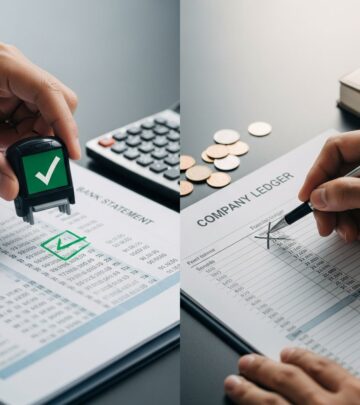
Systematically match each statement line to your register. Place checkmarks beside verified items on both documents. Look for omissions, such as autopay utilities or interest credits. Ignore cleared outstanding checks from prior periods once confirmed.
Step 4: Identify and Categorize Differences
Discrepancies fall into categories:
| Type | Description | Action |
|---|---|---|
| Outstanding Checks/Deposits | Items recorded by you but not yet by bank | Note and subtract/add from bank balance |
| Missing Entries | Forgotten fees, ATM charges, or payments | Add to register immediately |
| Bank Errors | Rare posting mistakes by institution | Contact bank with details |
| Math Errors | Addition/subtraction mistakes in register | Recalculate affected lines |
Adjust accordingly to bridge gaps.
Step 5: Compute Adjusted Balances
From your bank statement ending balance:
- Add deposits in transit (your records, not bank).
- Subtract outstanding checks/debits.
This “adjusted bank balance” should equal your register’s ending figure after updates. If not, repeat verification.
Step 6: Finalize and Document
Once matched, highlight the reconciled balance line. File statements securely and note the date. Celebrate accuracy and schedule the next review.
Overcoming Common Reconciliation Challenges
Errors happen; here’s how to fix them:
- Forgotten Fees: Banks charge for out-of-network ATMs or low balances—scan statements diligently.
- Timing Delays: Deposits or checks take days to clear; track them separately.
- Multiple Accounts: Reconcile each checking/savings account individually.
- Fraud Detection: Unfamiliar charges? Report within 60 days to limit liability per federal rules.
If imbalances exceed $5, investigate deeply; small differences often snowball.
Leveraging Technology for Smarter Tracking
Modern alternatives streamline the process:
- Mobile Apps: Bank apps auto-categorize spends and flag anomalies.
- Finance Software: Tools like Mint or YNAB import transactions for instant reconciliation.
- Spreadsheets: Custom Excel templates with formulas automate calculations.
Yet, hybrid methods—app data verified manually—offer the best oversight.
Building Lasting Habits for Financial Precision
Reconcile bi-weekly or post-statement arrival. Tie it to bill-paying routines. Teach family members for joint accounts. Over time, this builds intuition for cash flow, curbing impulse buys and aligning with savings goals.
Track categories monthly to visualize spending: housing (30%), food (15%), etc. Adjust budgets dynamically for optimal control.
Frequently Asked Questions
What if my checkbook never balanced before?
Start fresh: Copy your current online balance into a new register, log pendings, and proceed forward. Historical mismatches resolve over cycles.
How often should I reconcile?
Monthly minimum; weekly for high-activity accounts prevents buildup.
Do digital banks need reconciliation?
Yes—apps err too. Always verify against statements.
What if discrepancies persist?
Consult bank support or a advisor; persistent issues may signal deeper problems.
Advanced Tips for Financial Mastery
Zero-Based Budgeting Integration: Assign every dollar a job post-reconciliation.
Annual Review: Compare yearly trends for tax prep.
Emergency Fund Link: Maintain 3-6 months’ expenses separately, reconciled similarly.
These elevate basic tracking to strategic planning.
References
- Mastering The Art Of Balancing Your Checkbook – A Step-by-Step Guide — Busy Bee Advisors. 2023. https://busybeeadvisors.com/blog/mastering-the-art-of-balancing-your-checkbook-a-step-by-step-guide/
- How to Balance a Checkbook — American Express Credit Intel. 2024-01-15. https://www.americanexpress.com/en-us/credit-cards/credit-intel/how-to-balance-a-checkbook/
- How to Balance a Checkbook in 4 Steps — SoFi Learn. 2025-03-10. https://www.sofi.com/learn/content/how-to-balance-a-checkbook/
- How to Balance Your Checkbook — Michigan State University Extension (CANR). 2022-06-22. https://www.canr.msu.edu/news/how_to_balance_your_checkbook
- Easy Steps for Balancing Your Checking Account — Huntington Bank. 2024. https://www.huntington.com/-/media/pdf/BalancingWorksheet.pdf?rev=a3727d67be614614b13ccd228e65acea
Similar Articles








Read full bio of medha deb