APY Calculations Made Easy: Formula, Examples, And Tips
Unlock the power of APY to maximize your savings growth with step-by-step formulas, real-world examples, and expert strategies for smarter banking.

The Annual Percentage Yield (APY) represents the total return you can expect on your savings over a year, factoring in the magic of compounding interest. Unlike simple interest rates, APY provides a fuller picture of growth potential, helping savers make informed choices among banks and accounts.
Why APY Matters for Your Savings Strategy
APY stands out because it captures how interest builds on itself over time. Banks must disclose APY under the Truth in Savings Act (Regulation DD), ensuring transparency when comparing products like savings accounts, CDs, and money market funds. A higher APY signals faster growth, but understanding its calculation empowers you to verify rates and spot the best deals.
For everyday savers, grasping APY means distinguishing advertised rates from actual earnings. Compounding frequency—daily, monthly, or annually—amplifies returns, turning modest deposits into substantial nests over time.
The Core Formula Behind APY
At its heart, APY uses this standard equation: APY = (1 + r/n)^n – 1, where r is the nominal annual interest rate (as a decimal) and n is the number of compounding periods per year.
This formula, mandated by federal regulations, standardizes disclosures across institutions. For precision, tools from the Federal Financial Institutions Examination Council (FFIEC) allow direct computation aligned with Regulation DD.
Breaking Down the Variables
- Nominal Interest Rate (r): The base percentage promised by the bank, expressed as a decimal (e.g., 5% = 0.05).
- Compounding Periods (n): How often interest is added—365 for daily, 12 for monthly, 52 for weekly, or 1 for annually.
More frequent compounding boosts APY even if the nominal rate stays constant, as interest earns interest sooner.
Step-by-Step Guide to Manual APY Computation
Calculating APY manually builds confidence in evaluating offers. Start with a hypothetical: a 4% nominal rate compounded monthly (n=12).
- Divide rate by periods: 0.04 / 12 = 0.003333.
- Add 1: 1 + 0.003333 = 1.003333.
- Raise to power of n: 1.003333^12 ≈ 1.0407.
- Subtract 1: 1.0407 – 1 = 0.0407, or 4.07% APY.
For daily compounding at 4% (n=365): (1 + 0.04/365)^365 – 1 ≈ 4.08%, showing the edge of frequent cycles.
Using Online Calculators for Efficiency
While manual math works, APY calculators from reputable sites simplify inputs for initial deposits, contributions, and time horizons. They project balances, revealing how a 5% APY on $10,000 yields about $512 in year one with monthly compounding.
Real-World Examples: APY in Action
Consider two $20,000 savings scenarios over one year with daily compounding:
| Scenario | APY | Ending Balance | Interest Earned |
|---|---|---|---|
| Low-Yield Account | 2.00% | $20,408.11 | $408.11 |
| High-Yield Account | 4.00% | $20,833.00 | $833.00 |
Doubling the APY nearly doubles earnings, underscoring the value of shopping around.
Extend to five years: At 5% APY with monthly additions, a $500 starter grows differently based on contributions. Without extras, it hits $638.14; with $100 monthly, totals exceed $7,000, blending principal and compounded gains.
APY vs. Other Yield Metrics: Key Distinctions
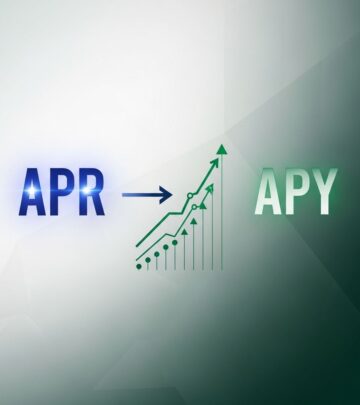
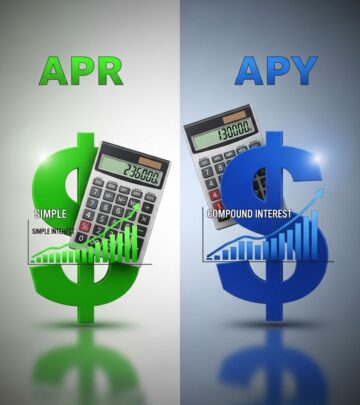
APY differs from APR (Annual Percentage Rate), which ignores compounding and suits loans. For deposits, APY reigns; for borrowing, APR highlights costs.
| Metric | Best For | Comes Compounding? | Federal Disclosure |
|---|---|---|---|
| APY | Savings/CDs | Yes | Required |
| APR | Loans/Cards | No | Required for credit |
| Nominal Rate | Base Comparison | No | Disclosed alongside |
APYE (APY Effective) assumes no withdrawals, per Truth in Savings Act, projecting ideal growth.
Factors That Influence Your Effective APY
Beyond the formula, real APY varies:
- Compounding Frequency: Daily trumps monthly—4% daily yields 4.08% APY vs. 4.07% monthly.
- Fees: Maintenance or minimum balance charges erode net yields; always subtract them.
- Inflation: If APY < inflation (e.g., 3% vs. 4%), purchasing power declines.
- Withdrawals: Early pulls reset compounding, lowering realized returns.
Strategies to Maximize APY Earnings
To supercharge savings:
- Hunt High-Yield Accounts: Online banks often offer 4-5%+ APYs vs. 0.01% at big chains.
- Leverage CDs: Lock in rates for terms; a 5% 1-year CD beats variable savings if rates drop.
- Add Regularly: Monthly deposits compound on growing principals.
- Monitor Rates: Switch when better APYs emerge, minding penalties.
- Automate Transfers: Consistent funding harnesses compounding without effort.
Pro tip: Use bank apps or statements for quoted APYs, then verify with formulas.
Common Pitfalls in APY Evaluation
Avoid these traps:
- Confusing nominal rates with APY—always calculate the latter.
- Ignoring fees that slash effective yields.
- Overlooking compounding details in fine print.
- Chasing teaser rates without long-term viability checks.
Federal tools ensure accuracy; cross-check bank claims.
Advanced APY Applications for Long-Term Planning
For retirement or goals, project multi-year growth. A $50,000 deposit at 4.5% APY, compounded daily, reaches $55,152 in two years—$5,152 earned. Add $500 monthly, and it surges to $68,240, with $18,240 in interest.
Inflation-adjusted, aim for APYs exceeding 3-4% annually. Tools factor contributions, revealing paths to $100,000+ nests.
Frequently Asked Questions
What is the difference between APY and interest rate?
Interest rate is nominal; APY includes compounding for true annual growth.
How often do banks compound interest?
Typically daily (365x), monthly (12x), or quarterly; check disclosures.
Can I calculate APY for partial years?
APY assumes full years, but prorated formulas or calculators handle shorter terms.
Does APY apply to checking accounts?
High-yield checkings may offer APY, but most pay zero; focus on savings/CDs.
Is a higher APY always better?
Yes for growth, but weigh liquidity, fees, and FDIC insurance.
Tools and Resources for APY Mastery
Leverage FFIEC calculators for regulation-compliant checks, bankrate-style simulators for scenarios, or institution apps for real-time quotes. Excel users: =POWER(1 + rate/periods, periods) – 1.
By demystifying APY, you position savings for optimal growth amid fluctuating rates.
References
- What Is Annual Percentage Yield (APY), and How Is It Calculated? — OneMain Financial. 2023. https://www.onemainfinancial.com/resources/money-management/what-is-apy
- What is APY and how is it calculated? — Fidelity. 2024. https://www.fidelity.com/learning-center/smart-money/what-is-apy
- How can I calculate the annual percentage yield (APY) on my account? — HelpWithMyBank.gov (CFPB). 2021-04-01. https://www.helpwithmybank.gov/help-topics/bank-accounts/savings-interest-bearing-accounts/savings-apy.html
- APY Interest Calculator — SoFi. 2025. https://www.sofi.com/calculators/apy-calculator/
- What is APY and How is it Calculated? — PNC Bank. 2024. https://www.pnc.com/insights/personal-finance/save/what-is-apy.html
- Simple Savings Calculator — Bankrate. 2025. https://www.bankrate.com/banking/savings/simple-savings-calculator/
Similar Articles








Read full bio of medha deb