APY Calculations: 5-Step Guide To Calculate Real Returns
Unlock the power of annual percentage yield to maximize your savings growth through precise calculations and smart strategies.
The
annual percentage yield (APY)
represents the real rate of return you’ll earn on savings or investments over a year, factoring in the magic of compound interest. Unlike simple interest rates, APY reveals the true earning potential by accounting for how often interest is added to your principal.Why APY Matters for Your Finances
Grasping APY empowers you to select high-yield accounts that accelerate wealth building. Banks advertise nominal rates, but APY exposes the compounded effect, helping you spot superior options. For instance, frequent compounding turns modest rates into substantial gains over time.
In a low-interest environment, even small APY differences compound significantly. A 4% APY on $10,000 grows to $10,408 in one year, versus $10,400 at 4% simple interest— a gap that widens yearly.
The Core Formula Behind APY
The standard equation for APY is:
APY = (1 + r/n)^n - 1
Here, r is the nominal annual interest rate (as a decimal), and n is the compounding periods per year. This formula assumes a full year and daily balance maintenance.
- Daily compounding (n=365): Maximizes growth through frequent additions.
- Monthly (n=12): Common for savings accounts.
- Quarterly (n=4): Less frequent but still effective.
For regulatory precision, the U.S. Consumer Financial Protection Bureau mandates a variant for variable terms:
APY = 100 × [(1 + Interest/Principal)^(365/Days in term) - 1]
This adjusts for actual durations, ensuring fair comparisons.
Step-by-Step Guide to Manual APY Computation
Calculate APY without tools using these steps for a 5% rate compounded monthly:
- Convert rate: r = 0.05.
- Divide by periods: 0.05 / 12 = 0.004167.
- Add 1: 1 + 0.004167 = 1.004167.
- Raise to power: 1.004167^12 ≈ 1.05116.
- Subtract 1: 1.05116 – 1 = 0.05116 or 5.116% APY.
This process highlights compounding’s boost: the effective yield exceeds the nominal 5%.
APY in Real-World Banking Products
Savings accounts, CDs, and money market funds quote APY to standardize comparisons. High-yield savings often compound daily, pushing APY above advertised rates.
| Product | Nominal Rate | Compounding | APY |
|---|---|---|---|
| Savings Account | 4.00% | Daily | 4.08% |
| CD (1-Year) | 5.00% | Monthly | 5.12% |
| Money Market | 3.50% | Quarterly | 3.54% |
These figures demonstrate how compounding frequency elevates returns.
Comparing APY to APR: Key Differences
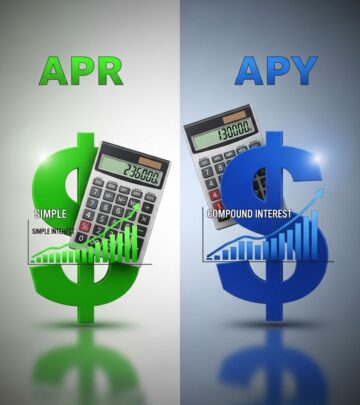
APY focuses on earnings with compounding, while
APR (annual percentage rate)
reflects borrowing costs, often excluding fees. For savers, prioritize APY; for loans, scrutinize APR.- APY always includes compounding effects.
- APR may not, leading to underestimations.
A 12% monthly compounded APR equates to 12.68% APY— a critical distinction for credit decisions.
Tools and Calculators for Effortless APY Analysis
Online APY calculators simplify inputs: enter rate, compounding frequency, and principal for instant results. They also project future balances, aiding goal-setting like emergency funds.
Advanced versions factor contributions, showing scenarios like $200 monthly deposits at 4.5% APY yielding $12,500 in five years.
Impact of Compounding Frequency on Earnings
More frequent compounding yields higher APY:
- Annually: Minimal boost.
- Semi-annually: Noticeable improvement.
- Daily: Optimal for growth.
On $5,000 at 3%:
| Frequency | APY | Year 1 Earnings |
|---|---|---|
| Annual | 3.00% | $150 |
| Monthly | 3.04% | $152 |
| Daily | 3.05% | $152.50 |
Daily wins by $2.50 annually, compounding to hundreds over decades.
Regulatory Standards for APY Disclosure
Federal rules require banks to display APY prominently, using average daily balances for accuracy. For tiered accounts, each level gets its APY.
Example: $1,000 at 5.39% daily compounded yields $53.90 interest, confirming the rate.
Strategies to Maximize Your APY Returns
- Shop high-yield online banks offering 4-5% APY versus 0.01% traditional.
- Maintain minimum balances to avoid rate drops.
- Leverage CDs for locked higher APYs.
- Automate transfers to capture promotional rates.
Reinvest earnings promptly to harness full compounding.
Common Pitfalls in APY Evaluation
Avoid these errors:
- Ignoring fees that erode yields.
- Overlooking variable rates tied to Fed funds.
- Confusing APY with simple interest.
- Forgetting inflation’s drag on real returns.
Always verify FDIC insurance up to $250,000.
Long-Term Projections with APY
APY shines in forecasting: $10,000 at 4.1% daily compounded grows to $14,802 in 5 years, $22,256 in 10. Use future value formulas for precision.
FAQs on APY Calculations
What is the difference between APY and interest rate?
Interest rate is nominal; APY includes compounding for the effective yield.
Does APY change with account balance?
Tiered accounts may adjust APY by balance levels.
Can I calculate APY for irregular deposits?
Use average daily balance methods per regulations.
Is higher APY always better?
Yes for liquidity-matched risk, but consider access restrictions.
How does inflation affect APY?
Real yield = APY minus inflation; aim above 2-3%[general knowledge].
Advanced APY for Investments
Beyond banks, APY applies to bonds or funds with reinvested dividends. Tools project compounded growth, vital for retirement planning.
References
- APY Calculator — Omni Calculator. 2023. https://www.omnicalculator.com/finance/apy
- Appendix A to Part 1030 — Annual Percentage Yield Calculation — Consumer Financial Protection Bureau. 2024-01-01. https://www.consumerfinance.gov/rules-policy/regulations/1030/A
- Annual Percentage Yield (APY) Calculator — CalculateStuff.com. 2023. https://www.calculatestuff.com/financial/apy-calculator
- What is APY and how is it calculated? — Fidelity Investments. 2025-06-15. https://www.fidelity.com/learning-center/smart-money/what-is-apy
- What is APY and How is it Calculated? — PNC Insights. 2024-11-20. https://www.pnc.com/insights/personal-finance/save/what-is-apy.html
- APY Interest Calculator — Axos Bank. 2025-02-01. https://www.axosbank.com/tools/calculators/apy-calculator
- APY Interest Calculator — SoFi. 2025-01-10. https://www.sofi.com/calculators/apy-calculator/
Similar Articles








Read full bio of Sneha Tete