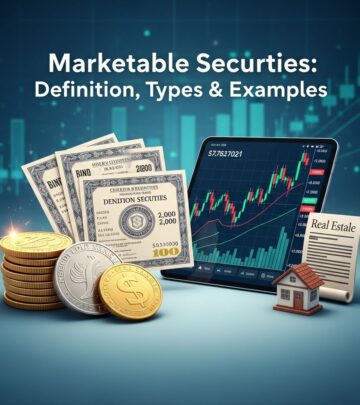
Marketable Securities: Definition, Types, and Investment Guide
Comprehensive guide to marketable securities: Learn types, characteristics, and investment strategies.

What Are Marketable Securities?
Marketable securities are financial instruments that can be quickly converted into cash at or near their market value. These investments represent ownership interests or debt obligations that are actively traded in established markets, making them highly liquid assets. For investors and corporations alike, marketable securities serve as an important component of investment portfolios, providing both income generation and capital appreciation opportunities while maintaining the flexibility to access funds when needed.
The term “marketable” is crucial to understanding this asset class. It means these securities can be sold in active, public markets with relative ease and without significant price concessions. Unlike illiquid assets such as real estate or private company shares, marketable securities offer investors the ability to convert their holdings into cash within a short timeframe, typically within days or even hours in some cases.
Key Characteristics of Marketable Securities
Marketable securities possess several defining characteristics that distinguish them from other types of investments:
- High Liquidity: These securities can be quickly sold in active markets without substantially affecting their price.
- Active Market Presence: They trade regularly on established exchanges or over-the-counter markets with numerous buyers and sellers.
- Standardized Terms: Marketable securities have consistent, standardized features and denominations that facilitate easy trading.
- Price Transparency: Market prices are readily available and updated frequently, allowing investors to make informed decisions.
- Low Transaction Costs: Trading expenses are generally minimal due to the high volume and efficiency of established markets.
- Regulatory Oversight: These securities operate under established regulatory frameworks that provide investor protection and market integrity.
Types of Marketable Securities
Equity Securities (Stocks)
Equity securities represent ownership interests in publicly traded companies. When investors purchase common or preferred stock, they become partial owners of the enterprise. Stocks are among the most widely traded marketable securities, offering investors the potential for dividend income and capital appreciation. Large-cap, mid-cap, and small-cap stocks all qualify as marketable securities when they trade on recognized exchanges. The stock market provides one of the most liquid and transparent environments for trading marketable securities, with billions of shares changing hands daily across various exchanges worldwide.
Debt Securities (Bonds)
Bonds are marketable securities that represent debt obligations of government entities or corporations. When investors purchase bonds, they are essentially lending money to the issuer in exchange for periodic interest payments and return of principal at maturity. Government bonds, corporate bonds, municipal bonds, and treasury securities all fall into this category. These fixed-income securities provide more predictable returns compared to stocks and appeal to conservative investors seeking steady income. The bond market is one of the largest and most liquid securities markets globally.
Money Market Instruments
Money market instruments are short-term debt securities that typically mature within one year. These include Treasury bills, commercial paper, and certificates of deposit (CDs). Money market instruments offer a safe parking place for cash and provide slightly higher returns than traditional savings accounts while maintaining excellent liquidity. These instruments are particularly popular with corporations and institutional investors seeking short-term investment opportunities with minimal risk.
Mutual Funds and Exchange-Traded Funds (ETFs)
Mutual funds and ETFs pool investor capital to purchase diversified portfolios of securities. These funds themselves are marketable securities that trade easily in the market. ETFs, in particular, offer the added benefit of intraday trading on stock exchanges, similar to individual stocks. Both types of funds provide investors with instant diversification and professional management while maintaining high liquidity.
Marketable Securities vs. Other Investments
| Characteristic | Marketable Securities | Non-Marketable Securities |
|---|---|---|
| Liquidity | High – can be sold quickly | Low – difficult to sell quickly |
| Market Access | Public exchanges or OTC markets | Private or limited markets |
| Price Transparency | Readily available | Not transparent |
| Trading Speed | Minutes to hours | Days to months |
| Transaction Costs | Minimal | Can be substantial |
| Examples | Stocks, bonds, Treasury bills | Real estate, private equity, collectibles |
Advantages of Marketable Securities
- Liquidity: The primary advantage is the ability to quickly convert investments to cash without significant losses.
- Portfolio Diversification: Investors can easily diversify across different asset classes, sectors, and geographies.
- Lower Risk: High liquidity reduces the risk of being trapped with an investment during market downturns.
- Reduced Costs: Lower transaction costs and spreads compared to illiquid investments enhance overall returns.
- Accessibility: Individual investors can participate in markets with relatively small capital amounts.
- Regulatory Protection: Strong regulatory frameworks provide investor safeguards and market integrity.
- Income Generation: Many marketable securities provide regular dividend or interest income.
- Price Discovery: Active markets ensure fair pricing based on supply and demand dynamics.
Disadvantages of Marketable Securities
Despite their many advantages, marketable securities come with certain drawbacks:
- Market Volatility: Prices fluctuate based on market conditions, economic factors, and investor sentiment, potentially leading to losses.
- Limited Control: Shareholders in large public companies have minimal influence over company decisions.
- Market Risk: Broad market downturns can negatively impact entire security classes simultaneously.
- Trading Costs: While relatively low, brokerage fees and spreads still reduce net returns.
- Information Overload: Constant market data and news can lead to emotional decision-making.
- Tax Implications: Capital gains and dividend income trigger tax liabilities that must be managed.
How Corporations Use Marketable Securities
Corporations frequently hold marketable securities as part of their cash management and investment strategy. Large companies with excess cash often invest in Treasury securities, commercial paper, or municipal bonds to generate returns while maintaining liquidity. These investments serve multiple purposes: they provide a cushion for unexpected expenses, generate income during periods of excess cash, and position the company for strategic acquisitions or investments. Marketable securities on the balance sheet represent highly liquid current assets that enhance a company’s financial flexibility and creditworthiness in the eyes of lenders and investors.
Accounting Treatment of Marketable Securities
Under accounting standards, marketable securities are classified as current assets if management intends to sell them within one year. They are typically valued at fair market value on the balance sheet, with unrealized gains or losses potentially affecting reported earnings depending on their classification. Securities designated as “trading securities” are marked to market each reporting period, while “available-for-sale” securities may have unrealized gains or losses reflected in other comprehensive income. This accounting treatment impacts financial reporting and can influence how investors perceive company profitability and financial health.
Market Liquidity and Trading Mechanisms
The liquidity of marketable securities depends on several factors including trading volume, bid-ask spreads, and market conditions. During normal market conditions, most marketable securities trade with tight spreads and high volume, facilitating easy entry and exit. However, during market stress or economic uncertainty, liquidity can deteriorate significantly as trading volumes decline and spreads widen. Understanding these market dynamics helps investors make better decisions about when to buy and sell securities.
Regulatory Framework
Marketable securities operate within a comprehensive regulatory framework designed to protect investors and ensure market integrity. In the United States, the Securities and Exchange Commission (SEC) oversees securities markets and enforces rules requiring disclosure, fair pricing, and prohibition of fraud. Similar regulatory bodies exist in other countries, collectively working to maintain confidence in capital markets. This regulatory oversight distinguishes marketable securities from unregulated investments and contributes to their widespread acceptance by institutional and individual investors.
Selecting Marketable Securities for Your Portfolio
When building an investment portfolio, investors should consider several factors when selecting marketable securities:
- Investment Objectives: Determine whether you’re seeking growth, income, or capital preservation.
- Risk Tolerance: Assess your comfort level with price volatility and potential losses.
- Time Horizon: Consider how long you can leave your money invested before needing access.
- Asset Allocation: Determine appropriate percentages for stocks, bonds, and cash equivalents based on your circumstances.
- Diversification: Spread investments across different securities, sectors, and geographies to reduce risk.
- Cost Considerations: Minimize fees, commissions, and expenses that erode returns.
- Tax Efficiency: Consider tax implications and use tax-advantaged accounts where appropriate.
Frequently Asked Questions
Q: What is the main difference between marketable securities and other investments?
A: The primary difference is liquidity. Marketable securities can be quickly converted to cash at market value in active markets, while other investments like real estate or private business interests may take months or years to sell and may require significant price concessions.
Q: Are all stocks marketable securities?
A: No, only stocks that trade on recognized public exchanges or active over-the-counter markets are considered marketable securities. Shares in private companies or restricted stock are not marketable securities due to limited trading opportunities.
Q: How do marketable securities appear on financial statements?
A: Marketable securities appear as current assets on the balance sheet when the company intends to sell them within one year. They are typically valued at fair market value, and changes in value may affect reported earnings depending on their classification.
Q: Can individual investors easily trade marketable securities?
A: Yes, individual investors can easily trade most marketable securities through brokerage accounts. Online trading platforms have made this process simple and affordable, with minimal commissions and instant execution for most securities.
Q: What role do marketable securities play in an emergency fund?
A: While money market funds and Treasury bills provide better returns than savings accounts while maintaining high liquidity, they should only be a portion of an emergency fund. The majority of emergency funds should typically remain in savings accounts for immediate, guaranteed access.
Q: How does market volatility affect marketable securities?
A: Market volatility causes prices of marketable securities to fluctuate. While this creates both opportunities and risks for traders, long-term investors who don’t need to access their funds immediately can typically ride out market volatility.
Q: Are government bonds considered marketable securities?
A: Yes, government bonds including Treasury bills, notes, and bonds are excellent examples of marketable securities. They trade actively in deep, liquid markets and can be sold quickly with minimal transaction costs.
References
- Securities and Exchange Commission (SEC) – Investor Information — U.S. Securities and Exchange Commission. 2025. https://www.sec.gov/investor
- Understanding Marketable Securities and Market Liquidity — U.S. Department of the Treasury. 2024. https://home.treasury.gov
- Financial Accounting Standards Board (FASB) – Standards on Investment Securities — FASB. 2024. https://www.fasb.org
- Bond Market Association – Fixed Income Securities Guide — SIFMA (Securities Industry and Financial Markets Association). 2024. https://www.sifma.org
- International Organization of Securities Commissions (IOSCO) – Standards for Market Integrity — IOSCO. 2024. https://www.iosco.org
Similar Articles








Read full bio of medha deb