Market Economy: Definition, Characteristics & Examples
Understand market economies: how free markets, competition, and self-interest drive economic systems.

What Is a Market Economy?
A market economy is an economic system characterized by competition and free trade, where private property rights and minimal government interference play central roles in determining economic outcomes. Unlike controlled economies where governments regulate key economic variables, market economies allow prices, production, and supply to respond organically to consumer demand through the decisions of individual participants and private organizations.
In a market economy, self-interest and profit motivation drive economic activity. The elementary components of price, production, and supply are not mandated by central authority but instead emerge from the interactions of millions of independent economic actors pursuing their own goals. This self-regulating mechanism, often referred to as the “invisible hand,” theoretically leads to increased efficiency, productivity, and optimal allocation of resources.
It is important to note that a truly pure laissez-faire economy—completely free from taxes, subsidies, and government manipulation—has never existed in recorded history. Most modern market economies incorporate some level of government intervention, regulation, and social safety nets, creating what economists call mixed economies.
Key Characteristics of Market Economies
Market economies share several defining features that distinguish them from other economic systems:
- Competition: Multiple buyers and sellers compete in markets, driving innovation and efficiency while keeping prices competitive.
- Free Trade: Goods, services, and capital flow relatively freely across markets with minimal barriers to exchange.
- Private Property Rights: Individuals and businesses own productive assets and have the right to use, control, and benefit from them.
- Limited Government Interference: Governments play a minimal role in dictating what is produced, how it is produced, and who consumes products.
- Consumer Sovereignty: Consumer preferences drive production decisions through their purchasing choices.
- Price Mechanism: Prices serve as signals that coordinate economic activity between producers and consumers.
- Profit Motive: Businesses seek to maximize profits, which incentivizes efficiency and innovation.
Historical Development of Market Economies
The concept of market economies evolved gradually over centuries as societies transitioned from isolated household economies to interconnected trading systems. In ancient times, individual households functioned as distinct economic units with minimal external trade. The term “economics” itself derives from the Greek phrase meaning “regulating one’s household,” reflecting this historical reality.
Ancient Greek and Medieval attitudes toward profit and commerce were often hostile. The ancient Greeks considered profit-seeking vulgar and detrimental to individual virtue and societal prosperity. This prejudice persisted into the Middle Ages and beyond. As late as the eighteenth century, charging interest on loans was condemned by major institutions including the Roman Catholic Church and the French government.
The gradual expansion of urban centers and increased demand for capital to meet basic needs prompted a slow relaxation of restrictions on trade and lending throughout Europe. This transition laid the groundwork for the emergence of modern market economies.
Adam Smith and The Wealth of Nations
The modern concept of market economies owes much to Scottish economist Adam Smith, whose seminal work “Inquiry into The Nature and Causes of the Wealth of Nations” (1776) provided a detailed theoretical foundation for market-based systems. Smith argued that a market economy unfettered by government control would naturally increase the potential for prosperity across society, yielding high moral character and increased cooperation.
Smith’s key insights included:
- Market economies driven by self-interest would result in efficient division of labor and specialization
- Increased productivity would stabilize supply and demand, creating the lowest possible prices for consumers
- Competition would encourage innovation and improvements in production methods
- Mutual benefit through voluntary exchange would strengthen social bonds
Smith’s theories proved highly influential in Western society and remain foundational to economic thought today. His concept of the “invisible hand”—the idea that individual self-interest promotes public good—remains central to understanding market dynamics.
Critiques of Market Economies
Despite Smith’s influential advocacy, market economies faced significant opposition from various thinkers and movements. Karl Marx’s “Das Kapital” (1867) presented an extensive critique of market economies and capitalism. Marx argued that owners of production exploit laborers by retaining the surplus value of commodities produced.
According to Marx, market economies inevitably generate class systems that pit the rich against the poor. The capitalist class accumulates wealth while workers receive only subsistence wages. Marx believed these inherent contradictions within market systems would ultimately cause their collapse, ideally leading to socialist or communist alternatives.
Other critiques of market economies include:
- Market failures when competition is insufficient or information asymmetries exist
- Externalities such as pollution that markets may not price correctly
- Income inequality and concentration of wealth
- Potential for monopolistic practices and anti-competitive behavior
- Inadequate provision of public goods like education and infrastructure
Market Economies vs. Controlled Economies
The distinction between market and controlled economies represents a fundamental axis of economic organization:
| Aspect | Market Economy | Controlled Economy |
|---|---|---|
| Price Determination | Set by supply and demand | Set by government authority |
| Production Decisions | Made by private businesses | Made by central planning authority |
| Property Rights | Primarily private ownership | Primarily state ownership |
| Government Role | Minimal intervention | Extensive control and regulation |
| Competition | Encouraged and essential | Limited or non-existent |
| Consumer Choice | Wide range of options | Limited selection |
Modern Complexities and Globalization
While American-style capitalism is often cited as the prime example of a market economy and communist states as representatives of controlled economies, the reality is significantly more complicated. In practice, many traditionally capitalist economies have incorporated substantial government subsidies, regulations, and controls. Conversely, communist and formerly communist systems have often eased their economic controls to stimulate growth and encourage foreign investment.
Globalization has particularly complicated traditional notions of market economies. Free and fair trade at both global and national levels can be hampered by differing levels of national government involvement through subsidies and regulation. Large, influential economies often employ protectionist measures that restrict free trade, contradicting pure market economy principles.
The World Trade Organization (WTO), established in 1995, serves as an international regulatory body intended to provide a neutral forum for international trade negotiations. The WTO establishes trade agreements aimed at ensuring a fair and competitive global market economy. However, the lure of global trade has prompted many traditionally controlled economies to loosen barriers, while countries of all sizes and government types continue to vary widely in their specific economic policies, which tend to be shaped by political and social pressures.
Mixed Economies in Practice
Most developed nations today operate mixed economies that blend market mechanisms with government intervention. These economies maintain market-based price systems and private ownership while also incorporating:
- Social safety nets and welfare programs
- Public provision of education, healthcare, and infrastructure
- Regulation of financial markets and consumer protection
- Environmental protections and labor standards
- Progressive taxation and redistribution policies
- Monetary policy management by central banks
The balance between market mechanisms and government intervention varies significantly across countries, reflecting different political philosophies, historical experiences, and cultural values.
Market Economies and Efficiency
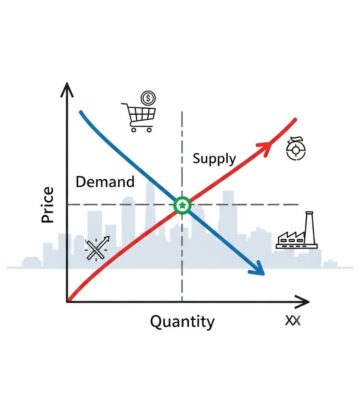
One of the primary arguments for market economies is their theoretical efficiency in allocating resources. Price signals in markets provide information about relative scarcity and desirability of goods, encouraging producers to allocate resources toward their most valued uses. When prices rise for a particular good, producers have incentives to increase supply, and consumers have incentives to economize on consumption. This self-adjusting mechanism theoretically prevents both shortages and surpluses.
Competition among producers drives continuous improvement in production methods, quality, and innovation. Businesses that fail to operate efficiently lose market share to competitors, creating strong incentives for operational excellence.
Challenges and Future Outlook
Market economies continue to face challenges in the twenty-first century. Broad trends toward or away from protectionism—especially by large, influential economies like the United States—continue to impact the reality of market economies. Trade wars, tariffs, and economic nationalism challenge the principle of free trade that underlies market economies.
Additionally, emerging issues such as climate change, pandemic response, technological disruption, and wealth inequality are prompting renewed debate about the appropriate balance between market mechanisms and government intervention. Many economists argue that certain challenges require coordinated policy responses that go beyond what pure market mechanisms can address.
Frequently Asked Questions
Q: What is the difference between a market economy and capitalism?
A: While related, these terms are not identical. A market economy is an economic system based on free markets and private property. Capitalism is an ideology emphasizing private ownership and profit maximization. Most capitalist economies are market economies, but market economies can exist with varying degrees of capitalist ideology.
Q: Can a market economy exist without any government intervention?
A: In theory, yes, but in practice, no truly pure market economy has ever existed in recorded history. All modern economies incorporate some government intervention in the form of regulations, taxation, and public services.
Q: How do prices work in a market economy?
A: Prices in market economies are determined by supply and demand. When demand exceeds supply, prices tend to rise, signaling producers to increase production. When supply exceeds demand, prices fall, encouraging consumption and discouraging production.
Q: What are examples of market economies?
A: The United States, United Kingdom, Germany, Japan, Canada, and Australia are often cited as examples of market economies, though all incorporate varying degrees of government intervention and are more accurately described as mixed economies.
Q: How does globalization affect market economies?
A: Globalization increases trade opportunities and competition but also complicates traditional market principles through government subsidies, protectionism, and varying regulatory standards across countries.
References
- Market economy — EBSCO Research Starters. 2025. https://www.ebsco.com/research-starters/economics/market-economy
- The World Trade Organization: A Primer on the WTO Dispute Settlement System — World Trade Organization. https://www.wto.org
- Smith, Adam. Inquiry into the Nature and Causes of the Wealth of Nations — 1776. Foundational economic text establishing market economy principles.
- Marx, Karl. Das Kapital — 1867. Comprehensive critique of market economies and capitalism.
Similar Articles








Read full bio of Sneha Tete