Market: Definition, Types, and How It Works
Understanding markets: Definition, functions, types, and their role in the economy.
What Is a Market?
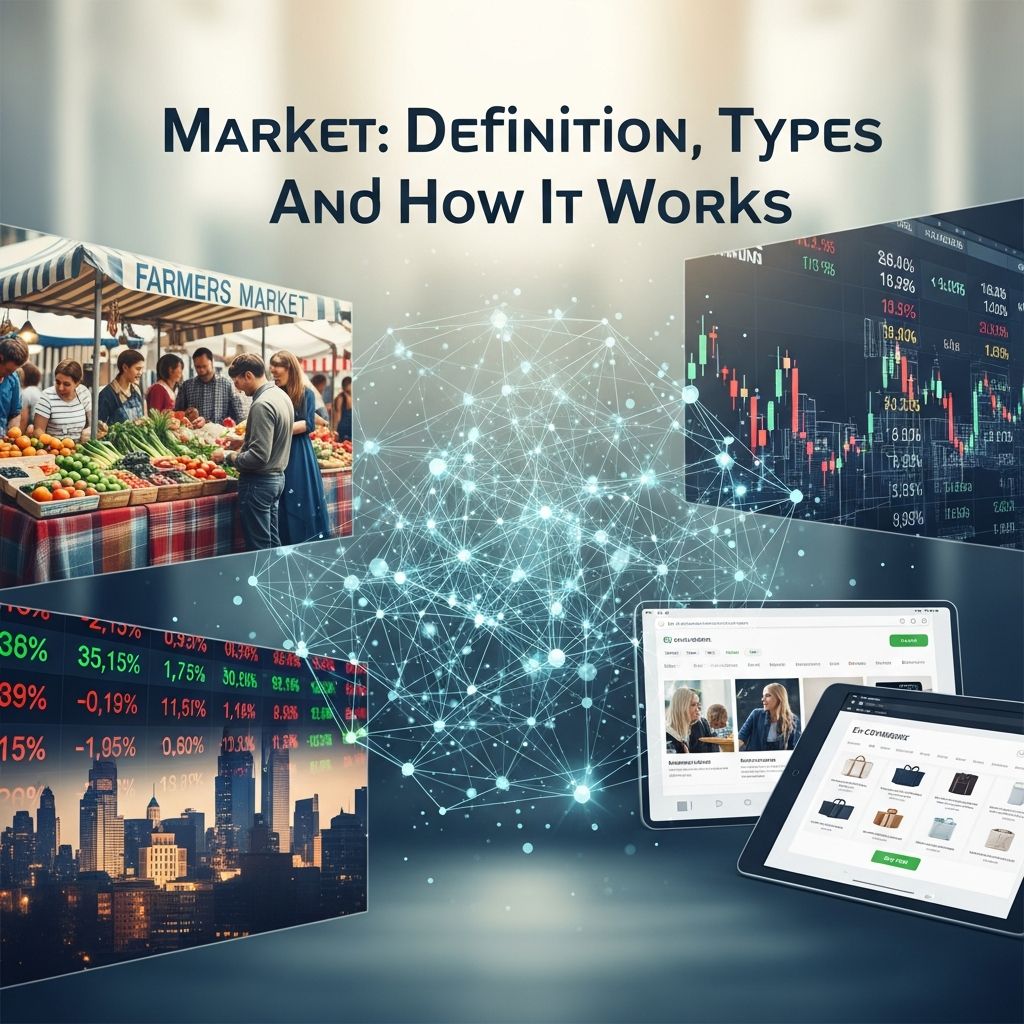
A market is any place or system where the exchange of goods, services, or securities occurs between buyers and sellers. The term market can refer to a physical location, such as a stock exchange, or to a virtual venue where transactions take place electronically. Markets are fundamental to the functioning of modern economies, facilitating the efficient allocation of resources and enabling price discovery through the interaction of supply and demand.
In economics, a market represents more than just a physical location. It encompasses all transactions for specific commodities or securities across different geographical locations and time periods. For instance, the global crude oil market includes all transactions of crude oil worldwide, whether they occur on trading floors in New York, London, or Dubai, or through electronic networks.
Key Characteristics of Markets
Markets possess several defining characteristics that enable their proper functioning:
- Price Discovery: Markets bring together buyers and sellers, allowing prices to be determined through supply and demand interactions.
- Liquidity: Markets provide liquidity, allowing participants to quickly buy or sell assets without significantly affecting prices.
- Transparency: Effective markets provide information about prices, transactions, and available opportunities to all participants.
- Regulation: Markets are typically regulated to protect participants and maintain fair trading practices.
- Access: Markets should be accessible to qualified participants, though some markets have restrictions based on participant status or investment requirements.
Types of Markets
Markets can be categorized in various ways depending on what is being traded, the structure of the market, and the participants involved.
Stock Market (Equity Market)
The stock market is where shares of publicly-traded companies are bought and sold. Investors purchase equity in companies, becoming partial owners and potentially receiving dividends. Stock markets serve as important indicators of economic health. Major stock exchanges include the New York Stock Exchange (NYSE), NASDAQ, London Stock Exchange (LSE), and Tokyo Stock Exchange (TSE). Stock markets allow companies to raise capital and investors to build wealth through ownership stakes in businesses.
Bond Market (Debt Market)
The bond market is where debt securities are traded. Bonds represent loans that investors make to corporations, governments, or other entities. In return, bondholders receive periodic interest payments and the return of principal at maturity. The bond market is significantly larger than the stock market by capitalization and includes government bonds, corporate bonds, municipal bonds, and international bonds. Bond markets are crucial for governments and corporations to finance operations and projects.
Commodity Market
The commodity market is where raw materials and primary products are traded, including oil, metals, agricultural products, and natural gas. These markets can be physical, with actual delivery of goods, or futures-based, where contracts for future delivery are traded. Commodity markets provide price discovery for essential resources and allow producers and consumers to hedge against price fluctuations.
Foreign Exchange Market (Forex Market)
The foreign exchange market, or forex market, is the global marketplace for trading currencies. It is the largest and most liquid market in the world, with trillions of dollars traded daily. The forex market facilitates international trade and investment, allows central banks to implement monetary policy, and provides opportunities for currency speculation.
Money Market
The money market is where short-term debt instruments are traded, typically with maturities of less than one year. This includes Treasury bills, commercial paper, and certificates of deposit. The money market provides liquidity and serves as a benchmark for short-term interest rates, influencing broader economic activity.
Real Estate Market
The real estate market encompasses the buying, selling, and leasing of property. Unlike financial markets, real estate markets are typically less liquid and more localized, though commercial real estate investment trusts (REITs) allow investors to gain exposure to real estate through securities markets.
Market Structures and Competition
Markets can be classified based on their competitive structure:
- Perfect Competition: Many buyers and sellers, homogeneous products, free entry and exit, and perfect information. Prices are determined by supply and demand.
- Monopolistic Competition: Many producers with differentiated products, some pricing power, but intense competition.
- Oligopoly: Few large firms dominate, significant barriers to entry, and strategic interdependence among competitors.
- Monopoly: Single producer with significant market power, high barriers to entry, and ability to set prices above competitive levels.
Supply and Demand in Markets
The interaction of supply and demand is the fundamental mechanism that drives market prices. When demand exceeds supply, prices tend to rise, incentivizing producers to increase production. Conversely, when supply exceeds demand, prices fall, reducing production incentives. This self-correcting mechanism helps markets reach equilibrium where quantity supplied equals quantity demanded.
Market prices signal information about scarcity and abundance. Rising prices indicate that a product is becoming scarcer relative to demand, while falling prices suggest oversupply. These price signals guide resource allocation across the economy, directing investments and production toward areas where they are most valued.
Market Efficiency
Market efficiency refers to how well prices reflect available information. In an efficient market, prices adjust quickly to new information, making it difficult to consistently earn above-average returns through active trading. There are three levels of market efficiency:
- Weak Form Efficiency: Prices reflect all past trading information; technical analysis cannot consistently beat the market.
- Semi-Strong Form Efficiency: Prices reflect all public information; fundamental analysis cannot consistently beat the market.
- Strong Form Efficiency: Prices reflect all information, public and private; insider trading would not generate abnormal returns.
Most financial markets are considered semi-strong efficient, meaning that while prices adjust quickly to public information, some opportunities may exist based on private information or market inefficiencies.
Market Volatility and Risk
Market volatility refers to the degree of price fluctuations in a market. High volatility indicates large and frequent price swings, while low volatility indicates more stable prices. Volatility is measured using statistical measures such as standard deviation or the VIX (Volatility Index) for stock markets.
Several factors influence market volatility:
- Economic data and announcements
- Interest rate changes
- Geopolitical events
- Corporate earnings reports
- Changes in investor sentiment
- Market manipulation or unusual trading patterns
Understanding volatility is crucial for investors as it affects portfolio risk and potential returns. Higher volatility can present both opportunities and risks for different types of investors.
Regulation of Markets
Markets are regulated by government agencies and self-regulatory organizations to protect investors, maintain fair competition, and ensure market integrity. In the United States, primary regulators include:
- Securities and Exchange Commission (SEC): Regulates securities markets and protects investors.
- Commodity Futures Trading Commission (CFTC): Oversees commodity and derivatives markets.
- Federal Reserve: Regulates banks and influences monetary policy and money markets.
- Self-Regulatory Organizations (SROs): Such as FINRA, which regulate brokers and dealers.
International markets have similar regulatory frameworks administered by their respective national authorities, such as the Financial Conduct Authority (FCA) in the United Kingdom and the European Securities and Markets Authority (ESMA) in Europe.
How Markets Determine Prices
Market prices are determined through continuous auctions where buyers and sellers submit bids and asks. The bid is the highest price a buyer will pay, while the ask is the lowest price a seller will accept. When a bid and ask price match, a transaction occurs. This price discovery mechanism ensures that market prices reflect the collective wisdom and information of all market participants.
Prices can be affected by numerous factors including earnings reports, economic indicators, changes in interest rates, geopolitical events, and shifts in investor sentiment. Market participants constantly reassess the value of assets based on new information, leading to continuous price adjustments.
Primary and Secondary Markets
Primary markets are where new securities are issued and sold for the first time. When a company goes public through an Initial Public Offering (IPO), it is selling securities in the primary market. Companies and governments use primary markets to raise capital for business expansion, infrastructure development, or debt management.
Secondary markets are where previously-issued securities are traded among investors. Stock exchanges like the NYSE and NASDAQ are secondary markets where investors buy and sell shares that were previously issued. Secondary markets provide liquidity and allow investors to exit positions without waiting until security maturity.
Market Participants
Various participants operate in financial markets:
- Individual Investors: Retail participants trading on their own behalf.
- Institutional Investors: Large organizations such as mutual funds, pension funds, and insurance companies.
- Market Makers: Firms that facilitate trading by maintaining inventories of securities and providing liquidity.
- Brokers and Dealers: Intermediaries who execute trades on behalf of clients or principal accounts.
- Central Banks: Participate in currency and money markets to implement monetary policy.
- Governments: Borrow through bond markets and sometimes participate in markets to achieve policy objectives.
Frequently Asked Questions
Q: What is the difference between a market and an exchange?
A: A market is a broader concept encompassing all transactions for a specific commodity or security, while an exchange is a specific venue or platform where transactions occur. For example, the stock market includes all stock transactions globally, while the NYSE is a specific exchange.
Q: Can markets exist without physical locations?
A: Yes, many modern markets are entirely electronic. The forex market, many bond markets, and cryptocurrency markets operate without physical trading floors, with transactions occurring through computer networks and electronic systems.
Q: What causes market crashes?
A: Market crashes can result from multiple factors including economic recessions, financial crises, geopolitical events, asset bubbles bursting, or panic selling. Often, crashes involve a combination of factors that undermine investor confidence.
Q: Why is market liquidity important?
A: Liquidity allows participants to quickly buy or sell assets without significant price movement. Without adequate liquidity, investors face challenges exiting positions, potentially leading to forced sales at unfavorable prices.
Q: How do central banks influence markets?
A: Central banks influence markets primarily through monetary policy decisions such as setting interest rates, conducting open market operations, and quantitative easing. These actions affect borrowing costs, inflation expectations, and investment returns.
Q: What is market sentiment?
A: Market sentiment refers to the overall attitude and emotional response of investors toward a market or security. Positive sentiment drives buying pressure, while negative sentiment leads to selling pressure, influencing prices beyond fundamental factors.
References
- Securities and Exchange Commission (SEC) — Investor.gov — U.S. Government. Accessed 2025. https://www.investor.gov/
- Board of Governors of the Federal Reserve System — The Structure of the Financial System — Federal Reserve. 2024. https://www.federalreserve.gov/
- International Organization of Securities Commissions (IOSCO) — IOSCO. 2024. https://www.iosco.org/
- World Bank — Financial Markets Overview — World Bank. 2025. https://www.worldbank.org/
- Commodity Futures Trading Commission (CFTC) — Market Oversight — U.S. Government. 2024. https://www.cftc.gov/
Similar Articles








Read full bio of medha deb