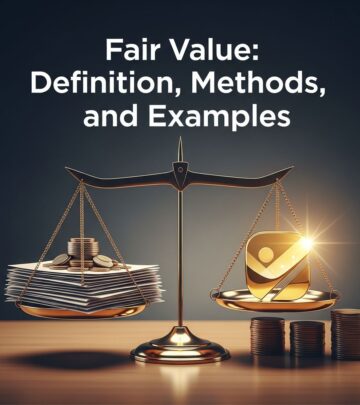
Mark to Market: Definition, How It Works & Examples
Understand mark-to-market accounting, fair value measurement, and its impact on financial reporting.

Mark-to-market (MTM), also known as fair value accounting, is a fundamental accounting method used to measure and report the current market value of assets and liabilities. Rather than relying on historical purchase prices, mark-to-market accounting adjusts asset and liability values to reflect their present fair market value. This approach has become increasingly important in modern finance, particularly in banking, investment management, and securities trading, where accurate and timely valuations are essential for stakeholders to make informed decisions.
What Is Mark to Market?
Mark-to-market is an accounting practice where financial instruments, assets, or liabilities are valued based on their current market price rather than their historical cost. The primary objective of mark-to-market accounting is to provide an accurate and transparent reflection of a company’s or institution’s financial position based on prevailing market conditions at any given point in time.
The term “marking to market” refers to the process of periodically adjusting the recorded value of these assets and liabilities to match their fair value in the open market. This ensures that financial statements present a realistic picture of what these assets would be worth if they were sold today, rather than what was paid for them in the past.
Mark-to-market differs significantly from historical cost accounting, the traditional accounting method where assets are recorded at their original purchase price and maintained at that value regardless of market fluctuations. While historical cost accounting provides stability and consistency, it often fails to reflect current economic reality, potentially misleading investors and other stakeholders about the true value of company assets.
How Mark-to-Market Works
The mechanics of mark-to-market accounting involve several key steps. First, companies identify all assets and liabilities that are subject to market price fluctuations. These typically include stocks, bonds, derivatives, mutual funds, and other tradable securities. Next, at each reporting period—whether daily, monthly, quarterly, or annually—the company determines the current fair market value of these instruments.
For actively traded securities with established market prices, this process is straightforward. The company simply uses the closing market price at the end of the reporting period. For less liquid assets or those without readily available market prices, companies may use comparable asset valuations, broker quotes, or sophisticated valuation models to estimate fair value.
Once the current market value is determined, the company adjusts its balance sheet to reflect this new value. If an asset has increased in value, the difference between the previous recorded value and the new market value is recognized as an unrealized gain. Conversely, if the asset has decreased in value, the difference is recorded as an unrealized loss. These gains and losses flow through the income statement, affecting reported profits and shareholders’ equity.
In practice, mark-to-market adjustments typically occur at the end of each trading day for active trading accounts. If an account’s value falls below a predetermined threshold, such as a maintenance margin requirement, the broker may issue a margin call requiring the investor to deposit additional funds or liquidate positions. This real-time monitoring helps manage risk and protect creditors from excessive losses.
Mark-to-Market vs. Historical Cost Accounting
Understanding the distinction between mark-to-market and historical cost accounting is crucial for evaluating financial statements. Historical cost accounting maintains asset values at their original purchase price, providing consistency and reducing manipulation of financial records. However, this approach becomes increasingly problematic in volatile markets where prices change dramatically.
Consider a practical example: A company purchases an office building for $1 million. Ten years later, the building’s market value has increased to $3 million. Under historical cost accounting, the building remains recorded at $1 million on the balance sheet, potentially undervaluing company assets. Under mark-to-market accounting, the asset would be recorded at its current fair value of $3 million, providing a more accurate representation of the company’s true financial position.
Mark-to-market accounting offers greater transparency and relevance for decision-making, especially for investors evaluating investment opportunities. However, it introduces greater volatility into financial statements, as asset values fluctuate with market conditions. During periods of market distress, this can lead to significant swings in reported earnings and equity.
Key Benefits of Mark-to-Market Accounting
Mark-to-market accounting provides numerous advantages for companies, investors, and financial markets:
Real-Time Valuation Accuracy — By reflecting current market prices, mark-to-market ensures that financial statements present the most accurate picture of asset values at any given moment. This real-time accuracy is particularly crucial in fast-moving markets where prices change rapidly and substantially.
Enhanced Decision-Making — Investors and stakeholders can make more informed decisions based on current market valuations rather than outdated historical costs. This transparency allows market participants to accurately assess investment performance and allocate capital more efficiently.
Improved Risk Management — By continuously monitoring the current market value of assets and liabilities, companies can better identify and manage financial risks. Mark-to-market accounting helps institutions understand their true exposure to market movements and adjust strategies accordingly.
Regulatory Compliance — Fair value accounting has been a standard requirement under Generally Accepted Accounting Principles (GAAP) in the United States since the early 1990s. Mark-to-market accounting helps companies comply with financial regulations that mandate fair value measurement of certain assets and liabilities.
Reduced Information Asymmetry — Mark-to-market accounting decreases the gap between what management knows about asset values and what investors understand, promoting fairness and transparency in financial markets.
Limitations and Criticisms of Mark-to-Market
Despite its benefits, mark-to-market accounting faces significant criticism, particularly from those who view it as a factor that can exacerbate financial crises.
Increased Volatility — Mark-to-market accounting can introduce substantial fluctuations into financial statements, as reported earnings and equity values swing with market movements. This volatility can create misleading impressions of company performance and financial stability.
Pro-Cyclical Effects — Critics argue that mark-to-market accounting amplifies market cycles. During downturns, declining asset values force companies to recognize losses, reducing capital and potentially triggering margin calls. This forces asset sales at depressed prices, further driving down market values and exacerbating the downturn.
Market Distress Issues — During financial crises, markets for certain assets become highly distressed, and prices may not accurately reflect the underlying economic value. For example, mortgage-backed securities during the 2008 financial crisis faced thin trading volumes at prices that may have undervalued their actual cash flow potential.
Valuation Challenges for Illiquid Assets — For assets without active markets or reliable price data, determining fair value becomes subjective and difficult. This can lead to inconsistent valuations and potential manipulation.
Mark-to-Market in Different Industries
Mark-to-market accounting is particularly prevalent in certain sectors where asset values fluctuate regularly and significantly:
Banking and Financial Services — Banks use mark-to-market accounting to value trading portfolios, investment securities, and derivatives. This helps ensure accurate reporting of capital levels and risk exposure, which is critical for regulatory oversight and depositor protection.
Investment Management — Investment firms employ mark-to-market methods to report the net asset value (NAV) of mutual funds, hedge funds, and other investment vehicles. This allows investors to understand the true value of their holdings.
Trading and Securities — Brokers and trading firms use mark-to-market accounting to monitor client accounts, calculate margin requirements, and manage trading risk in real time.
Insurance Companies — Insurers use mark-to-market accounting for their investment portfolios, which often contain substantial holdings of bonds, equities, and alternative investments.
The Role of Fair Value Hierarchy
Under modern accounting standards, companies must follow a fair value hierarchy when determining mark-to-market values. The hierarchy consists of three levels, prioritizing more reliable valuation inputs:
Level 1 — Uses quoted prices in active markets for identical assets or liabilities. This represents the most reliable valuation source.
Level 2 — Uses observable inputs other than quoted prices, such as prices for similar assets, interest rates, or other market-based data.
Level 3 — Uses unobservable inputs when market data is unavailable, relying on company estimates and models. This approach requires the greatest judgment and carries the highest potential for valuation errors.
Mark-to-Market and Financial Crisis
The role of mark-to-market accounting in the 2008 financial crisis generated significant debate among policymakers and economists. Some argue that mark-to-market accounting standards exacerbated the crisis by forcing financial institutions to recognize massive losses on mortgage-backed securities and other assets, reducing reported capital levels and triggering margin calls and asset sales at fire-sale prices.
Others contend that mark-to-market accounting simply revealed the true extent of losses that had occurred, and that accounting methodology was not the primary cause of the crisis. The debate highlighted the tension between accounting reliability and market stability, particularly during periods of severe market distress.
Practical Example of Mark-to-Market
Consider a practical scenario to illustrate mark-to-market accounting. Suppose an investment company purchases 1,000 shares of XYZ Corporation at $50 per share for a total of $50,000 on January 1st. At the end of the first quarter, XYZ shares are trading at $55, so the company marks this investment to market at $55,000, recognizing a $5,000 unrealized gain. At the end of the second quarter, XYZ shares decline to $48, and the company adjusts the value to $48,000, recognizing a $7,000 unrealized loss. These gains and losses flow through the income statement quarterly, creating volatility in reported earnings even though the company hasn’t sold the shares.
Frequently Asked Questions
What is mark-to-market accounting?
Mark-to-market (MTM) accounting is a method where assets and liabilities are valued based on their current market price rather than their historical purchase cost. This approach ensures that financial statements reflect the true economic value of assets and liabilities at a specific point in time.
How does mark-to-market affect financial statements?
Mark-to-market accounting causes financial statements to reflect the current market value of assets and liabilities. Unrealized gains and losses from price changes flow through the income statement, creating volatility in reported earnings and affecting shareholders’ equity. This provides more accurate valuations but can make financial performance appear more volatile.
Which industries use mark-to-market accounting?
Industries such as banking, investment management, securities trading, and insurance commonly use mark-to-market accounting. Any sector where assets are frequently traded or subject to significant price changes relies on this accounting method to reflect real-time valuations.
What is the difference between mark-to-market and historical cost accounting?
Historical cost accounting records assets at their original purchase price and maintains that value on the balance sheet. Mark-to-market accounting adjusts asset values to reflect their current fair market value. Mark-to-market provides more accurate current valuations but introduces volatility, while historical cost provides stability but may become outdated.
Did mark-to-market accounting cause the 2008 financial crisis?
This remains debated among economists. Some argue that mark-to-market accounting standards exacerbated the crisis by forcing institutions to recognize massive losses on distressed assets. Others contend that the accounting method simply revealed underlying problems rather than causing the crisis. Most experts believe multiple factors, including excessive leverage and risky lending practices, were primary causes.
How frequently is mark-to-market performed?
Mark-to-market adjustments typically occur daily for active trading accounts and at the end of each reporting period (monthly, quarterly, or annually) for financial statements. The frequency depends on the nature of the assets and regulatory requirements.
References
- Mark to Market (MTM) & How it Works — Appreciate Wealth. 2024. https://appreciatewealth.com/blog/mark-to-market
- Mark to Market – Overview, Importance, Practical Example — Corporate Finance Institute. 2024. https://corporatefinanceinstitute.com/resources/valuation/mark-to-market/
- Mark-to-Market Accounting — Wikipedia. Accessed 2024. https://en.wikipedia.org/wiki/Mark-to-market_accounting
- Mark to Market: Accounting and Finance Definition & Examples — Career Principles. 2024. https://www.careerprinciples.com/resources/what-is-mark-to-market-mtm
Similar Articles








Read full bio of Sneha Tete