Marginal vs. Effective Tax Rate: Key Differences
Understand the difference between marginal and effective tax rates to better manage your finances.
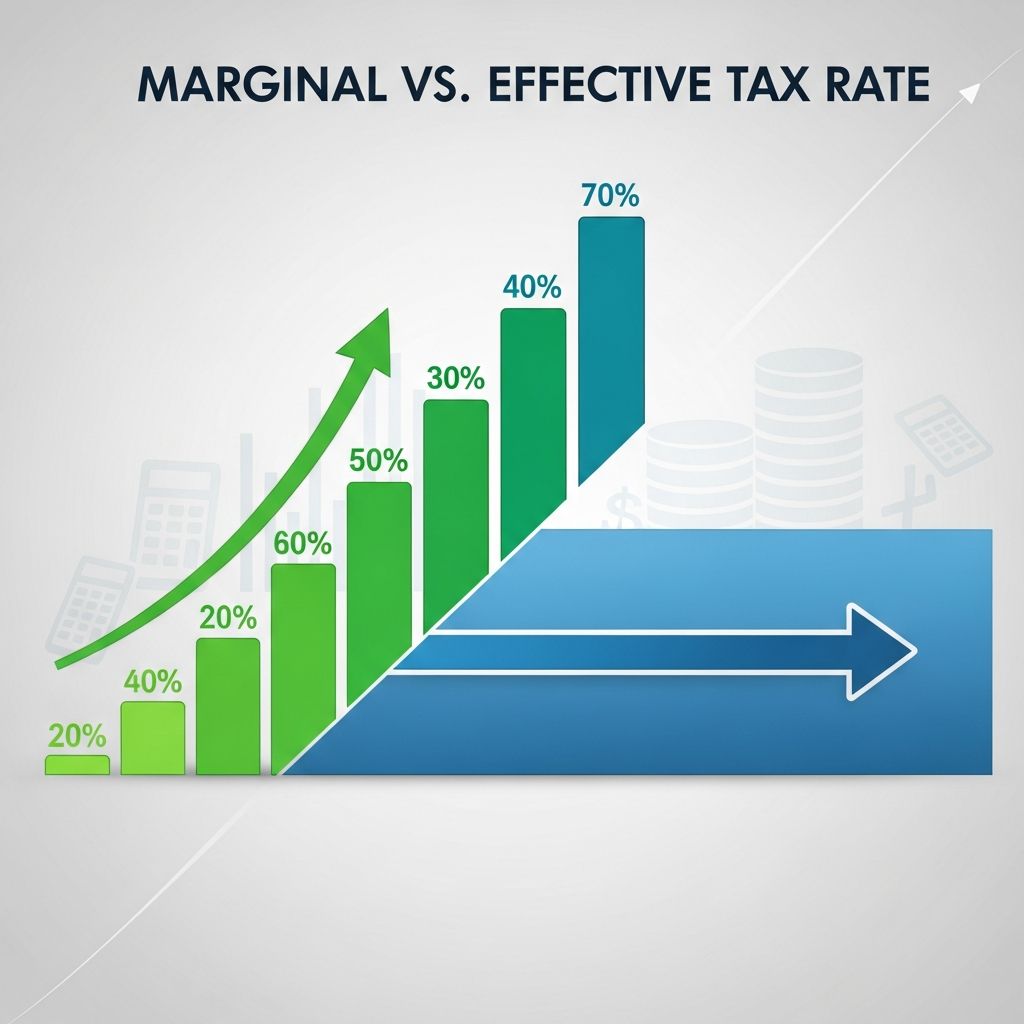
Understanding Marginal vs. Effective Tax Rates
When it comes to managing your personal finances and understanding your tax obligations, two key concepts frequently emerge: marginal tax rate and effective tax rate. Many people confuse these terms or use them interchangeably, but they represent fundamentally different aspects of how the U.S. tax system works. Grasping the distinction between these two rates is essential for making informed financial decisions, planning your budget, and comprehending what you’ll actually owe the IRS at the end of the tax year.
The United States employs a progressive income tax system rather than a flat tax structure. This means that as your income increases, you move into higher tax brackets, each with its own corresponding tax rate. Your marginal tax rate specifically refers to the tax rate applied to your last dollar of income, while your effective tax rate represents the average tax rate you pay across all your taxable income. Understanding how these rates work together is crucial for effective financial management and tax planning.
What Is Your Marginal Tax Rate?
Your marginal tax rate is the tax rate that applies to the portion of income falling within your highest tax bracket. In simpler terms, it’s the rate imposed on your last dollar of earned income. As your total income increases, you progress through successively higher tax brackets, and your marginal rate rises accordingly.
To illustrate this concept, consider a single filer in 2025. If your taxable income is $50,000, your marginal tax rate is 12 percent, meaning the final dollars you earn are taxed at that rate. However, if your taxable income reaches $150,000, your marginal tax rate jumps to 24 percent. This progression is what defines the progressive nature of the American tax system.
It’s important to understand that you don’t pay your marginal rate on your entire income. Rather, you pay different rates on different portions of your income based on which tax bracket each portion falls into. Your first dollar earned is taxed at the lowest bracket rate, and subsequent dollars are taxed at progressively higher rates as you move up through the brackets, until you reach your marginal bracket where your highest-earning dollars are taxed.
What Is Your Effective Tax Rate?
Your effective tax rate tells you what percentage of your annual income you actually paid to the IRS in taxes. It’s calculated by dividing your total tax liability by your taxable income and multiplying by 100 to express it as a percentage. This rate provides a rough estimate of your actual tax burden and can help you budget and plan for future tax obligations.
The effective tax rate is often significantly lower than your marginal tax rate because of the progressive bracket system. Since you only pay the highest rate on income within your highest bracket, and lower rates on income in lower brackets, your average rate across all income is typically much less than your marginal rate.
How to Calculate Your Effective Tax Rate
Calculating your effective tax rate is straightforward once you have the necessary information. You’ll need two key pieces of data: your total tax liability and your taxable income. Both figures appear on your annual tax return.
On Form 1040, you can find your taxable income on line 15 and your total tax on line 24. Once you’ve located these numbers, the calculation is simple: divide your total tax liability by your taxable income, then multiply the result by 100 to convert it to a percentage.
Example: If your taxable income was $100,000 and you paid $20,000 in federal income taxes, your effective tax rate would be calculated as follows: $20,000 ÷ $100,000 = 0.20, which equals a 20 percent effective tax rate. This means you paid an average of 20 cents in federal income tax for every dollar of taxable income you earned.
How Tax Brackets Work
The U.S. federal tax system divides income into brackets, with each bracket having its own designated tax rate. These brackets are defined by income ranges, and your income is taxed progressively through each bracket as you climb the income ladder.
For 2025, the federal tax brackets for single filers include rates of 10 percent, 12 percent, 22 percent, 24 percent, 32 percent, 35 percent, and 37 percent. Each bracket is associated with a specific income range. Income within the lowest bracket is taxed at 10 percent, income in the next bracket is taxed at 12 percent, and so on, until all your income has been accounted for.
Your first dollar earned will be taxed at the rate for the lowest tax bracket, and you’ll continue paying the specified tax rate on income within each successive bracket until you’ve reached the bracket that contains your final taxable income. This is why your effective tax rate is calculated as an average—you’re combining taxes paid at multiple different rates across different portions of your income.
2025 Federal Tax Brackets
Understanding the current tax brackets is essential for calculating both your marginal and effective tax rates. The following table displays the 2025 federal income tax brackets for different filing statuses:
| Tax Rate | Single | Married Filing Jointly | Head of Household |
|---|---|---|---|
| 10% | $0 to $11,925 | $0 to $23,850 | $0 to $17,950 |
| 12% | $11,925 to $48,475 | $23,850 to $95,375 | $17,950 to $68,525 |
| 22% | $48,475 to $103,350 | $95,375 to $182,100 | $68,525 to $103,650 |
| 24% | $103,350 to $197,300 | $182,100 to $231,250 | $103,650 to $197,300 |
| 32% | $197,300 to $250,525 | $231,250 to $280,700 | $197,300 to $250,525 |
| 35% | $250,525 to $626,350 | $280,700 to $426,400 | $250,525 to $626,350 |
| 37% | $626,350 or more | $426,400 or more | $626,350 or more |
Source: Internal Revenue Service
Real-World Example: Calculating Both Rates
Let’s work through a practical example to illustrate how both marginal and effective tax rates apply to a real taxpayer. Consider a married couple filing jointly with $120,000 in taxable income for 2025.
Using the tax brackets above, here’s how their tax liability breaks down:
- First $23,850 taxed at 10% = $2,385
- Next $71,250 (from $23,850 to $95,100) taxed at 12% = $8,550
- Remaining $24,900 (from $95,100 to $120,000) taxed at 22% = $5,478
Total tax owed: $16,413
To calculate their effective tax rate: $16,413 ÷ $120,000 = 0.1368, or approximately 13.68 percent. This is their actual average tax rate across all income.
Their marginal tax rate, however, is 22 percent—the rate applied to their last dollar of income, which falls in the 22 percent bracket. This demonstrates the significant difference between these two rates. While their last dollar is taxed at 22 percent, on average they’re only paying about 13.68 percent across all their income.
Why the Difference Matters
Understanding the distinction between marginal and effective tax rates is crucial for several reasons. Many people mistakenly believe their marginal rate represents what they pay on all their income, which can lead to inaccurate financial planning and budgeting. In reality, your effective rate is what truly matters when determining your overall tax burden.
Additionally, knowing your marginal rate is important for making investment and financial decisions. When you’re considering additional income, bonuses, or investment returns, those additional dollars will be taxed at your marginal rate, not your effective rate. This information helps you evaluate whether certain investments or income-generating activities are worth pursuing after considering the tax impact.
Furthermore, your effective tax rate gives you a realistic picture of what percentage of your total income goes to federal taxes, helping you understand your true disposable income and plan your budget accordingly. This is particularly valuable for long-term financial planning and retirement savings strategies.
How Progressive Taxation Creates the Difference
The reason marginal and effective tax rates differ has everything to do with the progressive nature of the U.S. federal income tax system. Rather than taxing everyone at a single flat rate, the tax code uses a tiered bracket system where progressively higher income is taxed at progressively higher rates.
This progressive structure means that lower-income portions of your earnings face lower tax rates, while only your highest-earning dollars face the highest rates. Because of this design, your average tax rate (effective rate) across all your income will typically be considerably lower than the rate applied to your highest-earning dollars (marginal rate).
For example, a married couple filing jointly with $731,201 in annual taxable income faces a marginal federal income tax rate of 37 percent on their last dollar, but their effective federal income tax rate is only approximately 25.5 percent. Their income simply isn’t all taxed at the 37 percent rate; only the portion exceeding the 35 percent bracket threshold is taxed at that highest rate.
Special Situations and Considerations
In certain circumstances, your effective tax rate might be surprisingly low or even negative. For instance, if you’re a married couple filing jointly with taxable income less than $23,200 annually, you benefit from the standard deduction. Depending on your specific situation, your effective tax rate could be negative due to tax credits such as the Earned Income Tax Credit (EITC), which actually results in the federal government sending you money rather than you owing taxes.
Similarly, as your income increases substantially, there can be significant disparity between your marginal and effective rates. The higher your income, the more pronounced this difference typically becomes, since a larger portion of your income has accumulated in lower brackets before reaching your marginal bracket.
Using This Knowledge for Financial Planning
Armed with an understanding of both your marginal and effective tax rates, you can make more informed financial decisions. When evaluating whether to take on additional work, pursue a side business, or accept investment income, consider that this additional income will be taxed at your marginal rate, not your effective rate. This helps you realistically assess the after-tax benefits of any new income source.
Additionally, understanding your effective tax rate helps you budget for future tax obligations and plan for major life changes like retirement or significant income increases. By knowing what percentage of your income typically goes to federal taxes, you can more accurately project your tax bills and plan your finances accordingly.
Frequently Asked Questions
Q: Is my marginal tax rate or effective tax rate more important?
A: Both are important but serve different purposes. Your effective tax rate shows what you actually pay overall, while your marginal rate indicates what you’ll pay on additional income. For budgeting and understanding your true tax burden, your effective rate is typically more meaningful.
Q: Will I always pay my marginal rate on new income?
A: Yes, any additional income you earn will be taxed at your current marginal rate (or potentially a higher rate if it pushes you into the next bracket). This is why it’s important to know your marginal rate when evaluating new income opportunities.
Q: Can my effective tax rate ever exceed my marginal rate?
A: No. Due to the progressive structure of tax brackets, your effective rate will always be equal to or lower than your marginal rate. It cannot exceed it.
Q: How do I find my exact tax rates on my tax return?
A: Calculate your effective rate using your total tax liability (Form 1040, line 24) divided by your taxable income (line 15). Your marginal rate is determined by which tax bracket your taxable income falls into based on the current year’s tax brackets and your filing status.
Q: Do state taxes affect my federal marginal and effective rates?
A: Federal rates are calculated independently of state taxes. However, you’ll have separate marginal and effective rates for state taxes as well, calculated using the same principles but applied to your state’s tax brackets and rates.
References
- Federal Income Tax Rates and Brackets — Internal Revenue Service. 2025. https://www.irs.gov/filing/federal-income-tax-rates-and-brackets
- Marginal vs. Effective Tax Rate: What’s The Difference? — Bankrate. https://www.bankrate.com/taxes/marginal-vs-effective-tax-rate/
- What Do Marginal and Effective Tax Rates Mean for You? — UBS Global Wealth Management. https://www.ubs.com/global/en/wealthmanagement/insights/marketnews/article.1058799.html
- Understanding Marginal vs. Effective Tax Rates — Morningstar Canada. https://global.morningstar.com/en-ca/personal-finance/understanding-marginal-vs-effective-tax-rates
- Why The Difference Between Marginal and Effective Tax Rates Matters — Russell Investments. https://russellinvestments.com/us/blog/taxman-theres-one-for-you-nineteen-for-me
- Marginal and Effective Tax Rates — Financial Success, Florida State University. https://financialsuccess.fsu.edu/taxes/marginal-and-effective-tax-rates
Similar Articles








Read full bio of medha deb