Marginal Propensity to Consume: MPC Explained
Understand how MPC influences consumer spending, savings, and economic multiplier effects.
What Is Marginal Propensity to Consume (MPC)?
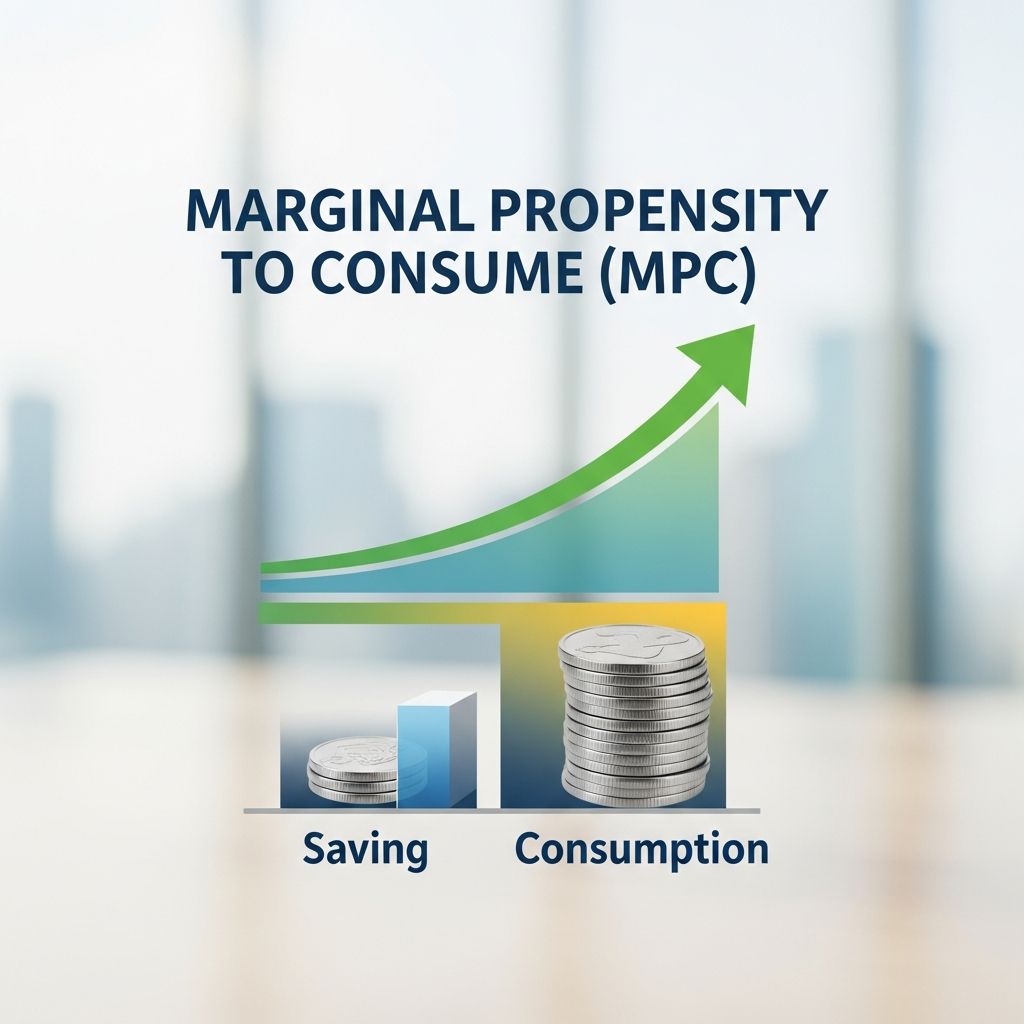
Marginal propensity to consume (MPC) is a fundamental economic concept that measures the proportion of an aggregate increase in income that a consumer allocates toward spending on goods and services rather than saving it. In essence, MPC quantifies consumer behavior in response to changes in disposable income, providing insights into how much of each additional dollar earned will be directed toward consumption versus savings.
MPC is a cornerstone component of Keynesian macroeconomic theory, which emphasizes the role of aggregate demand in driving economic growth and employment. The concept was developed by economist John Maynard Keynes and remains central to modern macroeconomic policy analysis. Understanding MPC is essential for policymakers, economists, and investors seeking to predict economic outcomes and design effective fiscal stimulus measures.
The calculation of MPC is straightforward: it equals the change in consumption divided by the change in income. This ratio produces a decimal value between 0 and 1, where higher values indicate greater consumer spending propensity and lower values suggest higher savings preferences. For example, if a consumer receives a $500 bonus and spends $400 on a new suit while saving $100, the MPC would be 0.80 (calculated as $400 divided by $500).
Understanding MPC in Simple Terms
At its core, MPC measures the fraction of additional income that people spend rather than save. When individuals receive extra income—whether through wage increases, bonuses, tax refunds, or other sources—they face a choice: spend the money or put it aside for future use. MPC captures this behavioral decision by showing what percentage of that new income gets devoted to immediate consumption.
The relationship between income levels and MPC reveals important patterns in consumer behavior. Generally, individuals with lower incomes demonstrate higher marginal propensity to consume because their basic needs for food, shelter, and utilities consume a larger portion of their earnings. When lower-income earners receive additional income, they tend to spend most of it on necessities and immediate wants, leaving little room for saving.
Conversely, higher-income individuals typically exhibit lower marginal propensity to consume. Since their fundamental consumption needs are already satisfied, additional income is more likely to be directed toward savings, investments, or purchases of luxury items that represent smaller portions of their total income. This inverse relationship between income levels and MPC has significant implications for understanding wealth distribution and economic inequality.
How to Calculate Marginal Propensity to Consume
Calculating MPC requires identifying two key variables: the change in consumption and the change in income. The formula is expressed as:
MPC = Change in Consumption ÷ Change in Income
To illustrate with a practical example, consider an individual who receives a $1,000 annual salary increase. If this person decides to spend $800 of the additional income on various goods and services while saving $200, the MPC calculation would be:
MPC = $800 ÷ $1,000 = 0.80
This result indicates that for every additional dollar of income, the consumer spends 80 cents and saves 20 cents. Another scenario involves someone receiving a $500 bonus who spends $400 and saves $100, yielding an MPC of 0.80 ($400 ÷ $500).
It’s important to note that MPC values range from 0 to 1. An MPC of 0 means a consumer saves all additional income and spends nothing, while an MPC of 1 indicates the consumer spends all additional income without saving. In reality, most individuals fall somewhere between these extremes, typically maintaining an MPC between 0.5 and 0.9 depending on various economic and personal factors.
The Relationship Between MPC and Marginal Propensity to Save
MPC and marginal propensity to save (MPS) are complementary concepts that together account for how consumers allocate all additional income. The fundamental relationship is expressed mathematically as:
MPC + MPS = 1
This equation reflects an economic truth: every dollar of additional income must be either spent or saved; there is no third option. Using the earlier example of a $500 bonus where $400 is spent and $100 is saved, the MPS would be calculated as:
MPS = $100 ÷ $500 = 0.20
Adding these values confirms the relationship: 0.80 (MPC) + 0.20 (MPS) = 1.00. This complementary relationship is crucial for economic modeling because understanding one automatically provides information about the other. If an economy has an average MPC of 0.75, it necessarily has an average MPS of 0.25.
In scenarios where consumers make different choices with additional income, the relationship remains consistent. If an individual receives a $500 bonus and saves the entire amount, spending nothing, the MPC would be 0 ($0 ÷ $500) and the MPS would be 1 ($500 ÷ $500). Alternatively, if the person spends all $500, the MPC would be 1 and the MPS would be 0. These extreme cases, while less common in practice, illustrate the mathematical relationship perfectly.
MPC and the Consumption Function
The consumption function is a graphical representation of the relationship between income changes and consumption changes, with MPC as a key component. This consumption line is created by plotting the change in consumption on the vertical y-axis and the change in income on the horizontal x-axis. The slope of this line is the MPC itself, providing a visual representation of consumer spending behavior.
In the consumption function graph, the steeper the slope, the higher the MPC, indicating that consumers are more responsive to income increases by spending more. Conversely, a gentler slope suggests a lower MPC, meaning consumers are more inclined to save additional income. This graphical tool has proven invaluable for economists analyzing consumer behavior trends and predicting future spending patterns based on anticipated income changes.
The consumption function also typically includes an intercept on the vertical axis representing autonomous consumption—the amount consumers spend even when income is zero. This might be funded through savings, borrowing, or government transfers. The overall consumption line equation can be expressed as: C = a + (MPC × Y), where C represents consumption, a represents autonomous consumption, MPC is the marginal propensity to consume, and Y represents income.
The Role of MPC in Economic Stimulus and the Multiplier Effect
In Keynesian macroeconomic theory, MPC plays a crucial role in determining the effectiveness of fiscal stimulus measures. When governments increase spending or reduce taxes to stimulate economic growth, the initial impact is multiplied through the economy based on the economy’s average MPC. This multiplication occurs because increased government spending raises consumer income, which subsequently increases consumer spending, creating a ripple effect throughout the economy.
The Keynesian multiplier is calculated using the formula: Multiplier = 1 ÷ (1 – MPC), or equivalently, Multiplier = 1 ÷ MPS. This relationship demonstrates why MPC is so critical for policy effectiveness. An economy with a high average MPC (say 0.90) would have a multiplier of 10 (1 ÷ 0.10), meaning each dollar of government stimulus would ultimately generate ten dollars of economic activity. In contrast, an economy with a lower average MPC (say 0.75) would have a multiplier of 4 (1 ÷ 0.25).
Consider a practical example: suppose the government increases spending by $1 billion, and the economy’s average MPC is 0.80. The government spending creates $1 billion in income for initial recipients. These recipients spend $800 million (80% of $1 billion), which becomes income for others in the economy. These secondary recipients spend $640 million (80% of $800 million), and the process continues. Eventually, the total increase in aggregate demand reaches $5 billion ($1 billion ÷ 0.20), demonstrating the multiplier effect in action.
Factors Influencing Marginal Propensity to Consume
Several factors influence an individual’s or economy’s marginal propensity to consume, affecting how responsive consumers are to income changes.
Income Level: As previously discussed, lower-income individuals typically have higher MPC values because a larger portion of additional income is required for basic necessities. Higher-income individuals have lower MPC values since their essential needs are already met.
Wealth and Asset Values: When individuals experience increases in wealth—through rising home values, investment gains, or inheritance—they may increase consumption spending even without additional income. This wealth effect can modify MPC behavior.
Consumer Confidence: Economic optimism encourages spending, while uncertainty or pessimism promotes saving. During economic expansions, consumer confidence typically rises, increasing MPC. During recessions, declining confidence reduces MPC.
Interest Rates: Higher interest rates make saving more attractive relative to spending, potentially decreasing MPC. Lower interest rates reduce the incentive to save, potentially increasing MPC and encouraging consumption.
Credit Availability: Easy access to credit enables consumers to spend beyond their current income, effectively increasing MPC. Tight credit conditions constrain spending possibilities.
Age and Life Stage: Younger workers may have higher MPC as they establish households and make major purchases. Older workers approaching retirement often have lower MPC as they focus on savings accumulation.
Cultural and Social Factors: Different societies and subcultures exhibit varying attitudes toward consumption and saving, influencing average MPC levels.
MPC Across Different Countries and Economic Systems
Research on marginal propensity to consume reveals significant variations across countries, reflecting differences in income levels, economic development, social safety nets, and cultural attitudes toward saving and consumption. Developing economies typically show higher average MPC values than developed economies, primarily because lower average incomes mean additional earnings are more likely to be spent on immediate needs.
Countries with robust social safety nets and generous pension systems may exhibit lower MPC values because citizens feel more secure about future income and potential hardships, encouraging greater savings. Conversely, nations with limited social safety nets may show higher MPC as consumers spend readily rather than accumulating precautionary savings.
The structure of the tax system also influences MPC. Progressive tax systems that redistribute income toward lower-income individuals effectively increase average MPC, since money directed to lower-income groups has higher MPC. Regressive tax systems that benefit higher-income groups may decrease average MPC.
Practical Applications and Policy Implications
Understanding MPC has significant practical applications for policymakers designing fiscal interventions. Tax cuts targeted at lower-income individuals generate stronger multiplier effects than equivalent cuts for higher-income groups because lower-income individuals have higher MPC. Similarly, direct government spending on programs employing lower-wage workers generates stronger multiplier effects than equivalent spending that primarily benefits higher-income recipients.
Central banks and finance ministries use MPC estimates to forecast the impact of policy changes and design appropriate responses to economic challenges. During recessions, stimulus packages may be calibrated to account for expected MPC behavior. If surveys indicate declining consumer confidence, policymakers anticipate lower MPC and may increase stimulus amounts to achieve desired economic effects.
Businesses also use MPC concepts to forecast consumer demand. When anticipating rising disposable incomes, companies in discretionary sectors estimate how much additional income will translate into increased spending using MPC data. This informs inventory decisions, expansion plans, and marketing strategies.
Frequently Asked Questions About MPC
What is considered a high marginal propensity to consume?
An MPC above 0.80 is generally considered high, indicating that more than 80% of additional income is devoted to consumption. This is typical for lower-income households and developing economies. An MPC above 0.90 is quite high and would indicate very strong consumption responses to income increases.
Why does MPC matter for economic policy?
MPC determines the multiplier effect of fiscal stimulus, directly affecting policy effectiveness. Higher MPC means government spending has stronger multiplier effects, generating more total economic activity per dollar spent. This makes MPC crucial for designing efficient economic stimulus programs.
How does MPC change during economic recessions?
During recessions, MPC typically decreases as consumer confidence declines and uncertainty increases. Consumers become more cautious, saving larger portions of additional income in case of job losses or other hardships. This lower MPC reduces multiplier effects, meaning stimulus spending generates less economic activity than in normal times.
Can MPC be greater than 1?
No, MPC cannot exceed 1 because it represents the proportion of additional income spent on consumption. The maximum is 1 (spending all additional income), and the minimum is 0 (saving all additional income). Values outside this range would violate basic accounting principles.
How does MPC relate to consumer debt?
When consumers have access to credit, they can spend more than current income allows, effectively increasing apparent MPC. However, this borrowed consumption eventually constrains future MPC as debt servicing reduces future disposable income. High consumer debt levels may lower long-term MPC as households prioritize debt repayment.
Is MPC the same for all income groups?
No, MPC varies significantly across income groups. Lower-income households typically have MPC values between 0.70 and 0.95, while higher-income households may have MPC values between 0.20 and 0.50. This variation reflects different spending necessities and savings capacities.
References
- Marginal Propensity to Consume — United Nations Economic and Social Commission for Western Asia (UNESCWA). https://archive.unescwa.org/marginal-propensity-consume
- Marginal Propensity to Consume (MPC): Key Concepts & Formula in Economics — StudoCu/Investopedia Economics Documentation. https://www.investopedia.com/terms/m/marginalpropensitytoconsume.asp
Similar Articles








Read full bio of medha deb