Marginal Profit: Definition, Formula, and Business Analysis
Understanding marginal profit to optimize production and maximize business profitability effectively.

What Is Marginal Profit?
Marginal profit represents the profit earned by producing and selling one additional unit of a product or service. It is a fundamental concept in economics and business management that helps organizations understand the incremental financial benefit of increasing production by one unit. This metric is crucial for determining the optimal production level where a company maximizes its overall profitability.
In practical terms, marginal profit reveals whether it remains economically viable to continue expanding production. When marginal profit becomes negative, it indicates that producing additional units actually reduces total profit rather than increasing it. Understanding this concept allows business managers and entrepreneurs to make informed decisions about scaling operations and resource allocation.
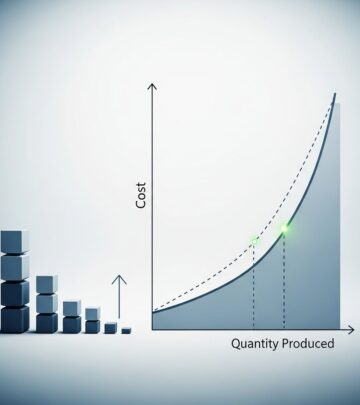
The relationship between marginal profit and production volume is not always linear. Initially, marginal profit may increase as production scales due to economies of scale and operational efficiencies. However, beyond a certain point, marginal profit typically declines as production costs rise faster than revenue generation, a phenomenon known as diminishing marginal returns.
Understanding the Key Components
To fully grasp marginal profit, it is essential to understand the underlying components that make up this calculation:
- Marginal Revenue (MR): The additional revenue generated from selling one more unit. It represents the incremental income from increased sales volume.
- Marginal Cost (MC): The additional cost incurred to produce one more unit, including direct labor, materials, and variable manufacturing expenses.
- Production Volume: The total quantity of units manufactured, which directly influences both marginal revenue and marginal cost calculations.
- Fixed Costs: Expenses that remain constant regardless of production volume, such as rent, salaries, and equipment depreciation.
- Variable Costs: Expenses that fluctuate with production levels, including raw materials, packaging, and direct labor.
Marginal Profit Formula and Calculation
The basic marginal profit formula is straightforward but powerful:
Marginal Profit = Marginal Revenue (MR) − Marginal Cost (MC)
To calculate marginal profit effectively, follow these steps:
Step-by-Step Calculation Process
- Determine Marginal Revenue: Calculate the change in total revenue divided by the change in quantity sold. Formula: MR = ΔTotal Revenue / ΔQuantity.
- Calculate Marginal Cost: Find the change in total cost divided by the change in quantity produced. Formula: MC = ΔTotal Cost / ΔQuantity.
- Subtract Marginal Cost from Marginal Revenue: Apply the marginal profit formula to obtain the per-unit profit from additional production.
- Analyze the Result: A positive marginal profit indicates continued production remains profitable. A negative or zero marginal profit suggests production should stabilize or cease.
Practical Example of Marginal Profit Calculation
Consider a manufacturing company producing specialty widgets. Initially, the company produces 100 units with total revenue of $10,000 and total costs of $6,000, resulting in a profit of $4,000. When production increases to 101 units, total revenue rises to $10,095 and total costs increase to $6,050.
Marginal Revenue: $10,095 − $10,000 = $95
Marginal Cost: $6,050 − $6,000 = $50
Marginal Profit: $95 − $50 = $45
This calculation shows that producing the 101st unit generates an additional $45 in profit. Management can use this information to assess whether expanding production capacity is economically justified.
The Relationship Between Marginal Profit and Production
Marginal profit typically follows a predictable pattern as production increases:
- Initial Phase: As production begins, marginal profit often increases due to better utilization of fixed assets and improved operational efficiency. Economies of scale benefit the operation.
- Optimal Phase: There exists a production level where marginal profit reaches its maximum. This represents the most efficient production point relative to incremental costs.
- Declining Phase: Beyond the optimal point, marginal profit decreases as variable costs rise, labor becomes less efficient, and resource constraints become apparent. This stage reflects diminishing marginal returns.
- Negative Phase: Eventually, marginal profit may become negative, meaning each additional unit actually reduces total profitability despite generating revenue.
Why Marginal Profit Matters for Business
Understanding marginal profit is vital for several critical business decisions:
Production Optimization
Businesses use marginal profit analysis to determine the optimal production volume that maximizes total profit. The point where marginal profit equals zero represents the threshold beyond which additional production becomes unprofitable. Strategic decisions about expanding or contracting production capacity should be grounded in marginal profit analysis.
Pricing Strategy
Marginal profit insights inform pricing decisions. When marginal profit is high, companies may have flexibility to maintain or increase prices. When marginal profit is declining, competitive pricing strategies or cost reduction initiatives become necessary to maintain profitability.
Break-Even Analysis
Marginal profit calculation helps identify the break-even point where total revenue equals total costs. Understanding this threshold is essential for financial planning and risk assessment. Companies can determine minimum sales volumes required to avoid losses.
Capital Investment Decisions
When considering investments in new equipment or facility expansion, marginal profit analysis helps evaluate whether the additional production capacity will generate sufficient incremental profit to justify the capital expenditure.
Marginal Profit vs. Other Profit Metrics
| Metric | Definition | Focus |
|---|---|---|
| Marginal Profit | Profit from one additional unit | Incremental decision-making |
| Gross Profit | Revenue minus cost of goods sold | Overall product profitability |
| Net Profit | Total revenue minus all expenses | Bottom-line financial performance |
| Operating Profit | Revenue minus operating expenses | Core business profitability |
Common Challenges in Marginal Profit Analysis
While marginal profit analysis is powerful, businesses often encounter several challenges when implementing it:
- Cost Attribution: Accurately determining which costs are variable versus fixed can be complex, particularly in diverse manufacturing environments with shared resources.
- Market Dynamics: Marginal revenue may fluctuate based on market demand, competitive pressure, and pricing strategies, making predictions challenging.
- Quality Considerations: Focusing solely on marginal profit may lead to neglecting quality improvements or customer satisfaction, which affect long-term profitability.
- Capacity Constraints: Physical limitations, supply chain constraints, and labor availability can restrict the practical application of marginal profit optimization.
- Time Lag Effects: The impact of cost changes may not be immediately apparent, complicating real-time marginal profit calculations.
Real-World Applications
Marginal profit analysis is applied across various industries to enhance decision-making:
Manufacturing: Companies use marginal profit to determine optimal batch sizes and production schedules, balancing setup costs against production efficiency.
Retail: Retailers analyze marginal profit to decide on inventory levels, promotional strategies, and product mix optimization.
Software as a Service (SaaS): SaaS businesses analyze marginal profit from additional subscribers to inform scaling decisions and customer acquisition spending.
Hospitality: Hotels and restaurants use marginal profit analysis to optimize occupancy rates, pricing strategies, and operational staffing levels.
Frequently Asked Questions (FAQs)
Q: How does marginal profit differ from average profit?
A: Marginal profit measures the profit from one additional unit, while average profit is the total profit divided by total units produced. Average profit provides overall profitability perspective, whereas marginal profit guides incremental production decisions.
Q: Can marginal profit be negative, and what does it mean?
A: Yes, marginal profit can be negative when the cost of producing an additional unit exceeds the revenue it generates. Negative marginal profit indicates that continuing to increase production will reduce total profit, signaling that production should decrease.
Q: At what point should a business stop increasing production?
A: Businesses should stop increasing production when marginal profit approaches zero or becomes negative. This point, where marginal revenue equals marginal cost, represents the profit-maximizing production level under economic theory.
Q: How does marginal profit relate to economies of scale?
A: Initially, marginal profit often increases due to economies of scale as fixed costs are spread across more units and operational efficiencies improve. However, as production expands further, diseconomies of scale eventually cause marginal profit to decline.
Q: Is marginal profit analysis suitable for all business types?
A: Marginal profit analysis is most applicable to businesses with variable production volumes, such as manufacturing, retail, and service industries. It’s less relevant for businesses with fixed service delivery models or those where marginal costs are negligible.
Q: How frequently should marginal profit be calculated?
A: Marginal profit should be recalculated whenever significant changes occur in production costs, pricing, market conditions, or supply chain dynamics. Regular monitoring helps businesses adjust production strategies proactively.
References
- Microeconomics: Principles and Analysis — Frank, Robert H. & Bernanke, Ben S. (McGraw-Hill Education, 2007). [Foundational economic principles on marginal analysis]
- Cost Accounting: Foundations and Evolutions — Kinney, Michael R. & Raiborn, Cecily A. (Cengage Learning, 2011). [Standard cost accounting methodologies for marginal cost calculation]
- Production and Operations Management — Chase, Richard B., Jacobs, F. Robert, & Aquilano, Nicholas J. (McGraw-Hill, 2009). [Production optimization and marginal profit applications in manufacturing]
- Managerial Economics and Business Strategy — Baye, Michael R. (McGraw-Hill Education, 2013). [Strategic business decision-making using economic analysis]
- Financial Accounting Standards Board (FASB) — U.S. Generally Accepted Accounting Principles. 2024. https://www.fasb.org/ [Official accounting standards for cost reporting]
Similar Articles








Read full bio of Sneha Tete