Marginal Cost of Production: Definition and Formula
Understanding marginal cost of production and its impact on business profitability and output decisions.
Understanding Marginal Cost of Production
Marginal cost of production is a fundamental economic concept that measures the change in total production cost when one additional unit of output is produced. For businesses operating in competitive markets, understanding and calculating marginal cost is essential for making informed decisions about production levels, pricing strategies, and resource allocation. This metric provides critical insights into how costs change as production volume increases, helping companies determine the optimal point at which to stop expanding output.
In practical terms, marginal cost represents the incremental expense associated with manufacturing one more unit of a product or service. When a factory operates at maximum capacity and needs to produce additional items, the company may incur overtime pay for workers, increased machinery maintenance costs, or other variable expenses. By analyzing marginal cost alongside market prices and marginal revenue, businesses can determine whether producing additional units will be profitable or create financial losses.
Definition and Basic Concept
Marginal cost, often abbreviated as MC, is defined as the cost incurred for producing each extra unit of output beyond the current production level. Unlike average cost, which divides total cost by the number of units produced, marginal cost focuses specifically on the expense of that additional single unit. This distinction is crucial because it allows managers to understand whether increasing production will improve or harm the company’s profitability.
The relationship between marginal cost and production volume typically follows a predictable pattern. Initially, as production begins, marginal cost tends to decrease because fixed costs are spread across more units and workers become more efficient. However, as production continues to increase, marginal cost eventually rises due to the law of diminishing marginal returns, where additional resources become less productive. This creates the characteristic U-shaped marginal cost curve observed in economic analysis.
Components of Marginal Cost
Marginal cost comprises two primary categories of expenses that vary or remain constant with production changes:
Variable Costs
Variable costs increase or decrease directly with the volume of production. These expenses change proportionally as the quantity of output increases or decreases. For example, a shoemaker requires sixty cents worth of leather and plastic materials for each shoe produced. If production doubles, the total material costs double accordingly. Other common variable costs include direct labor for production, raw materials, packaging, and shipping. Understanding variable costs is essential because they directly impact marginal cost calculations and represent the most controllable expenses in the production process.
Fixed Costs
Fixed costs remain constant regardless of production volume and do not change when output increases or decreases. Examples include rent paid for factory facilities, insurance premiums, administrative salaries, and depreciation of equipment. While fixed costs don’t change in total amount, they effectively decrease on a per-unit basis as production volumes increase. For instance, if a factory pays $10,000 monthly rent, that cost is spread across fewer units at low production levels but across many more units at higher production levels, reducing the fixed cost per unit significantly.
Marginal Cost Formula and Calculation
The marginal cost can be calculated using a straightforward mathematical formula. When the cost function is continuous and differentiable, marginal cost is expressed as the first derivative of the total cost function with respect to output quantity:
MC(Q) = dC / dQ
Where MC represents marginal cost, C is the total cost function, and Q is the quantity of output produced. For practical business applications where precise mathematical functions may not be available, marginal cost can be calculated using the change formula:
MC = ΔC / ΔQ
In this formula, ΔC represents the change in total cost, and ΔQ represents the change in quantity produced, typically a single additional unit. To illustrate, suppose the total cost of producing one shoe is $30, and the total cost of producing two shoes is $40. The marginal cost of the second shoe equals $40 minus $30, which equals $10 per unit. This calculation clearly shows that the second unit cost less to produce than the first, reflecting initial economies of scale.
Short-Run vs. Long-Run Marginal Cost
Short-Run Marginal Cost
Short-run marginal cost occurs when additional output is produced within a limited time period, typically when the company maintains a fixed amount of assets and infrastructure. During the short run, companies cannot easily adjust fixed factors like factory size or major equipment. Instead, they adjust variable factors such as labor hours and raw material quantities. A manufacturer facing increased demand might increase shifts or add temporary workers rather than building a new facility. The short-run marginal cost reflects only the cost of varying those controllable inputs while keeping fixed assets constant.
Long-Run Marginal Cost
Long-run marginal cost represents the increased cost incurred when every input becomes variable, allowing companies to scale operations fully. In the long run, a business can expand factory capacity, hire permanent employees, develop new production lines, or enter new markets. The long-run marginal cost typically differs from short-run marginal cost because companies can optimize all factors of production. By having complete flexibility in adjusting all inputs, firms can achieve more efficient production methods and potentially lower long-run marginal costs compared to short-run constraints.
The Marginal Cost Curve
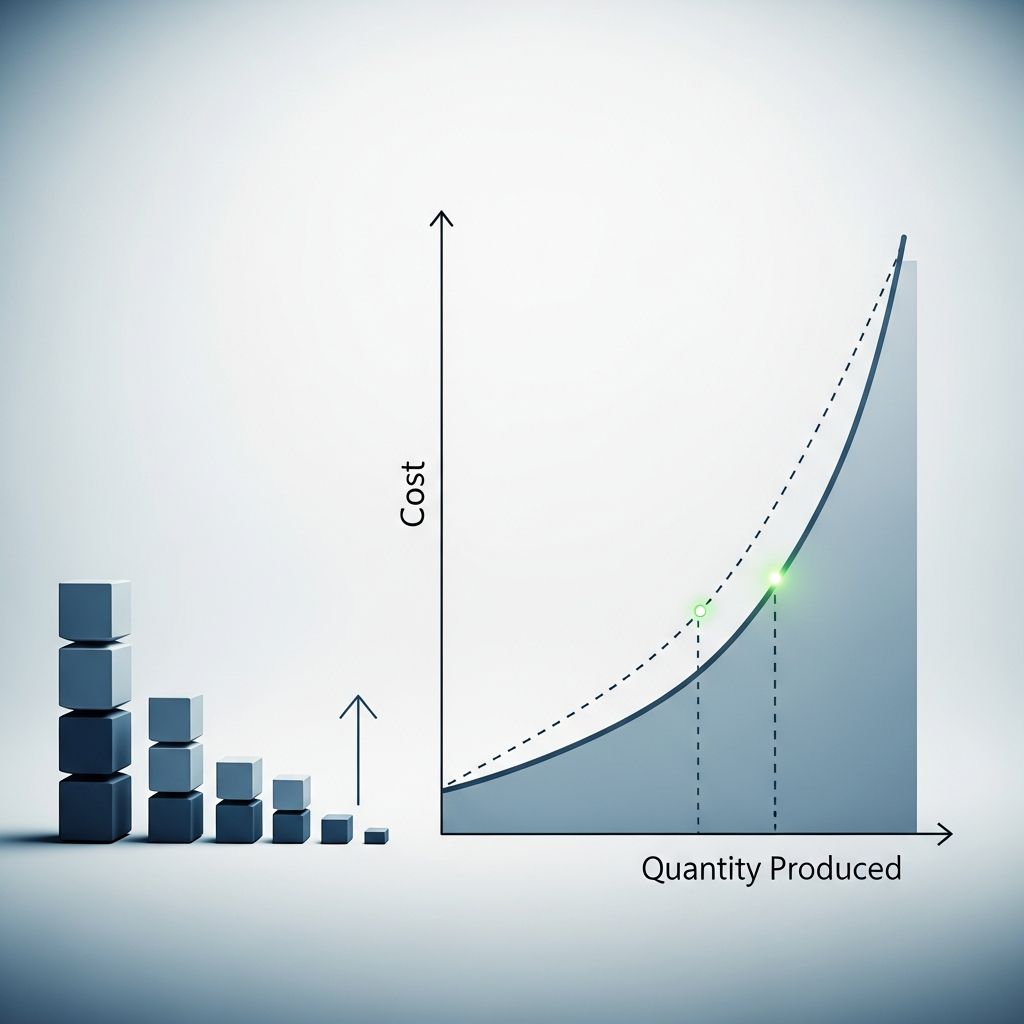
The marginal cost curve is a graphical representation showing the relationship between production quantity and marginal cost at each output level. This curve typically displays a distinctive U-shape that reflects how marginal costs behave across different production volumes. Understanding the shape and movement of this curve provides visual insight into production economics.
Initially, as a company begins production, the marginal cost curve slopes downward. This occurs because fixed costs are distributed across more units, and workers become more efficient through specialization and familiarity with tasks. During this phase, each additional unit costs less to produce than the previous one, reflecting improving productivity and efficiency gains.
As production continues to increase, the marginal cost curve reaches a minimum point. At this point, the company has achieved an optimal balance between its fixed and variable resources. Beyond this minimum, the curve begins sloping upward, indicating that additional units become progressively more expensive to produce. This upward slope reflects the law of diminishing marginal returns, where adding more labor or resources produces smaller increases in output, causing the cost per additional unit to rise.
Decision-Making Based on Marginal Cost
Production Level Optimization
Companies use marginal cost analysis to determine optimal production levels that maximize profitability. In perfectly competitive markets, the fundamental decision rule is straightforward: produce and sell an additional unit if the market price exceeds the marginal cost, but do not produce if marginal cost exceeds the selling price. Production continues until the marginal cost equals the market price, the point where profit maximization occurs.
When marginal cost is lower than the selling price, each additional unit contributes positively to total profit. Conversely, when marginal cost rises above the selling price, producing additional units actually reduces overall profitability. This principle helps managers avoid the common mistake of overproduction, which can lead to unnecessary costs and reduced profits despite higher sales volume.
Resource Allocation
Through marginal cost analysis, manufacturers can determine how to allocate resources most effectively among different production units and departments. Understanding which products or production lines have lower marginal costs identifies opportunities for expansion and efficiency improvements. Resources can be directed toward product lines with favorable marginal cost structures while addressing inefficiencies in high-marginal-cost areas.
Pricing Strategies
Marginal cost information enables companies to develop competitive pricing strategies that maintain healthy profit margins. After determining the relationship between marginal cost and marginal revenue, organizations can establish per-unit pricing that sustains sales volumes while maximizing profits. Understanding the marginal cost at different production levels allows businesses to set dynamic pricing that reflects their actual production expenses.
Economies of Scale and Marginal Cost
Marginal cost plays a crucial role in understanding and achieving economies of scale. Economies of scale occur when companies produce more units of output at lower average costs, allowing the production of additional units at cheaper per-unit prices. As production volume increases, companies can distribute fixed costs across more units, negotiate better prices from suppliers for bulk purchases, and improve worker efficiency through specialization.
Sometimes, producing a certain quantity of additional units creates economies of scale that reduce overall costs across all production units. For example, investing in more efficient machinery or training workers more thoroughly might initially increase costs but ultimately lower the marginal cost of each subsequent unit produced. Companies operating with economies of scale produce more output at lower cost, thereby maximizing profits while minimizing marginal cost of production.
However, at some point, increasing production volume can lead to diseconomies of scale, where additional expansion actually increases marginal costs. This might occur due to management inefficiencies, supply chain complexity, or resource constraints, indicating that the company has reached an optimal production size for maximum efficiency.
Practical Business Applications
Profitability Analysis
Understanding marginal cost helps businesses evaluate whether specific production decisions will enhance or reduce profitability. When marginal cost per unit is high, increasing production capacity becomes expensive and may not be justified by market demand or pricing. Conversely, when marginal cost is low, a company can achieve economies of scale and potentially increase production to capture greater market share at lower per-unit costs.
Capacity Planning
Marginal cost analysis informs decisions about factory expansion, equipment purchases, and workforce scaling. By understanding how marginal costs change at different production levels, managers can identify the optimal size for operations and avoid investing in excess capacity that would not be efficiently utilized.
Product Mix Decisions
When companies produce multiple products, marginal cost analysis helps determine which products should receive priority in production scheduling and resource allocation. Products with lower marginal costs can be produced more profitably, while those with high marginal costs may need pricing adjustments or process improvements.
Marginal Cost vs. Average Cost
It is important to distinguish between marginal cost and average cost, as these metrics provide different insights. Average cost is calculated by dividing total production cost by the number of units produced, providing the per-unit cost across the entire production volume. Marginal cost, conversely, focuses only on the cost of producing one additional unit at the current production level.
These metrics diverge significantly because average cost includes the impact of fixed costs spread across all units, while marginal cost reflects only the incremental expenses. Early in production, average cost typically exceeds marginal cost, but as production increases, marginal cost often rises above average cost once the upward portion of the U-shaped marginal cost curve is reached. Understanding both metrics provides comprehensive insight into production economics.
Key Takeaways
The marginal cost of production is a vital metric for business decision-making and economic analysis. It measures the incremental expense of producing one additional unit, comprising both variable and fixed cost components. The characteristic U-shaped marginal cost curve reflects how costs initially decrease with production efficiency but eventually increase due to diminishing marginal returns. Companies use marginal cost to optimize production levels, align pricing with profitability, and allocate resources efficiently. In competitive markets, the profit-maximizing production point occurs where marginal cost equals market price, a principle that guides strategic business decisions. By leveraging marginal cost analysis alongside other financial metrics, businesses can improve operational efficiency, enhance profitability, and make well-informed strategic decisions about production and expansion.
Frequently Asked Questions
Q: How does marginal cost differ from average cost?
A: Average cost divides total production cost by the number of units produced, showing the per-unit cost across all production. Marginal cost focuses specifically on the cost of producing one additional unit. Average cost includes all fixed costs distributed across units, while marginal cost reflects only incremental variable expenses and any change in fixed cost allocation.
Q: At what point should a company stop increasing production?
A: A company should continue producing additional units as long as the market price exceeds the marginal cost. Production should stop when marginal cost equals the selling price, as producing beyond this point would generate losses on those additional units rather than additional profit.
Q: Why does marginal cost eventually increase with higher production volumes?
A: Marginal cost increases due to the law of diminishing marginal returns. As production expands, the company may face constraints such as overtime pay, equipment wear, supply chain bottlenecks, or management inefficiencies that make each additional unit progressively more expensive to produce.
Q: Can marginal cost be negative?
A: While theoretically possible in unusual circumstances, marginal cost is typically positive because producing additional units requires spending on materials, labor, and resources. A negative marginal cost would mean that producing more actually reduces total costs, which rarely occurs in practice.
Q: How do economies of scale reduce marginal cost?
A: Economies of scale reduce marginal cost by spreading fixed costs across more units, improving worker efficiency, and enabling bulk purchasing of materials at lower prices. These factors combine to lower the per-unit cost of production at higher volumes.
References
- Marginal Cost of Production – Formula and Examples — Corporate Finance Institute. 2025. https://corporatefinanceinstitute.com/resources/accounting/marginal-cost-of-production/
- Marginal Cost — Wikipedia. Accessed November 2025. https://en.wikipedia.org/wiki/Marginal_cost
- Marginal Cost — EBSCO Research Starters Business and Management. 2025. https://www.ebsco.com/research-starters/business-and-management/marginal-cost
Similar Articles








Read full bio of Sneha Tete