Margin Accounts: What Investors Need To Know
Unlock greater investment potential with margin accounts while navigating amplified risks and strategic opportunities.

Margin accounts enable investors to borrow funds from their brokerage to purchase securities, effectively increasing their buying power beyond their cash deposits. This leverage can magnify gains but also heightens potential losses, making it suitable primarily for experienced traders.
Understanding the Fundamentals of Margin Trading
A margin account differs from a standard cash account by allowing borrowing against deposited securities or cash. Brokers lend money using eligible holdings as collateral, typically up to 50% of the purchase price for initial transactions under Federal Reserve Regulation T. For instance, with $10,000 in cash, an investor might buy $20,000 worth of stock, borrowing the additional $10,000.
Securities must meet specific criteria to serve as collateral, such as sufficient liquidity and low volatility. Brokers impose their own house requirements on top of regulatory minimums. Interest accrues daily on the borrowed amount, similar to a line of credit, with rates varying by broker and market conditions.
How Margin Accounts Amplify Your Investment Capacity
The core appeal of margin lies in leverage, which expands purchasing power. Consider an investor with $5,000 eyeing stocks worth $10,000. In a cash account, only the $5,000 purchase is feasible. With margin, the full $10,000 can be bought, borrowing $5,000. If the investment rises 20% to $12,000, selling repays the loan plus interest, leaving a profit far exceeding a cash-only scenario.
| Scenario | Initial Investment | Borrowed Amount | Value After 20% Gain | Net Profit (After Repay & Est. Interest) |
|---|---|---|---|---|
| Cash Account | $5,000 | $0 | $6,000 | $1,000 |
| Margin Account | $5,000 | $5,000 | $12,000 | $1,900 |
This table illustrates leverage’s effect: margin doubles the return percentage on initial capital. Beyond buying, margin supports short selling, where investors borrow shares to sell high and repurchase low.
Key Advantages of Using Margin in Your Portfolio
- Enhanced Buying Power: Access more securities without liquidating holdings, ideal for seizing market opportunities.
- Potential for Higher Returns: Leverage amplifies percentage gains on your equity, as shown in examples where ROI jumps from 20% to 40% or more.
- Portfolio Diversification: Borrow against concentrated positions, like employer stock, to spread risk without triggering taxes on sales.
- Flexible Repayment: No fixed schedule; repay anytime while meeting maintenance requirements.
- Tax Considerations: Interest may be deductible against investment income; consult a tax advisor.
- Advanced Strategies: Enables options trading like spreads or short positions.
These benefits shine in bullish markets or for diversification without capital gains taxes.
Critical Risks and Downsides to Margin Trading
While powerful, margin introduces substantial risks. Losses are magnified: a 20% drop in the prior example turns a $1,000 cash loss into $3,100 after repaying the loan, potentially wiping out equity.
- Interest Expenses: Ongoing costs erode returns, especially in flat or declining markets.
- Margin Calls: If account equity falls below maintenance margin (often 25-30%), brokers demand more funds or sell assets.
- Amplified Losses: Borrowing means owing regardless of performance, possibly exceeding initial investment.
- Volatility Exposure: Rapid market swings can trigger forced liquidations at unfavorable prices.
Regulators like FINRA and the SEC enforce rules to protect against excessive leverage, but individual brokers set stricter limits.
Navigating Margin Requirements and Maintenance
Initial margin requires at least 50% equity for new purchases. Maintenance margin, typically 25%, ensures ongoing collateral sufficiency. If equity dips below this—say, due to a 30% stock drop—a margin call issues. Investors must deposit cash/securities or sell holdings within days.
Example: $20,000 portfolio with $10,000 borrowed (50% initial). A 30% decline values it at $14,000. Equity is $4,000 (28.6%), still above 25%. A further drop to $10,000 leaves $0 equity, prompting immediate action.
Real-World Applications and Strategic Uses
Margin suits short-term trades or hedging. Diversification example: Holding $100,000 in one stock? Borrow $50,000 to buy diversified ETFs, reducing single-stock risk without selling.
Short selling leverages margin too: Borrow and sell overvalued shares, profiting on declines. Options strategies like covered calls or iron condors require margin approval.
Businesses use margin for opportunistic investments, borrowing to scale positions beyond cash reserves.
Who Should Consider a Margin Account?
Not for novices. Ideal for those with experience, high risk tolerance, and diversified portfolios. Minimums often start at $2,000 equity. Assess finances: Can you handle calls without distress? Brokers review trading history for approval.
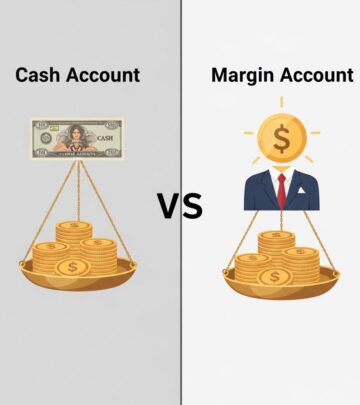
Compare account types:
| Feature | Cash Account | Margin Account |
|---|---|---|
| Leverage | No | Yes, up to 2:1 |
| Short Selling | No | Yes |
| Interest | None | On borrowed funds |
| Risk Level | Low | High |
Steps to Open and Manage a Margin Account
- Apply: Request via broker; provide financials and experience.
- Get Approved: Meet criteria like net worth and trading history.
- Fund: Deposit minimum equity.
- Monitor: Track equity, interest, and market moves.
- Comply: Respond to calls promptly.
Use tools like portfolio analyzers to simulate scenarios.
Frequently Asked Questions (FAQs)
What is the minimum for a margin account?
Typically $2,000 in equity, per broker policies.
Can I lose more than I invest?
Yes, due to leverage and potential margin calls exceeding deposits.
Are margin interest rates fixed?
No, they fluctuate with market rates; check broker disclosures.
Does margin work for retirement accounts?
Generally no; IRAs prohibit borrowing.
How do I avoid margin calls?
Maintain buffer above requirements, diversify, and use stop-loss orders.
Final Thoughts on Leveraging Margin Wisely
Margin accounts offer sophisticated tools for growth-oriented investors but demand discipline. Weigh benefits against risks, start small, and stay informed on regulations. Consult professionals before proceeding.
References
- Understanding the benefits and risks of margin — Fidelity Investments. 2023. https://www.fidelity.com/learning-center/trading-investing/trading/understanding-benefits-risks-margin
- What is a Margin Account? — Chase. 2024. https://www.chase.com/personal/investments/learning-and-insights/article/what-is-a-margin-account
- Margin Account: Definition, How It Works, and Example — BILL. 2023. https://www.bill.com/learning/margin-account
- Risks and Benefits of Margin Trading: Is It a Good Idea? — SoFi. 2024. https://www.sofi.com/learn/content/risks-benefits-margin-trading/
- What to Know About Margin — Charles Schwab. 2024. https://www.schwab.com/learn/story/what-every-trader-should-know-about-margin
- Guide to Margin Investing — Citi Wealth. 2023. https://marketinsights.citi.com/Financial-Education/Investing/what-is-margin-investing.html
- What Is Margin Trading? Definition and Benefits — Ally. 2024. https://www.ally.com/stories/invest/what-is-margin-trading-is-it-right-for-you/
Similar Articles








Read full bio of medha deb