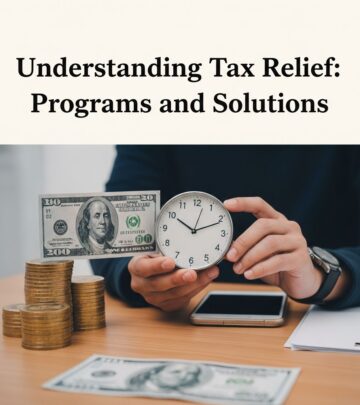
Managing Tax Debt: Practical Relief Options
Discover effective strategies to resolve tax debt and regain financial stability

Tax debt represents one of the most stressful financial situations a person or business can face. The combination of mounting penalties, accumulating interest, and potential collection actions creates urgency and anxiety. However, many taxpayers don’t realize that they have multiple legitimate pathways to address their tax obligations without devastating their finances. Understanding these options is the first step toward regaining control of your financial situation.
Understanding Your Tax Debt Problem
Before exploring solutions, it’s important to assess the scope of your tax situation. Tax debt can accumulate for various reasons—missed estimated payments for self-employed individuals, insufficient withholding from paychecks, unexpected income changes, business losses, or simply miscalculation. Regardless of how the debt accumulated, the IRS provides structured relief mechanisms designed to work with taxpayers rather than against them.
The key is recognizing that inaction is the worst response. Ignoring tax debt compounds the problem through mounting penalties and interest. Taking proactive steps demonstrates good faith to the IRS and opens access to relief options that aren’t available to those who ignore their obligations.
Payment Flexibility: Installment Agreements Explained
For taxpayers who can commit to regular monthly payments but cannot pay their full tax liability immediately, installment agreements represent the most accessible relief option. These arrangements allow you to pay your tax debt incrementally over time, with the IRS accepting payment through automatic bank withdrawals or other approved methods.
The IRS offers three primary installment agreement structures:
- Guaranteed Installment Agreements: Available for debts under $10,000, these agreements provide streamlined processing with fewer requirements.
- Streamlined Installment Agreements: For debts between $10,000 and $50,000, these plans offer simplified qualification criteria while maintaining manageable payment terms.
- Partial Payment Installment Agreements: When your debt exceeds $50,000 and you cannot pay in full, this option allows you to negotiate a payment amount based on your genuine financial capacity.
One significant advantage of installment agreements is that they halt the accumulation of failure-to-pay penalties once you enter the agreement. While interest continues to accrue, this penalty relief alone can save thousands of dollars on larger debts. For instance, someone carrying $40,000 in tax debt could save substantial amounts through penalty cessation alone.
To qualify for an installment agreement, you must demonstrate ability to make consistent monthly payments and maintain current status on all tax filings. If your financial circumstances change, you can modify the payment arrangement, providing flexibility as your situation evolves.
Short-Term Payment Solutions
For taxpayers facing temporary cash flow challenges, short-term payment plans offer quick relief. These arrangements allow you to settle your complete tax debt within 180 days, making them ideal for situations where you anticipate having sufficient funds relatively soon. This might apply when you’re awaiting bonuses, commissions, the sale of an asset, or other expected income events.
Short-term plans require less paperwork than long-term installment agreements and generally involve lower fees, making them cost-effective for bridging temporary gaps in cash flow. The simplicity and speed of these arrangements make them an attractive first option for many taxpayers.
Extended Payment Arrangements
When short-term solutions are insufficient, long-term installment agreements extend payment periods up to 72 months. These extended arrangements make monthly obligations more manageable by spreading payments across a longer timeframe. For individuals earning modest incomes or facing significant financial constraints, this extended timeline can mean the difference between managing the debt and experiencing financial crisis.
Long-term agreements require more detailed financial documentation, as the IRS needs to assess your genuine ability to maintain payments over several years. However, this investment in documentation typically results in approval for those with legitimate financial constraints.
Reducing Your Overall Tax Burden
Beyond payment arrangements, several strategies can reduce the total tax liability you face, potentially decreasing reliance on relief programs or accelerating debt resolution.
Optimizing Tax Withholding
Many tax debt situations originate from inadequate withholding or estimated payments. Adjusting your W-4 form and estimated tax payments can prevent future debt accumulation. Life changes—marriage, divorce, significant income fluctuations, or dependent status changes—warrant withholding reviews. Self-employed individuals particularly benefit from ensuring accurate quarterly estimated tax payments, preventing large year-end liabilities.
Maximizing Available Tax Credits
Tax credits directly reduce your tax liability dollar-for-dollar, making them more valuable than deductions. Ensuring you claim all credits you qualify for reduces your tax obligation fundamentally. Common credits include:
- Earned Income Tax Credit (EITC)
- Child and Dependent Care Credit
- American Opportunity Tax Credit (AOTC)
- Lifetime Learning Credit (LLC)
Many taxpayers leave money on the table by not exploring available credits. Consulting with a tax professional can identify credits you might have overlooked, reducing current and future tax obligations.
Settling for Less: Offer in Compromise
When genuine financial hardship prevents paying your full tax liability now or in the foreseeable future, an Offer in Compromise allows you to settle for substantially less than owed. This option represents substantial relief for qualifying taxpayers but requires careful navigation.
The IRS accepts approximately 25% of submitted offers, making qualification selective. Acceptance depends on demonstrating that:
- You genuinely cannot pay the full amount
- Paying in full would create severe financial hardship
- Your proposed settlement represents fair value based on your circumstances
The IRS analyzes your ability to pay based on employment, income, assets, and debt obligations. For those who qualify, this option can provide transformative relief. However, you should explore other options before pursuing an offer in compromise, as the approval bar remains high and application requirements are extensive.
The IRS provides an Offer in Compromise Pre-Qualifier tool on its website to assess initial eligibility before investing time in a full application.
Alternative Relief Options
Currently-Not-Collectible Status
For individuals experiencing severe financial hardship where even modified payment plans are impossible, Currently-Not-Collectible (CNC) status temporarily pauses collection activities. This status acknowledges that collection efforts would prove futile and potentially harmful. While interest and penalties continue accruing, this status prevents aggressive collection actions and provides breathing room for financial recovery.
CNC status is temporary, and the IRS periodically reviews your financial situation to determine when collection activities can resume. This option works best for those anticipating improved circumstances within a reasonable timeframe.
Penalty Abatement
Not all penalties are permanent. Penalty abatement eliminates or reduces penalties for valid reasons, such as reasonable cause or first-time penalties. If you face penalties due to circumstances beyond your control—illness, natural disaster, casualty loss, or other hardship—abatement may be available. Professional representation can strengthen penalty abatement requests.
Leveraging Alternative Financing
For taxpayers with access to credit, external financing can sometimes provide cost-effective solutions. If you can secure low-interest financing—through personal loans, home equity lines of credit, or other sources—paying the IRS immediately eliminates ongoing IRS interest and penalties. This approach works when external interest rates are substantially lower than IRS interest rates, creating net savings despite the debt restructuring.
Building Sustainable Tax Compliance
Resolving current tax debt is insufficient without preventing future problems. Sustainable relief requires establishing systems ensuring ongoing compliance.
Preventive Infrastructure
Establish regular tax review cycles—quarterly assessments of your tax situation allow early identification of problems before they become substantial debts. Self-employed individuals and those with variable income particularly benefit from quarterly reviews and corresponding estimated payment adjustments.
Professional Relationships
Engaging qualified professionals creates accountability and expertise:
- Tax preparers: Help ensure accurate returns and identify planning opportunities
- Bookkeepers: Maintain organized financial records throughout the year, enabling accurate tax calculations
- Financial advisors: Integrate tax planning into overall financial strategy
Record-Keeping Systems
Organized documentation of income and expenses prevents calculation errors and supports tax reporting accuracy. Digital systems, spreadsheets, or professional bookkeeping software create reliable records accessible during tax preparation. This infrastructure proves invaluable if you face audits or disputes.
Navigating Federal and State Coordination
Many taxpayers face tax debt at both federal and state levels. Addressing both simultaneously prevents conflicting requirements and maximizes negotiating leverage. State tax laws and relief options vary significantly, requiring specialized knowledge. Professional guidance ensures coordinated strategies addressing both obligations efficiently.
Assessing Your Situation: Key Questions
When evaluating relief options, consider these critical factors:
- Can you afford regular monthly payments, or is your situation more dire?
- Is your income stable or likely to change significantly?
- Are you approaching life transitions like retirement that affect earning capacity?
- Have you resolved the underlying causes of your tax debt?
- Are you currently compliant with all tax filing requirements?
Honest answers to these questions guide appropriate solution selection.
Implementation Roadmap
Step 1: Gather Documentation — Compile financial statements, income documentation, and expense records demonstrating your financial situation.
Step 2: Professional Consultation — Have a qualified tax professional assess your circumstances and recommend appropriate options.
Step 3: Strategy Development — Create a comprehensive plan addressing both immediate debt and future compliance.
Step 4: Implementation — Execute the agreed-upon arrangement while maintaining current tax compliance.
Step 5: Ongoing Monitoring — Review arrangements periodically and adjust as circumstances change.
FAQ Section
How long can an IRS installment agreement last?
Short-term agreements allow 180-day payment periods, while long-term installment agreements extend up to 72 months (six years). Your specific timeline depends on your debt amount and financial capacity.
Will an installment agreement prevent wage garnishment?
Yes, entering an approved payment arrangement typically halts collection activities, including wage garnishment. Maintaining agreement compliance preserves this protection.
Can I modify my payment plan if circumstances change?
Yes, installment agreements can be modified if your financial situation improves or deteriorates. Proactively communicating changes with the IRS prevents agreement default.
What happens if I miss a payment under an installment agreement?
Missing payments can result in agreement default and reinstatement of collection activities. However, communicating proactively about temporary difficulties often allows temporary adjustments rather than default.
Is an Offer in Compromise the same as forgiveness?
No, OIC represents settling for less through negotiation, not forgiveness. The IRS accepts reduced payment based on demonstrable inability to pay in full.
Conclusion
Tax debt, while serious, need not be insurmountable. Multiple pathways exist to address tax obligations while maintaining financial viability. From straightforward installment agreements to complex offers in compromise, relief options accommodate various circumstances. The critical first step is recognizing that solutions exist and taking action rather than allowing debt to accumulate. Pairing immediate relief through appropriate options with long-term compliance systems creates sustainable resolution, preventing future tax debt situations.
References
- 7 Proven Tax Debt Relief Options: Which Solution Fits You? — Dickmann Tax Group. Accessed 2026. https://dickmanntaxgroup.com/resources/tax-debt-relief-options-which-fits/
- Ways to Pay Off IRS Tax Debt: Efficient Strategies for Financial Relief — Finally. Accessed 2026. https://finally.com/blog/tax-hints/ways-to-pay-off-irs-tax-debt/
- How to Set up a Tax Debt Repayment Plan With the IRS — Money Management Institute. Accessed 2026. https://www.moneymanagement.org/blog/how-to-set-up-a-debt-repayment-plan-with-the-irs
- How to settle your IRS tax debt — CBS News. Accessed 2026. https://www.cbsnews.com/news/how-to-settle-your-irs-tax-debt/
- Tax relief and resolution: 5 ways to deal with tax debt — NerdWallet. Accessed 2026. https://www.nerdwallet.com/taxes/learn/tax-relief-back-taxes
Similar Articles








Read full bio of Sneha Tete