Managerial Accounting: Definition, Purpose, and Key Techniques
Master managerial accounting: strategic financial tools for internal decision-making and business growth.
What Is Managerial Accounting?
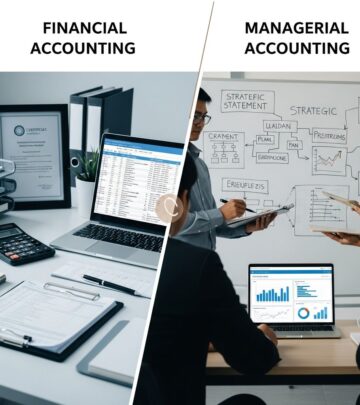
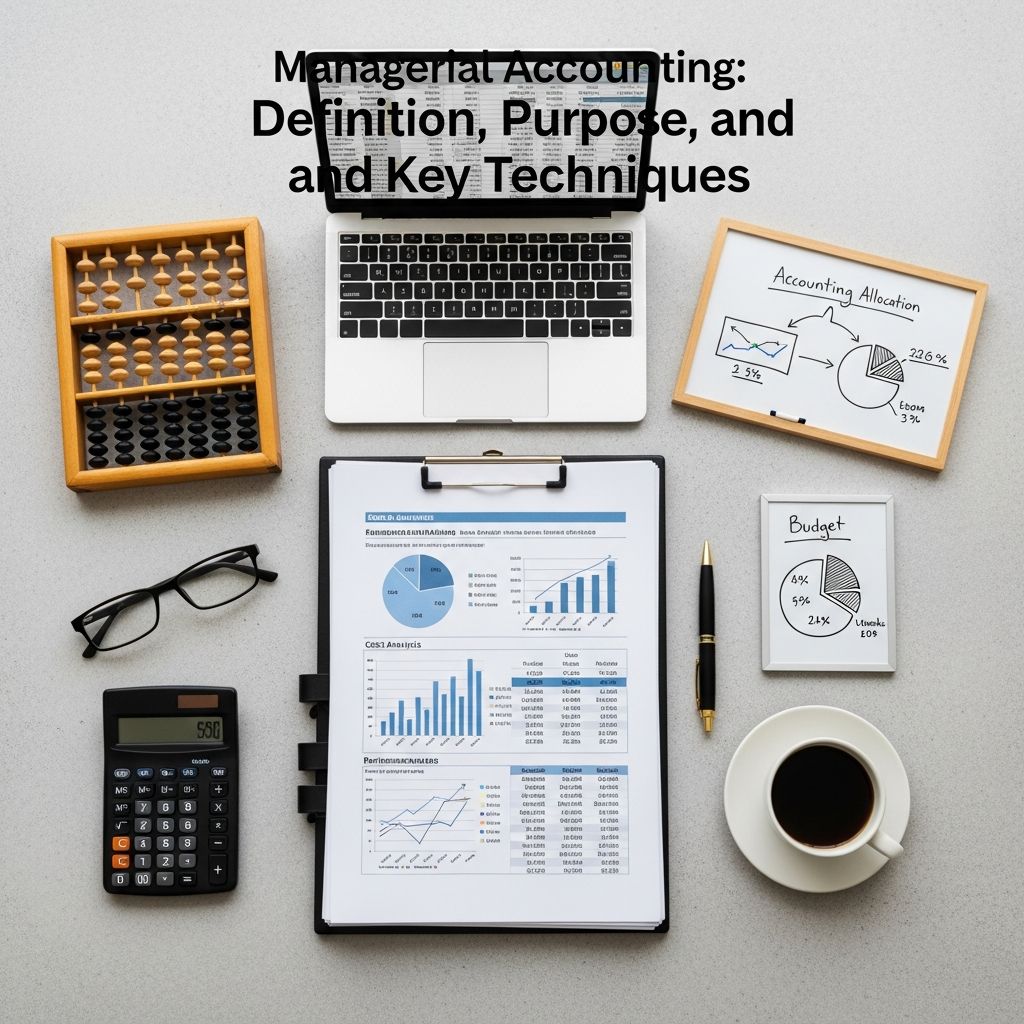
Managerial accounting, also referred to as cost accounting or management accounting, is the practice of gathering, measuring, analyzing, interpreting, and communicating financial and non-financial data for the internal decision-makers of an organization. Unlike financial accounting, which prepares standardized reports for external stakeholders like investors and regulators, managerial accounting focuses exclusively on providing actionable insights to company management, executives, and department heads.
The primary objective of managerial accounting is to support organizational efficiency and help track progress toward stated business goals. Managerial accountants serve as strategic partners who identify ways to create value, minimize risk, and maximize profitability. They accomplish this by transforming raw financial data into meaningful information that drives informed operational and business decisions.
Managerial accounting is distinguished by its internal focus, flexibility in reporting standards, and emphasis on providing timely, relevant information for specific business needs. Organizations rely on managerial accounting to make decisions about resource allocation, pricing strategies, performance evaluation, and long-term strategic planning.
Key Differences: Managerial vs. Financial Accounting
While both managerial and financial accountants may occasionally use the same underlying data, their purposes, audiences, and methodologies differ significantly. Understanding these distinctions is essential for appreciating the unique value that managerial accounting brings to organizations.
| Aspect | Managerial Accounting | Financial Accounting |
|---|---|---|
| Primary Audience | Internal stakeholders (managers, executives, department heads) | External stakeholders (investors, creditors, regulators, SEC, IRS) |
| Focus | Internal decision-making and operational efficiency | Historical financial performance and compliance |
| Time Horizon | Short-term goals and immediate decisions | Long-term financial position |
| Reporting Standards | No mandatory standards; flexible and customizable | Must adhere to GAAP or IFRS standards |
| Reporting Frequency | Daily, weekly, monthly, or as needed | Quarterly or annually |
| Data Type | Financial and non-financial metrics | Primarily financial transactions |
| Analysis Scope | Department-specific and issue-focused | Company-wide and holistic |
The Value of Managerial Accounting
Managerial accounting provides organizations with quantitative analytical tools that enhance decision-making across multiple business functions. The value proposition of managerial accounting extends far beyond simple number crunching; it equips executives with comprehensive insights needed to navigate complex business environments.
Supporting Cost-Benefit Analysis: Managerial accounting enables managers to understand the relationship between costs and benefits, facilitating more strategic resource allocation. When faced with specific decisions, managers can request targeted information on business operations to chart the most effective course of action.
Resource Management and Performance Measurement: All managers bear responsibility for allocating and measuring the performance of resources under their control. These resources encompass financial investments, human capital (team members), and technological assets (such as customer databases). Managerial accounting provides the framework for tracking and optimizing these resources.
Informed Leadership Decisions: By providing timely and relevant information, managerial accounting enables leadership to make informed decisions about financial strategies, revenue growth, change management, organizational structure, and technology adoption. The reports generated by managerial accountants directly influence the strategic direction and operational effectiveness of the organization.
Actionable Data: Unlike financial accounting, which produces compliance-oriented reports, managerial accounting generates actionable data that managers can immediately apply to improve operations, reduce costs, and enhance profitability.
Core Functions of Managerial Accounting
Managerial accounting performs several critical functions within organizations. Understanding these functions helps clarify how managerial accountants contribute to organizational success.
Financial Planning and Budgeting
Managerial accountants develop comprehensive budgets and financial forecasts that guide organizational spending and resource allocation. These budgets serve as financial roadmaps for departments and the organization as a whole, enabling managers to plan for future operations and contingencies.
Cost Analysis and Control
One of the most important functions of managerial accounting is analyzing and controlling costs. Managerial accountants identify cost drivers, track production costs, and help organizations understand where money is spent. This function is essential for maintaining profitability and identifying opportunities for cost reduction.
Performance Evaluation
Managerial accountants assess business performance using key performance indicators (KPIs) and metrics relevant to specific departments or business units. They analyze profitability by product line, evaluate operational efficiency, and compare actual results against budgeted targets.
Decision Support
Managerial accountants provide detailed diagnostic and forecasting reports that support specific business decisions. Whether evaluating a new investment, discontinuing a product line, or expanding operations, managerial accountants translate data into insights that inform these critical choices.
Cash Flow Management
Understanding and managing cash flow is vital to organizational survival. Managerial accountants analyze cash flow patterns, identify liquidity concerns, and help management plan for working capital needs.
Key Techniques in Managerial Accounting
Managerial accounting employs various analytical techniques to extract meaningful insights from financial data. These techniques enable accountants to identify trends, solve problems, and support strategic initiatives.
Margin Analysis
Margin analysis focuses on the incremental benefits of optimizing production and sales operations. This technique includes calculating the breakeven point—the sales volume at which a company neither makes nor loses money. By understanding margin structure and breakeven points, organizations can determine the optimal sales mix for their products and establish competitive pricing strategies.
Product Costing and Valuation
Managerial accountants employ various costing methods, including absorption costing, variable costing, and activity-based costing (ABC), to accurately assign costs to products and services. Understanding true product costs enables management to make informed decisions about pricing, product profitability, and production priorities.
Return on Investment (ROI) Analysis
ROI analysis measures the profitability of investments relative to their cost. Managerial accountants help managers evaluate whether capital investments, marketing campaigns, or other initiatives generate acceptable returns. This technique is critical for allocating limited capital to the most promising opportunities.
Inventory Turnover Analysis
This technique measures how efficiently a company manages inventory by calculating how many times inventory is sold and replaced over a period. High turnover generally indicates efficient inventory management, while low turnover may signal obsolescence or demand problems.
Financial Leverage Analysis
Managerial accountants analyze the relationship between debt and equity financing, helping management understand how leverage affects profitability and financial risk. This analysis informs capital structure decisions and financing strategies.
Cash Flow Forecasting
Using historical data and operational projections, managerial accountants create detailed cash flow forecasts. These forecasts help management anticipate funding needs, plan for seasonal fluctuations, and make timing decisions for major expenditures.
Variance Analysis
Variance analysis compares actual results to budgeted or standard amounts, identifying where performance diverges from expectations. This technique helps management understand why variances occurred and determine appropriate corrective actions.
Managerial Accounting Responsibilities
Managerial accountants undertake a diverse range of responsibilities that contribute directly to organizational success. Their work extends beyond traditional accounting functions to include strategic consulting and operational improvement.
- Creating comprehensive financial, diagnostic, and forecasting reports tailored to management needs
- Analyzing product lines and determining profitability by product, customer, or market segment
- Conducting facility and operational cost analyses to identify efficiency improvements
- Performing constraint analysis to identify bottlenecks and optimize resource utilization
- Managing accounts receivable and analyzing collection patterns
- Identifying inefficiencies and proposing solutions for operational improvement
- Analyzing financial opportunities and risks related to strategic initiatives
- Supporting pricing strategy development and competitive analysis
- Evaluating make-or-buy decisions and outsourcing opportunities
- Assisting with merger and acquisition analysis
Benefits of Managerial Accounting
Organizations that effectively leverage managerial accounting capabilities gain several significant advantages in today’s competitive business environment.
Flexibility and Customization
Because managerial accounting is designed exclusively for internal use, it is not constrained by external reporting standards such as GAAP. This flexibility allows organizations to develop reporting formats and analyses specifically tailored to their unique information needs and business model. Different departments can receive customized reports addressing their particular concerns and decision requirements.
Timely Information for Quick Decisions
Unlike financial accounting, which typically reports on a quarterly or annual basis, managerial accounting can provide information daily, weekly, or monthly. This frequency enables managers to make timely adjustments to strategy when business circumstances change, rather than waiting for formal financial statements.
Strategic Decision Support
Managerial accounting provides the detailed analysis necessary to support significant strategic decisions. Whether considering new product launches, market expansion, facility investments, or organizational restructuring, managers can rely on comprehensive financial analysis to inform their choices and minimize risk.
Operational Efficiency
By continuously analyzing costs, performance metrics, and operational data, managerial accounting helps organizations identify and eliminate inefficiencies. This ongoing optimization contributes to improved profitability and competitive advantage.
Improved Planning and Control
Comprehensive budgeting, forecasting, and performance measurement capabilities provided by managerial accounting enable organizations to plan effectively and maintain control over operations. Management can proactively address problems rather than simply reacting to financial results.
Frequently Asked Questions
Q: How does managerial accounting differ from financial accounting?
A: Managerial accounting focuses on internal decision-making with flexible reporting standards and frequent reporting, while financial accounting prepares standardized external reports following strict GAAP or IFRS standards on a quarterly or annual basis. Managerial accounting can include non-financial data and is customized to specific organizational needs, whereas financial accounting provides historical financial performance data to external stakeholders.
Q: Who uses managerial accounting information?
A: Managerial accounting information is used by internal stakeholders including company executives, managers, department heads, and other employees involved in strategic planning and operational decision-making. This information is not provided to external parties like investors, creditors, or regulatory agencies.
Q: What is the main goal of managerial accounting?
A: The primary goal of managerial accounting is to provide relevant, timely financial and non-financial information to support internal management decisions, optimize resource allocation, control costs, and track organizational progress toward stated business objectives.
Q: Is managerial accounting subject to GAAP standards?
A: No, managerial accounting is not required to follow GAAP (Generally Accepted Accounting Principles) or IFRS standards. This flexibility allows organizations to develop reporting methods and formats that best serve their specific internal needs and business model.
Q: What skills do managerial accountants need?
A: Managerial accountants need strong analytical and communication skills, proficiency with financial analysis tools and software, the ability to understand business operations, critical thinking capabilities, and the capacity to translate complex financial data into actionable insights for non-financial managers.
Q: How frequently are managerial accounting reports prepared?
A: Managerial accounting reports can be prepared daily, weekly, monthly, or at any frequency needed by management to support decision-making. This contrasts with financial accounting reports, which are typically prepared quarterly or annually.
Q: What is the role of a managerial accountant in an organization?
A: Managerial accountants serve as strategic partners who provide financial analysis and insights to support organizational decision-making. They analyze operations, develop budgets, evaluate performance, identify opportunities for improvement, and help management minimize risk while maximizing profitability.
References
- What Is Managerial Accounting? — Boise State University Online. 2021-11-26. https://www.boisestate.edu/online/2021/11/26/what-is-managerial-accounting/
- Managerial Accounting: Key Techniques and Decision-Making Tools — Corporate Finance Institute. https://corporatefinanceinstitute.com/resources/accounting/managerial-accounting/
- Key Insights on Financial vs. Managerial Accounting — Our Lady of the Lake University. https://www.ollusa.edu/blog/financial-accounting-vs-managerial-accounting.html
- What is Management Accounting? — Southern New Hampshire University. https://www.snhu.edu/about-us/newsroom/business/management-accounting
- Why Choose Managerial Accounting — Becker Professional Education. https://www.becker.com/blog/cma/managerial-accounting-what-is-it-and-why-choose-this-career
Similar Articles








Read full bio of Sneha Tete