MACRS: Modified Accelerated Cost Recovery System
Complete guide to MACRS depreciation method for tax and accounting purposes.
Understanding MACRS: Modified Accelerated Cost Recovery System
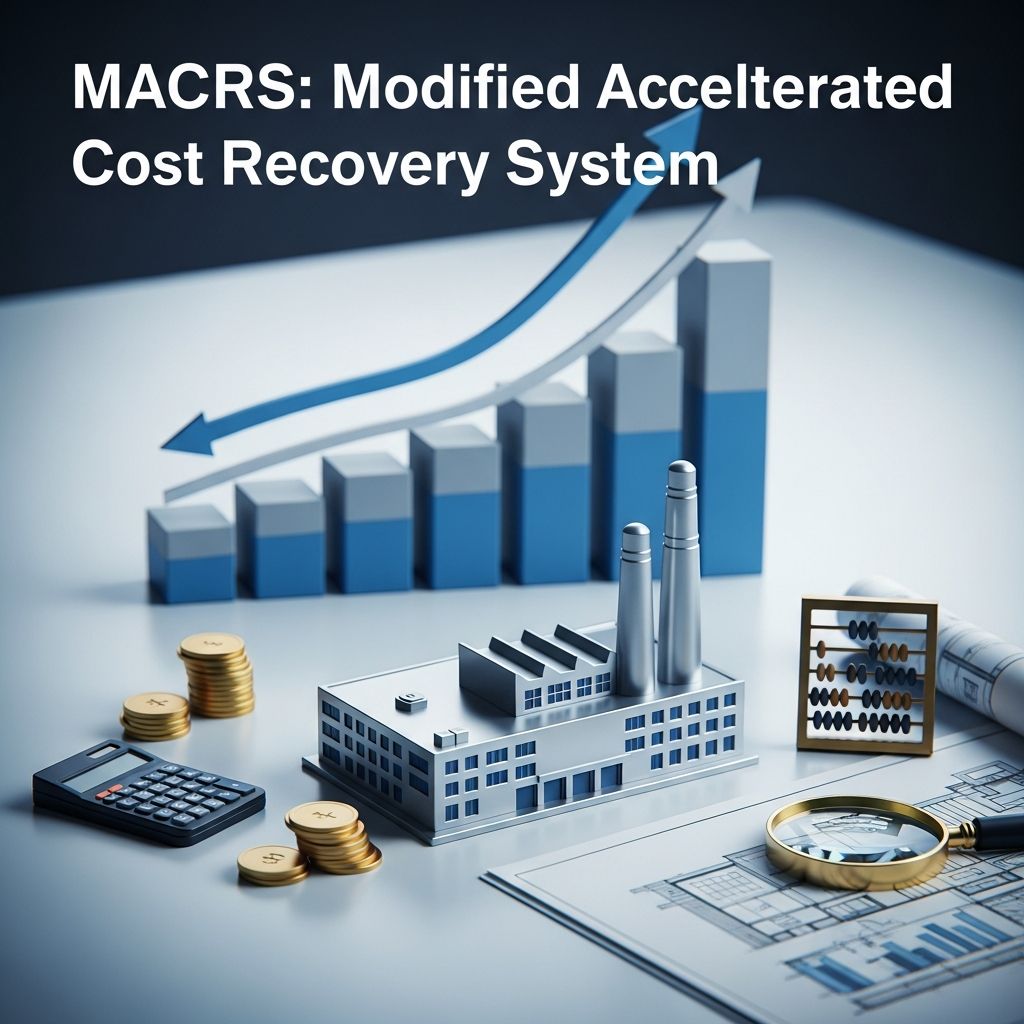
The Modified Accelerated Cost Recovery System, commonly referred to as MACRS, is the standard method the Internal Revenue Service (IRS) uses to calculate depreciation for tax purposes in the United States. Unlike various accounting depreciation methods, MACRS provides a standardized, systematic approach that eliminates much of the guesswork involved in determining how businesses can deduct the cost of assets over time. Understanding MACRS is essential for business owners, accountants, and tax professionals who need to properly report asset depreciation on tax returns and financial statements.
What is Depreciation and Why It Matters
Before diving into MACRS specifically, it’s important to understand the concept of depreciation. Depreciation represents the systematic allocation of an asset’s cost over its useful life. When a business purchases equipment, vehicles, machinery, or other assets used in generating income, the cost cannot be deducted entirely in the year of purchase. Instead, the cost is spread across multiple years through depreciation.
The primary reason businesses depreciate assets relates to the matching principle, a fundamental accounting concept that requires business income to be matched as closely as possible with associated expenses. If a company purchased a five-year asset for $50,000 and deducted the entire amount in year one, its net income would be severely understated that year and overstated in the subsequent four years. Depreciation corrects this distortion by allocating the expense proportionally across the asset’s useful life.
It’s crucial to understand that depreciation has nothing to do with an asset’s fair market value or actual physical condition. An asset might appreciate in value while still being depreciated for tax purposes. Depreciation purely reflects the loss of usefulness and income-generating capability over time.
The History and Purpose of MACRS
MACRS was introduced as part of the Economic Recovery Tax Act of 1981 and has become the mandatory depreciation method for most tangible business property placed in service after 1986. The system was designed to simplify depreciation calculations, provide consistency across different industries and asset types, and encourage business investment through accelerated depreciation schedules.
Prior to MACRS, businesses had more flexibility in choosing depreciation methods, which created inconsistency and complexity in tax reporting. MACRS standardized the process by establishing predetermined recovery periods and depreciation percentages for different asset classes, making tax compliance more straightforward and predictable.
Key Components of MACRS
MACRS operates on several fundamental principles that determine how assets are depreciated:
Recovery Periods
One of the most important aspects of MACRS is the assignment of recovery periods to different asset types. The IRS publishes tables that classify assets by general type or industry and assign specific recovery periods ranging from 3 to 50 years. Common recovery periods include:
- 3-year property: manufacturing equipment, special handling devices
- 5-year property: automobiles, computers, office equipment
- 7-year property: office furniture, machinery, equipment
- 15-year property: certain land improvements, restaurant property
- 20-year property: farm buildings, municipal sewers
- 27.5-year property: residential rental property
- 39-year property: nonresidential real property
Depreciation Methods
MACRS employs different depreciation methods depending on the asset classification:
- 200% Declining Balance Method: Used for most personal property with recovery periods of 3, 5, 7, or 10 years. This accelerated method provides larger deductions in early years.
- 150% Declining Balance Method: Applied to certain assets like horses and agricultural machinery, providing moderate acceleration.
- Straight-Line Method: Used for real property and optional for some other assets, providing equal deductions each year.
Half-Year Convention
MACRS operates under the assumption that most assets are placed in service halfway through the tax year. This means that regardless of when during the year an asset is actually purchased, taxpayers can only deduct one-half of the first-year depreciation. Correspondingly, the final year of the recovery period also includes only half-year depreciation. For example, a five-year asset would be depreciated over 5.5 years (0.5 + 4 + 0.5).
The Two MACRS Systems
MACRS provides two distinct depreciation systems:
General Depreciation System (GDS)
The General Depreciation System is the more commonly used MACRS method. It provides the shortest recovery periods and uses accelerated depreciation methods, resulting in larger tax deductions in earlier years. Most business property placed in service after 1986 uses GDS unless specifically required or elected to use the alternative system.
Alternative Depreciation System (ADS)
The Alternative Depreciation System uses longer recovery periods and the straight-line depreciation method. Certain properties are required to use ADS, including imported property, tax-exempt property, and property used primarily outside the United States. Additionally, taxpayers may elect to use ADS for specific property if it better suits their tax planning strategy.
How to Calculate MACRS Depreciation
Calculating MACRS depreciation involves a straightforward process using IRS tables:
- Determine the asset’s basis: This is typically the purchase price plus any capitalized improvements or installation costs.
- Identify the asset class: Consult IRS Publication 946 to determine which recovery period applies to your specific asset.
- Select the depreciation method: Choose between GDS and ADS, typically GDS unless otherwise required.
- Apply the percentage: Use the appropriate MACRS table to find the depreciation percentage for your asset’s recovery period and the specific year.
- Calculate the deduction: Multiply the asset’s basis by the applicable depreciation percentage.
For example, if a business purchases office equipment for $10,000 classified as 5-year property using GDS and the 200% declining balance method, the depreciation percentage for year one is 20%, resulting in a $2,000 deduction.
Section 179 and Bonus Depreciation
While MACRS is the standard depreciation method, the tax code provides additional options that may allow faster asset cost recovery. Section 179 of the Internal Revenue Code allows businesses to immediately expense the cost of qualifying property, up to certain annual limits, rather than depreciate it over time. This election can be particularly beneficial for small businesses and sole proprietorships.
Additionally, bonus depreciation provisions have periodically allowed businesses to deduct a percentage (often 100% in recent years) of the acquisition cost of qualified property in the year it’s placed in service. These provisions have been implemented to stimulate business investment and economic growth.
Comparison of MACRS to Other Depreciation Methods
| Depreciation Method | Calculation Basis | Year 1 Deduction | Use Case |
|---|---|---|---|
| MACRS (GDS) | Predetermined percentages | Accelerated | Most business property after 1986 |
| Straight-Line | Equal annual amount | Moderate | Real property, optional for some assets |
| Declining Balance | Percentage of remaining basis | Accelerated | Used within MACRS framework |
| Units of Production | Actual usage | Variable | Equipment with measurable output |
Practical Applications and Examples
Understanding MACRS through real-world examples helps illustrate its practical application. Consider a restaurant that purchases new cooking equipment for $8,000. The equipment is classified as 7-year property. Using GDS and the 200% declining balance method, the restaurant would claim approximately $2,286 in depreciation in year one (accounting for the half-year convention). Over the seven-year recovery period, the entire $8,000 basis would be recovered through tax deductions.
Another example involves a small business purchasing a company vehicle for $30,000. Classified as 5-year property, the first-year MACRS deduction would be approximately $6,000. The accelerated deduction front-loads tax benefits, improving cash flow in early years when the asset is typically most valuable to the business.
Special Considerations and Limitations
While MACRS provides significant tax benefits, certain limitations and special considerations apply. Not all business assets qualify for MACRS depreciation; for example, land cannot be depreciated. Additionally, assets purchased and placed in service in the same year may qualify for Section 179 expensing or bonus depreciation, which can provide even faster cost recovery than MACRS.
Businesses must maintain detailed records of all depreciable assets, including acquisition dates, cost, recovery period, and annual depreciation calculations. When assets are sold or disposed of, the accumulated depreciation must be tracked to calculate any resulting gain or loss.
MACRS vs. Book Depreciation
It’s important to recognize that MACRS is used exclusively for tax purposes. Businesses preparing financial statements for investors, creditors, or other stakeholders typically use different depreciation methods better suited to reflecting actual asset use and value decline. A company might depreciate an asset on a straight-line basis for book purposes while using MACRS for tax filing, creating differences between book income and taxable income that are reconciled through tax accounting adjustments.
Frequently Asked Questions
Q: Can I choose not to use MACRS for my business assets?
A: For most tangible business property placed in service after 1986, MACRS is mandatory for tax purposes. However, you may elect to use the Alternative Depreciation System (ADS) for specific property, and certain assets may qualify for Section 179 expensing instead of depreciation.
Q: How does the half-year convention work in MACRS?
A: The half-year convention assumes all assets are placed in service midway through the tax year, regardless of actual purchase date. This means you claim only half of the first-year percentage and also half of the final-year percentage, extending the recovery period by half a year.
Q: What’s the difference between GDS and ADS?
A: GDS uses shorter recovery periods and accelerated depreciation methods, while ADS uses longer recovery periods and the straight-line method. GDS is the default system; ADS is required for certain property or may be elected by the taxpayer.
Q: Can I depreciate land under MACRS?
A: No, land cannot be depreciated under any depreciation system because it doesn’t wear out or become obsolete. Only improvements to land and movable assets can be depreciated.
Q: How do Section 179 expensing and bonus depreciation interact with MACRS?
A: Section 179 and bonus depreciation are alternatives to MACRS depreciation that allow businesses to recover asset costs more quickly. These elections can be made instead of following standard MACRS rules for qualifying property.
References
- Publication 946: How to Depreciate Property — Internal Revenue Service (IRS). 2024. https://www.irs.gov/publications/p946
- Depreciation 101: What is MACRS? — The Tax Geek. October 2, 2022. https://www.youtube.com/watch?v=0rN-S2QmNPU
- Internal Revenue Code Section 168: Accelerated Cost Recovery System — U.S. Congress. https://www.govinfo.gov/content/pkg/USCODE-2022-title26/html/USCODE-2022-title26-subtitleA-chap1-subchapB-partVI-sec168.htm
- Economic Recovery Tax Act of 1981 — U.S. Congress. https://www.congress.gov/bill/97th-congress/hr-4242
Similar Articles








Read full bio of Sneha Tete