Macroeconomics: Definition, Scope, and Key Principles
Comprehensive guide to macroeconomics, exploring economy-wide trends and policy implications.
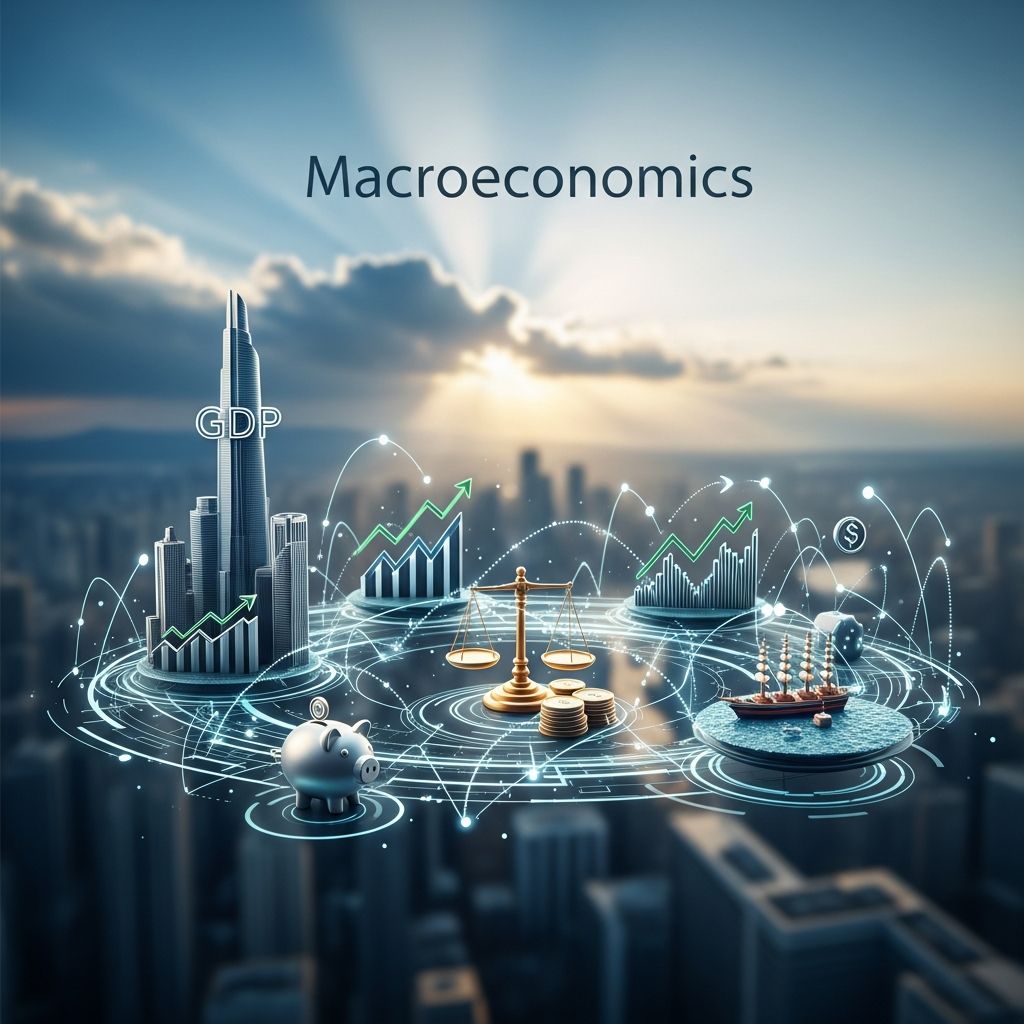
Macroeconomics is a branch of economics that examines the performance, structure, behavior, and decision-making of an economy as a whole. Rather than focusing on individual markets or consumer choices, macroeconomics takes a bird’s-eye view of regional, national, and global economies. This field of study helps policymakers, investors, and business leaders understand large-scale economic phenomena and make informed decisions that affect millions of people.
What Is Macroeconomics?
Macroeconomics represents one of the two primary branches of economic study, the other being microeconomics. While microeconomics focuses on individual actors such as consumers and firms, macroeconomics examines aggregate variables and economy-wide trends. Macroeconomists study crucial indicators including gross domestic product (GDP), national income, unemployment rates, price indices, inflation, consumption patterns, savings behavior, investment levels, energy markets, international trade, and international finance.
The discipline has evolved to encompass a comprehensive understanding of how markets interact to produce large-scale economic outcomes. Macroeconomic analysis is essential for understanding business cycles, financial crises, long-term growth trajectories, and the effectiveness of government policies. Modern macroeconomics integrates insights from various schools of thought and employs both theoretical models and empirical research methods to address real-world economic challenges.
Macroeconomics vs. Microeconomics: Key Differences
Understanding the distinction between macroeconomics and microeconomics is fundamental to grasping how economic analysis operates at different levels. While these two branches complement each other, they employ different approaches and focus on different phenomena.
Scope and Focus
Microeconomics examines individual economic units such as consumers, households, and firms. It investigates how these entities make decisions about resource allocation, pricing, and production. Microeconomics employs a bottom-up approach, analyzing specific markets and how supply and demand forces determine price levels in particular sectors.
Macroeconomics, by contrast, takes a top-down approach, analyzing entire economies and large-scale economic phenomena. It focuses on aggregate measures such as national output, overall price levels, employment rates, and international trade flows. Where a microeconomist might study the factors affecting oil prices, a macroeconomist examines how changes in energy markets affect national inflation and economic growth.
Analytical Approach
Microeconomics hones in on the details of specific markets and the behavior of individual actors. It answers questions about how consumers allocate their budgets, how firms determine production levels, and how market competition affects pricing. Microeconomic analysis helps explain phenomena such as why certain products become more expensive or how minimum wage policies affect employment in specific industries.
Macroeconomics looks at the bigger picture, addressing economy-wide trends and patterns. It seeks to understand what causes recessions, how central banks control inflation, why some nations experience faster economic growth than others, and how international trade relationships affect national prosperity. The two approaches are interconnected: decisions made at the micro level by consumers and businesses ultimately influence macro-level outcomes like national economic growth and stability, while macroeconomic conditions shape the environment in which individuals and firms operate.
Core Macroeconomic Variables and Concepts
Three central macroeconomic variables form the foundation of analysis and policymaking: output (GDP), unemployment, and inflation. These variables provide essential snapshots of an economy’s health and inform policy decisions across the globe.
Gross Domestic Product (GDP)
GDP represents the total market value of all finished goods and services produced within a country during a specific period. This metric serves as the primary indicator of economic health and living standards. Economists track GDP growth to assess whether an economy is expanding or contracting. Rising GDP generally indicates economic prosperity and increased employment opportunities, while declining GDP may signal recession or economic stagnation. GDP can be measured in nominal terms (unadjusted for inflation) or real terms (adjusted for inflation), with real GDP providing a more accurate picture of actual economic growth.
Unemployment
Unemployment measures the percentage of the labor force that is actively seeking work but unable to find employment. This indicator reflects the economy’s ability to create jobs and provide income-generating opportunities. High unemployment signals economic weakness and unused productive capacity, while low unemployment suggests a robust labor market. Macroeconomists distinguish between different types of unemployment, including frictional unemployment (temporary joblessness during transitions), structural unemployment (resulting from skills mismatches or industry decline), and cyclical unemployment (related to business cycle fluctuations).
Inflation
Inflation represents the rate at which the general price level of goods and services rises over time. The Consumer Price Index (CPI) serves as a key indicator of inflation, measuring how purchasing power changes. While moderate inflation is generally considered normal in healthy economies, high inflation erodes savings and purchasing power, while deflation (negative inflation) can discourage spending and investment. Central banks typically target a specific inflation rate, often around 2 percent annually, to balance price stability with economic growth.
Time Horizons in Macroeconomic Analysis
Macroeconomics traditionally divides analysis into different time frames, each with distinct characteristics and appropriate policy responses. This temporal distinction is crucial for understanding economic dynamics and designing effective policies.
Short Run (Business Cycle)
The short run, typically spanning a few years, focuses on business cycle fluctuations and changes in aggregate demand. During this period, the economy experiences booms and recessions driven largely by shifts in overall demand for goods and services. Stabilization policies such as monetary policy and fiscal policy prove most relevant in the short run, helping governments smooth out economic volatility and prevent severe recessions or inflationary overheating.
Medium Run
Over the medium run, typically a decade or so, the economy tends toward an output level determined by supply factors including the capital stock, technology level, and labor force size. Unemployment tends to revert to its structural or “natural” level, determined by labor market characteristics rather than cyclical demand fluctuations. Because these supply factors move slowly, medium-term analysis often treats them as relatively fixed, while policies such as labor market reforms and competition policy may influence structural outcomes.
Long Run
Long-run macroeconomic analysis emphasizes economic growth and the factors that drive sustained increases in living standards over decades and centuries. Advances in technology, accumulation of capital and machinery, improved education, and enhanced human capital all contribute to increased economic output over extended periods. However, output does not always increase consistently; business cycles cause short-term drops in output known as recessions, and economists seek policies that prevent economies from slipping into either recessions or unsustainable overheating while promoting higher productivity and improved standards of living.
Macroeconomic Policy Tools
Policymakers employ various tools to influence macroeconomic outcomes, typically organized into two main categories: fiscal policy and monetary policy. These instruments address different time horizons and economic challenges.
Fiscal Policy
Fiscal policy involves government spending and taxation decisions. When the economy experiences recession and high unemployment, expansionary fiscal policy—through increased government spending or tax cuts—aims to stimulate aggregate demand and job creation. Conversely, during periods of high inflation and overheating, contractionary fiscal policy reduces government spending or raises taxes to cool excessive demand. Fiscal policy operates with certain lags, as legislative processes can slow implementation, making it somewhat less flexible than monetary policy for addressing short-term fluctuations.
Monetary Policy
Monetary policy, conducted by central banks through control of interest rates and money supply, represents the second major stabilization tool. Central banks raise interest rates to reduce borrowing and spending during inflationary periods, thereby cooling economic activity. They lower interest rates during recessions to encourage borrowing and investment, stimulating demand. Monetary policy typically operates more quickly than fiscal policy and provides central banks with considerable influence over short-term economic conditions.
Structural Policies
Beyond short-term stabilization, structural policies target medium- and long-run economic performance. Labor market policies aim to reduce structural unemployment by improving worker skills and job matching. Education and research development investments enhance human capital and technological progress. Competition policies promote efficiency and innovation. These structural measures work more slowly than stabilization policies but address underlying determinants of productivity and growth.
Macroeconomic Models and Analysis
Macroeconomic research, teaching, and policy debates typically evolve around formal models—both theoretical and empirical—to clarify assumptions and demonstrate their consequences precisely. Simple theoretical models containing only a few equations highlight key basic principles and are widely used in teaching and research. Larger applied quantitative models used by governments, central banks, think tanks, and international organizations help predict the effects of policy changes and economic shocks, serving as the foundation for economic forecasting.
Modern macroeconomics emphasizes empirical work and improved methods to distinguish between correlation and causality, part of what economists call the “credibility revolution” in the discipline. This approach strengthens the evidentiary basis for policy recommendations and improves the accuracy of economic forecasts.
Contemporary Macroeconomic Challenges
Contemporary macroeconomics addresses several complex challenges that extend beyond traditional business cycle analysis. These include managing the financial system and understanding macrofinancial linkages, addressing leverage and liquidity problems in the financial sector, implementing macroprudential tools to prevent financial crises, and managing unsustainable public debt levels. The 2008 financial crisis highlighted the importance of understanding interconnections between the financial system and the broader economy, leading to increased focus on financial stability as a macroeconomic objective alongside traditional goals of growth, low unemployment, and price stability.
Frequently Asked Questions
What is the primary focus of macroeconomics?
Macroeconomics focuses on the performance and structure of entire economies, examining aggregate variables such as GDP, unemployment, inflation, and international trade. It analyzes economy-wide trends and develops policies to promote growth and stability.
How does macroeconomics differ from microeconomics?
While microeconomics examines individual actors like consumers and firms, macroeconomics takes a broader view of entire economies. Microeconomics uses a bottom-up approach studying specific markets, whereas macroeconomics employs a top-down approach analyzing aggregate economic phenomena and national-level trends.
What are the three core macroeconomic variables?
The three core variables are output (GDP), which measures total economic production; unemployment, which measures joblessness; and inflation, which measures the rate of price increases. These variables serve as primary indicators of economic health.
What is the difference between fiscal and monetary policy?
Fiscal policy involves government spending and taxation decisions to influence the economy. Monetary policy, conducted by central banks, controls interest rates and money supply. Both are stabilization tools but operate through different mechanisms and with different time lags.
Why is understanding different time horizons important in macroeconomics?
Different time horizons reveal different economic dynamics. The short run emphasizes business cycles and demand fluctuations, the medium run focuses on structural factors, and the long run emphasizes growth and technological progress. Appropriate policies differ for each horizon.
How do macroeconomic models contribute to policymaking?
Macroeconomic models help policymakers understand relationships between variables, predict the effects of policy changes, and forecast future economic conditions. Models range from simple theoretical frameworks to complex quantitative systems used by central banks and governments.
References
- Macroeconomics — Wikipedia. Accessed November 2025. https://en.wikipedia.org/wiki/Macroeconomics
- Microeconomics vs. Macroeconomics: Understanding the Differences — Wilson College. November 4, 2024. https://online.wilson.edu/resources/microeconomics-vs-macroeconomics/
- Principles of Economics — International Monetary Fund (IMF). https://www.imf.org/
- National Accounts Statistics — Organization for Economic Co-operation and Development (OECD). https://www.oecd.org/
Similar Articles








Read full bio of Sneha Tete