The Evolution of Lollapalooza: From Band Farewell to Global Festival
Discover how Perry Farrell transformed a farewell tour into one of the world's most iconic music festivals.
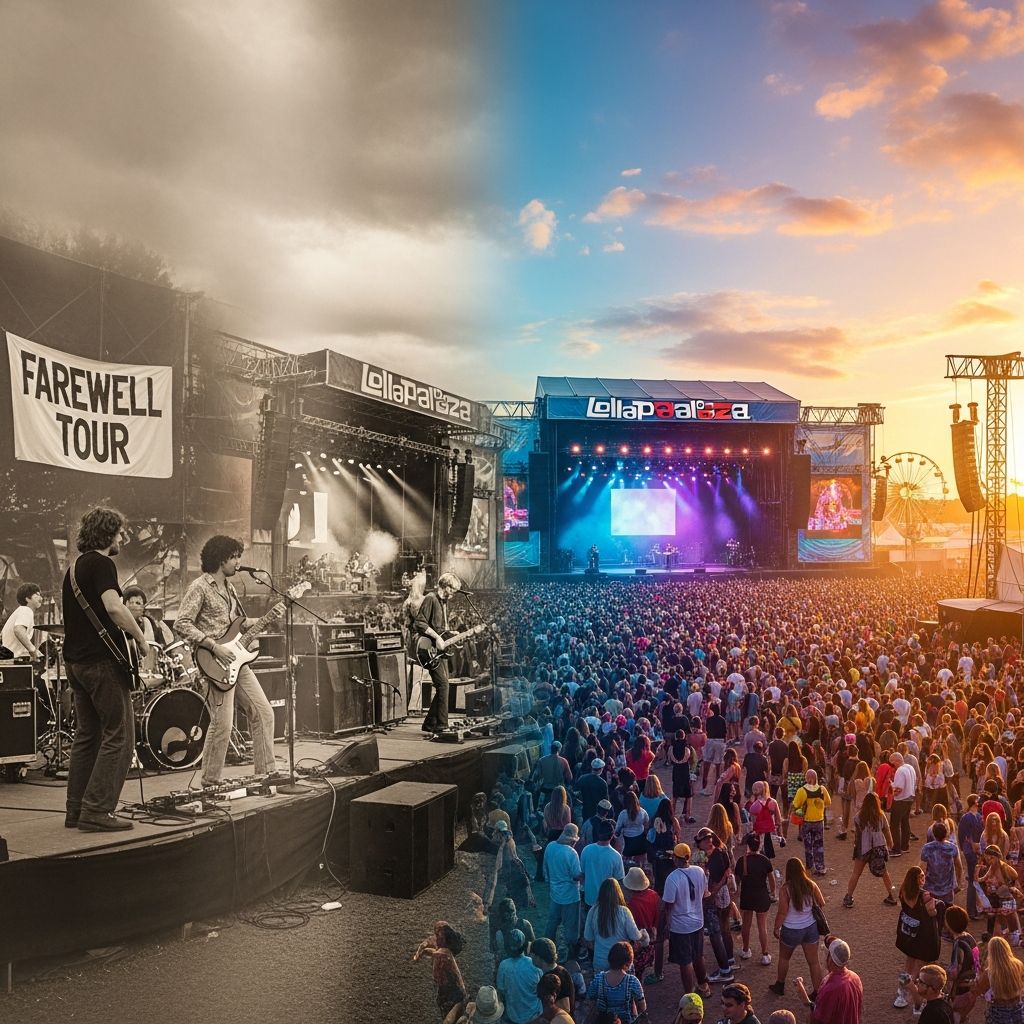
When Jane’s Addiction frontman Perry Farrell conceptualized what would become one of music’s most enduring festivals in 1991, he envisioned something entirely different from what exists today. What began as a multicity venture to celebrate his band’s separation has evolved into a meticulously curated destination event that draws hundreds of thousands of music enthusiasts annually. The journey of Lollapalooza represents a fascinating case study in how creative vision, resilience through financial challenges, and strategic reinvention can transform a single artistic concept into a global cultural phenomenon.
The Visionary Inception: A Farewell Takes Shape
The genesis of Lollapalooza emerged from necessity and creativity intertwined. Farrell sought to create a memorable conclusion to Jane’s Addiction’s tenure as a working band, but rather than settling for a conventional farewell tour, he imagined something grander—a traveling celebration of musical diversity that would span multiple cities across North America. The inaugural journey launched in the summer of 1991, establishing a template that would influence festival culture for decades to come.
The name itself carries interesting historical roots. Farrell selected the term after encountering it in a Three Stooges film, drawn to its archaic meaning of something extraordinarily impressive or remarkable. This choice reflected his intention to create an event that transcended ordinary concert experiences, positioning Lollapalooza not merely as a musical gathering but as a cultural spectacle worthy of its unusual nomenclature.
The First Tour: Scale and Artistic Diversity
The 1991 Lollapalooza tour represented an ambitious undertaking by contemporary standards. The festival made stops across more than twenty cities throughout the United States and Canada, beginning with its premiere in Phoenix, Arizona, on July 18, 1991. The routing continued through late August, concluding at the King County Fairgrounds near Seattle, Washington. This extensive geographical footprint differentiated Lollapalooza from previous large-scale music events.
What truly distinguished the inaugural festival was its commitment to musical eclecticism. Rather than focusing exclusively on one genre or aesthetic, Farrell assembled a diverse lineup that reflected the breadth of contemporary alternative and experimental music:
- Alternative rock acts including Siouxsie and the Banshees and the Jane’s Addiction themselves
- Industrial music pioneers such as Nine Inch Nails, who brought avant-garde electronic aesthetics to mainstream festival audiences
- Rap and hip-hop representation through Ice-T, whose presence on the lineup also provided the platform for his heavy metal band Body Count to gain exposure
- Supporting artists including the Rollins Band, demonstrating the festival’s comprehensive approach to musical curation
The financial success of this inaugural run proved pivotal. Immediate profitability convinced Farrell and organizers that Lollapalooza possessed genuine commercial viability beyond a one-time farewell gesture, prompting plans for expansion in subsequent years.
The Touring Years: Growth, Challenges, and Venue Incidents
Following its successful debut, Lollapalooza established itself as an annual touring institution throughout the 1990s. The 1992 edition introduced the multistage format that remains central to the festival’s infrastructure today, allowing organizers to accommodate larger lineups while minimizing delays between performances. This logistical innovation proved instrumental in scaling the event without compromising the concert experience.
The touring years witnessed significant evolution in the festival’s presentation and audience experience. By 1994, Lollapalooza had become sophisticated enough to accommodate multiple weekend iterations at different venues, with performances at locations such as the Gorge Amphitheatre in Washington and venues in California. The 1994 lineup expanded to include emerging alternative rock luminaries like Smashing Pumpkins, Beastie Boys, and Green Day, alongside hip-hop representation through A Tribe Called Quest.
However, the touring model’s popularity occasionally exceeded venue capacities and local authorities’ comfort levels. Most notably, attendees at Great Woods in Mansfield, Massachusetts, during one tour iteration engaged in significant property destruction, dismantling venue fencing and utilizing it for bonfires throughout performances. This incident forced organizers to temporarily relocate New England dates to alternative venues, including a naval facility at Quonset Point in Rhode Island, before finally returning to Great Woods in 1995 after local officials attempted to permanently exclude the festival.
The touring format continued annually from 1991 through 1997, establishing Lollapalooza as a fixture of North American summer concert culture. However, financial sustainability began deteriorating as the decade concluded.
Financial Turbulence and the Search for Stability
By the late 1990s, the touring model that had defined Lollapalooza’s success encountered mounting profitability challenges. Beginning in 1998, the festival ceased operations, marking the first significant interruption to its annual tradition. The financial pressures that precipitated this cancellation reflected broader challenges in touring festival economics, including rising operational costs, venue complications, and shifting audience demographics.
An attempted revival in 2003 generated optimism among devoted fans, yet persistent financial difficulties continued hampering the concept. When organizers announced cancellation of the 2004 touring edition, it became apparent that the traditional multicity festival format required fundamental reimagining. The touring model’s operational complexity, combined with unpredictable revenue streams across disparate geographical markets, had created unsustainable financial pressure.
The Transformative Pivot: Establishing a Permanent Home
The critical turning point arrived in 2005 when Perry Farrell secured new financial backing and reimagined Lollapalooza as a stationary destination festival. This strategic pivot represented a complete departure from the touring philosophy that had defined the festival for fifteen years. Rather than expecting audiences to follow the festival across multiple cities, organizers would create a single location so compelling that music enthusiasts would travel to it.
The selection of Chicago’s Grant Park as the permanent home reflected calculated strategic reasoning. Grant Park offered exceptional accessibility for music lovers originating from throughout the United States and provided adequate space for the infrastructure required by a major festival. Additionally, Chicago’s cultural character—recognized for its liberal, open-minded population receptive to diverse artistic expression—aligned with Lollapalooza’s foundational aesthetic commitments.
The inaugural Grant Park edition in 2005 debuted as a two-day festival, establishing a more intimate scale than previous touring iterations while maintaining the artistic ambition that had always characterized Lollapalooza. Despite challenging weather conditions, including a record-breaking 104-degree Fahrenheit heat wave that hospitalized two attendees for heat-related illness, the festival attracted approximately 65,000 people. This attendance figure, combined with overwhelmingly positive reception, validated the destination festival concept and secured Lollapalooza’s future.
Expansion and Evolution: From Two Days to Four
The success of the 2005 Chicago debut prompted rapid expansion. When Lollapalooza returned to Grant Park in 2006, organizers added a third day, recognizing that demand for tickets and artist slots exceeded what a two-day format could accommodate. This expansion reflected both audience enthusiasm and the festival’s enhanced capacity to curate increasingly ambitious lineups.
Notably, 2006 marked a significant shift in Lollapalooza’s artistic direction. While the festival maintained its alternative rock foundation, mainstream artists began appearing alongside traditional alternative fare. The 2006 lineup featured emerging alternative acts like Panic! At the Disco and The Raconteurs alongside mainstream crossover artists including Kanye West and Red Hot Chili Peppers, signaling the festival’s evolution toward broader appeal.
For over a decade, the three-day format served Lollapalooza effectively. However, by 2016, another expansion became necessary. The addition of a fourth day transformed Lollapalooza into the four-day festival that contemporary audiences experience. This expansion acknowledged both increased demand for festival attendance and the proliferation of artist availability, enabling organizers to feature significantly more performers across expanded stage infrastructure.
Contemporary Status and Long-Term Commitment
The establishment of Lollapalooza in Chicago garnered such success that municipal and organizational leadership recognized the festival’s cultural and economic significance. Following a particularly strong 2008 edition, Chicago city officials and festival organizers negotiated an agreement extending Lollapalooza’s Chicago residency through 2018, with the city securing $13 million in commitments. This formal arrangement provided stability and demonstrated the festival’s entrenchment as a cornerstone of Chicago’s cultural calendar.
Beyond its Chicago foundation, Lollapalooza has expanded internationally. From 2005 onward, the festival has maintained its primary residence at Grant Park while simultaneously establishing satellite editions in Chile, Brazil, Argentina, Germany, France, and India, creating a truly global festival network.
Recent Challenges and Adaptations
The global COVID-19 pandemic tested Lollapalooza’s resilience significantly. The 2020 edition, originally scheduled for April with Guns N’ Roses and Travis Scott as headliners, underwent multiple reschedules. Initial postponement to December proved unsuccessful; subsequent rescheduling to September 2021 continued facing restrictions; and a final shift to March 2022 finally enabled the festival’s return. When Foo Fighters were announced as closing-night headliners for March 2022, the unexpected death of their drummer Taylor Hawkins two days before the performance necessitated replacement by Brazilian tribute artists, demonstrating the festival’s capacity for sensitive adaptation during crisis moments.
FAQ: Understanding Lollapalooza
Who created Lollapalooza and why?
Perry Farrell, frontman of Jane’s Addiction, created Lollapalooza in 1991 as a farewell tour for his band. Rather than a conventional goodbye, he envisioned a multicity festival celebrating diverse musical genres and styles.
Where did the name Lollapalooza originate?
Farrell selected the name after hearing it used in a Three Stooges film. The archaic term means extraordinarily impressive or remarkable, reflecting his ambition to create a culturally significant event.
When did Lollapalooza transition to Chicago’s Grant Park?
After years as a touring festival and financial difficulties in the late 1990s, Lollapalooza transformed into a stationary destination festival in 2005, establishing its permanent home in Chicago’s Grant Park.
How many days is the modern Lollapalooza festival?
Today’s Lollapalooza spans four days, expanded from the original two-day format that premiered in 2005. The four-day structure was implemented beginning in 2016.
What genres of music are represented at Lollapalooza?
Lollapalooza maintains its historical commitment to musical diversity, featuring alternative rock, hip-hop, indie, electronic, pop, and numerous other genres across multiple stages.
References
- Who Started Lollapalooza? Origins of Chicago Music Festival — Pequod’s Pizza Blog. https://pequodspizza.com/blog/who-started-lollapalooza/
- Lollapalooza | History & Facts — Britannica. https://www.britannica.com/art/Lollapalooza
- Lollapalooza — Wikipedia. https://en.wikipedia.org/wiki/Lollapalooza
- List of Lollapalooza lineups by year — Wikipedia. https://en.wikipedia.org/wiki/List_of_Lollapalooza_lineups_by_year
- A History of Lollapalooza Lineups & Past Performers — TickPick. https://www.tickpick.com/blog/a-history-of-lollapalooza-lineups-past-performers/
Similar Articles








Read full bio of medha deb