Logical Thinking: Definition With Examples
Master logical thinking skills to solve problems effectively and advance your career.
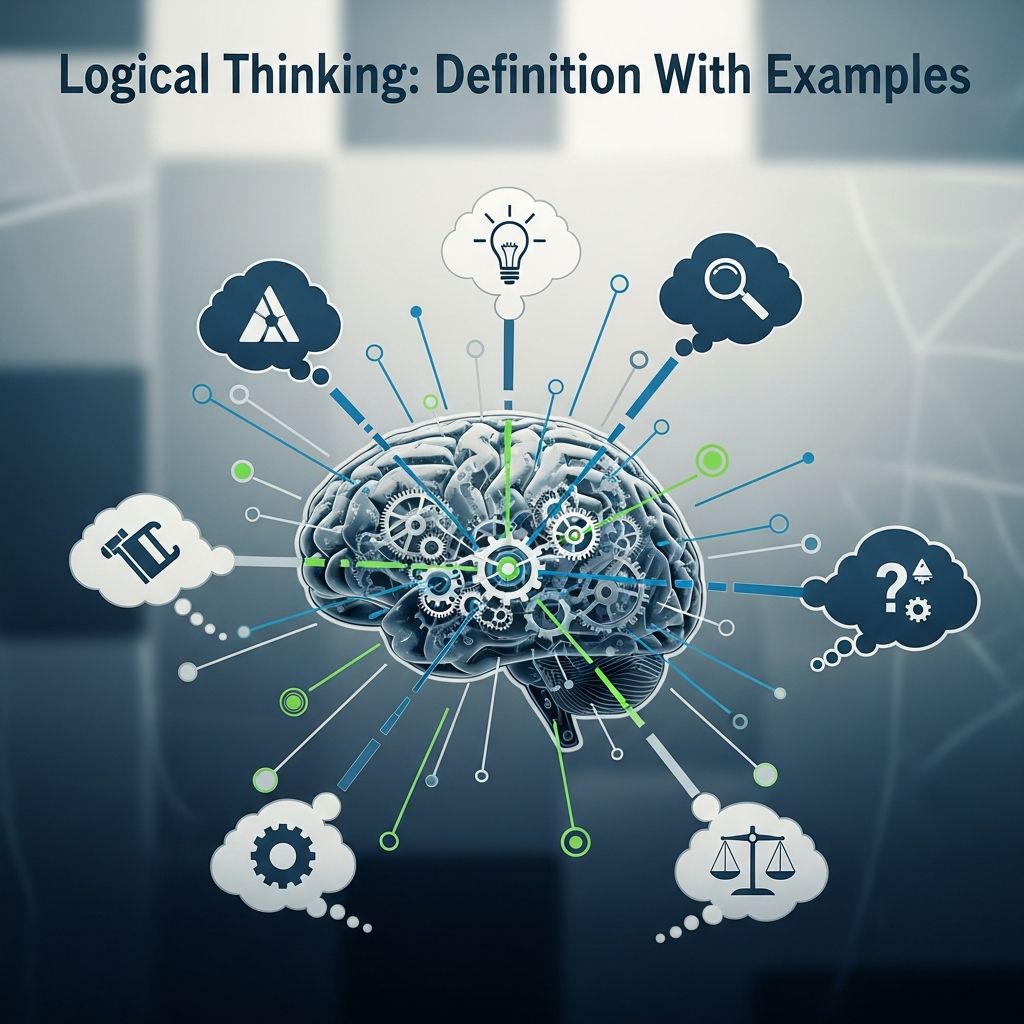
Logical thinking is a fundamental skill that enables individuals to analyze situations, evaluate information, and reach sound conclusions through systematic reasoning. In today’s fast-paced professional environment, the ability to think logically has become increasingly valuable across industries and organizational levels. Whether you’re managing complex projects, making critical business decisions, or solving everyday workplace challenges, logical thinking provides a structured framework for approaching problems methodically and arriving at well-reasoned solutions.
What Is Logical Thinking?
Logical thinking is the process of using reasoning consistently to come to a conclusion. It involves analyzing a situation or problem using reason and coming up with potential solutions based on facts and evidence. Logical thinkers gather all available information, assess the facts carefully, and then methodically decide the best way to move forward. This approach contrasts sharply with relying on intuition, gut feelings, or snap judgments.
At its core, logical thinking means following a chain of reason, step by step, to reach a valid conclusion. According to Dr. Karl Albrecht in his book Brain Building, the basis of all logical thinking is sequential thought—taking important ideas, facts, and conclusions and arranging them in a step-by-step progression that creates meaning. To think logically is essentially to think in steps, where each conclusion builds naturally from the previous one.
In the workplace, logical thinking serves as an essential tool to help analyze problems, brainstorm ideas, and find answers. Employers value employees who can identify the right solutions that are financially reasonable, probable, and actionable. This skill demonstrates professionalism, reliability, and the ability to contribute meaningfully to organizational success.
Types of Logical Thinking
Logical thinking encompasses several distinct methods of reasoning, each applicable to different situations and challenges. Understanding these different approaches allows you to select the most appropriate reasoning method for your specific problem.
Deductive Reasoning
Deductive reasoning starts with a broad truth or general principle (called a major premise) and applies it to a specific case (minor premise) to reach a conclusion. This method ensures that if both premises are true, the conclusion must also be true. Deductive reasoning teaches individuals to apply general rules to specific cases with certainty.
Example:
- Major premise: All successful businesses maintain accurate financial records
- Minor premise: Company X is a successful business
- Conclusion: Company X maintains accurate financial records
Deductive reasoning is particularly valuable in environments where clear rules and established facts provide the foundation for decision-making.
Inductive Reasoning
Inductive reasoning works in the opposite direction of deductive reasoning. It moves from specific observations to general conclusions. You start with specific observations and pattern recognition, then develop a broader conclusion. While not all conclusions reached through inductive reasoning are guaranteed to be correct, it provides a strong basis for forming hypotheses that can be tested through further research and data collection.
Example:
- Observation 1: Employee training programs improved productivity by 15% last quarter
- Observation 2: Previous training initiatives also boosted team performance
- General conclusion: Investing in employee training programs enhances overall productivity
Inductive reasoning is powerful for identifying trends and developing new theories, though it remains open to exceptions and requires validation.
Linear Reasoning
Linear reasoning follows a clear, step-by-step progression, moving along a methodical path from beginning to end. This approach is closely linked to traditional measures of intelligence and forms the foundation of academic learning, particularly in mathematics and structured problem-solving.
Example: Solving a multi-step project management problem by following established procedures and protocols, where each step directly leads to the next.
Conditional Reasoning
Conditional reasoning uses if-then statements to form conclusions. This method evaluates whether specific conclusions follow from given conditions and is frequently encountered in mathematical proofs, scientific hypotheses, and everyday decision-making.
Example: If a product meets quality standards, then it can be released to market. The product meets quality standards. Therefore, the product can be released to market.
Cause-and-Effect Reasoning
Cause-and-effect reasoning identifies relationships where one event or action directly produces another outcome. This reasoning method helps individuals understand real-world systems and consequences, underpinning scientific thinking and supporting responsible decision-making.
Example: Poor communication among team members leads to project delays. By improving communication protocols, we can reduce project delays and improve delivery timelines.
Analogical Reasoning
Analogical reasoning draws conclusions by comparing similarities between two systems or situations. This method involves identifying comparable elements and extending knowledge from one domain to another, revealing meaningful connections that foster deeper understanding.
Example: Just as a well-maintained engine runs smoothly, a well-maintained information technology system performs efficiently and minimizes downtime.
Abductive Reasoning
Abductive reasoning uses known facts to develop a hypothesis or theory that may or may not prove correct. This bottom-up approach to logic forms the foundation for preliminary investigations and research directions.
Example: Sales declined last month, customer service complaints increased last month, therefore reduced customer satisfaction may have caused the sales decline.
Backward Induction
Backward induction begins with possible future outcomes and works backward to determine how each could be achieved. This reverse-engineering approach helps in strategic planning and goal achievement.
Example: An employee wants a senior management position within five years. They work backward to identify the education, experience, and skill development needed to reach that goal.
Essential Logical Thinking Skills
Developing strong logical thinking requires cultivating multiple complementary skills that work together to support effective problem-solving and decision-making.
Problem-Solving
The primary goal of logical thinking is to solve problems effectively. Problem-solving comprises three essential parts: identifying why the problem is occurring, brainstorming potential solutions, and deciding which solution to implement. This skill requires both analytical ability and creativity, as strong problem-solvers analyze facts thoroughly while simultaneously exploring creative alternatives.
Critical Thinking
Critical thinking involves evaluating information objectively, questioning assumptions, and assessing the reliability of sources and evidence. This skill enables individuals to make informed judgments rather than accepting information at face value.
Creativity
While often perceived as separate from logical thinking, creativity plays a vital role in developing innovative solutions to complex problems. Combining logical analysis with creative thinking allows for both feasible and imaginative approaches to challenges.
Analytical Skills
Analytical skills involve breaking down complex issues into smaller, manageable components and understanding how these parts relate to one another. By dissecting problems systematically, individuals can comprehend the bigger picture and reach rational conclusions.
Reasoning and Inference
Inference occurs when we assume something new based on facts we already know. Strong reasoning skills enable individuals to draw lines between related information points and construct logical chains of thought that lead to valid conclusions.
Why Logical Thinking Matters
In professional settings, logical thinking directly impacts career advancement and organizational success. Employers actively seek employees who can approach challenges systematically, make data-driven decisions, and communicate their reasoning clearly. Logical thinkers demonstrate reliability, professionalism, and the ability to contribute meaningfully to strategic initiatives.
On a practical level, logical reasoning facilitates rational and effective decision-making. When multiple courses of action are available, logical thinking enables individuals to weigh potential benefits and drawbacks, consider their likelihood, and arrive at balanced, well-considered decisions. This capability becomes increasingly valuable as responsibilities expand.
Common Logical Thinking Challenges
Garbage In, Garbage Out
A fundamental characteristic of logic is that incorrect premises lead to invalid conclusions. All logical reasoning is built on assumptions known as premises, which aren’t always incontrovertible fact. When faulty assumptions underlie reasoning, even perfect logical structure produces unreliable conclusions.
Example: If the premise “Grey cars have cautious drivers” is incorrect, the conclusion “Gary is a cautious driver because he drives a grey car” becomes invalid, regardless of how logically it was constructed.
Strengthening Your Logical Thinking Skills
Logical thinking ability can be developed and strengthened through deliberate practice and conscious application of reasoning methods. Consider these approaches to enhance your logical thinking capabilities:
- Practice systematic problem-solving: When facing challenges, consciously work through problems step-by-step rather than jumping to conclusions
- Question assumptions: Regularly examine the premises underlying your reasoning to ensure they’re valid and well-founded
- Seek diverse perspectives: Engaging with different viewpoints expands your reasoning toolkit and reveals blind spots
- Study logical puzzles: Dedicating time to logic puzzles and brainteasers strengthens pattern recognition and reasoning abilities
- Analyze real-world scenarios: Applying logical thinking to actual workplace situations builds practical expertise
- Review past decisions: Examining how your reasoning led to previous outcomes helps refine your logical thinking approach
Frequently Asked Questions
Q: What is the difference between logical thinking and critical thinking?
While related, these skills differ in scope. Logical thinking follows structured reasoning methods to reach conclusions, while critical thinking involves questioning assumptions, evaluating evidence quality, and assessing reliability. Critical thinking often incorporates logical thinking but extends beyond it to include skepticism and judgment evaluation.
Q: Can logical thinking skills be learned, or are they innate?
Logical thinking skills can absolutely be learned and developed. While some individuals may have natural inclinations toward systematic reasoning, everyone can strengthen these abilities through practice, education, and conscious application of reasoning methods.
Q: How does logical thinking apply in everyday work situations?
Logical thinking applies to virtually every workplace scenario—from analyzing project timelines and budgets to resolving team conflicts and making strategic decisions. Using logical reasoning helps ensure that decisions are based on facts rather than emotions or assumptions.
Q: What are signs that someone has strong logical thinking abilities?
Individuals with strong logical thinking typically ask clarifying questions, gather relevant information before deciding, consider multiple perspectives, explain their reasoning clearly, remain open to evidence that contradicts their initial thoughts, and make decisions based on systematic analysis rather than emotion.
Q: How can organizations foster logical thinking among employees?
Organizations can encourage logical thinking through training programs, case study analysis, problem-solving workshops, mentoring relationships with experienced logical thinkers, and creating workplace cultures that reward evidence-based decision-making and systematic problem-solving.
Q: Is logical thinking the same as being intelligent?
Logical thinking and intelligence are related but distinct. Intelligence encompasses various cognitive abilities, while logical thinking specifically refers to the ability to reason systematically and reach sound conclusions. One can possess logical thinking skills without being exceptionally intelligent in other areas, and vice versa.
References
- What Is Logical Thinking in the Workplace? — The Forage. 2024. https://www.theforage.com/blog/skills/logical-thinking
- 9 Examples of Logical Thinking — Simplicable. 2024. https://simplicable.com/en/logical-thinking
- What Is Logical Thinking? 6 Types; 5 Exercises to Improve It — Edublox Tutor. 2024. https://www.edubloxtutor.com/logical-thinking/
- Logical Reasoning — Wikipedia. 2024. https://en.wikipedia.org/wiki/Logical_reasoning
- What is Logical Thinking? Meaning, Skills, and Examples — Learning Routes. 2024. https://www.learningroutes.in/blog/logical-thinking
- The Best Ways To Strengthen Your Logical Thinking Skills — Indeed. 2024. https://www.indeed.com/career-advice/career-development/strengthen-logical-thinking-skills
Similar Articles








Read full bio of Sneha Tete