Locate Your Credit Card Account Number Easily
Discover multiple secure ways to retrieve your credit card account number without hassle, from physical cards to digital tools.
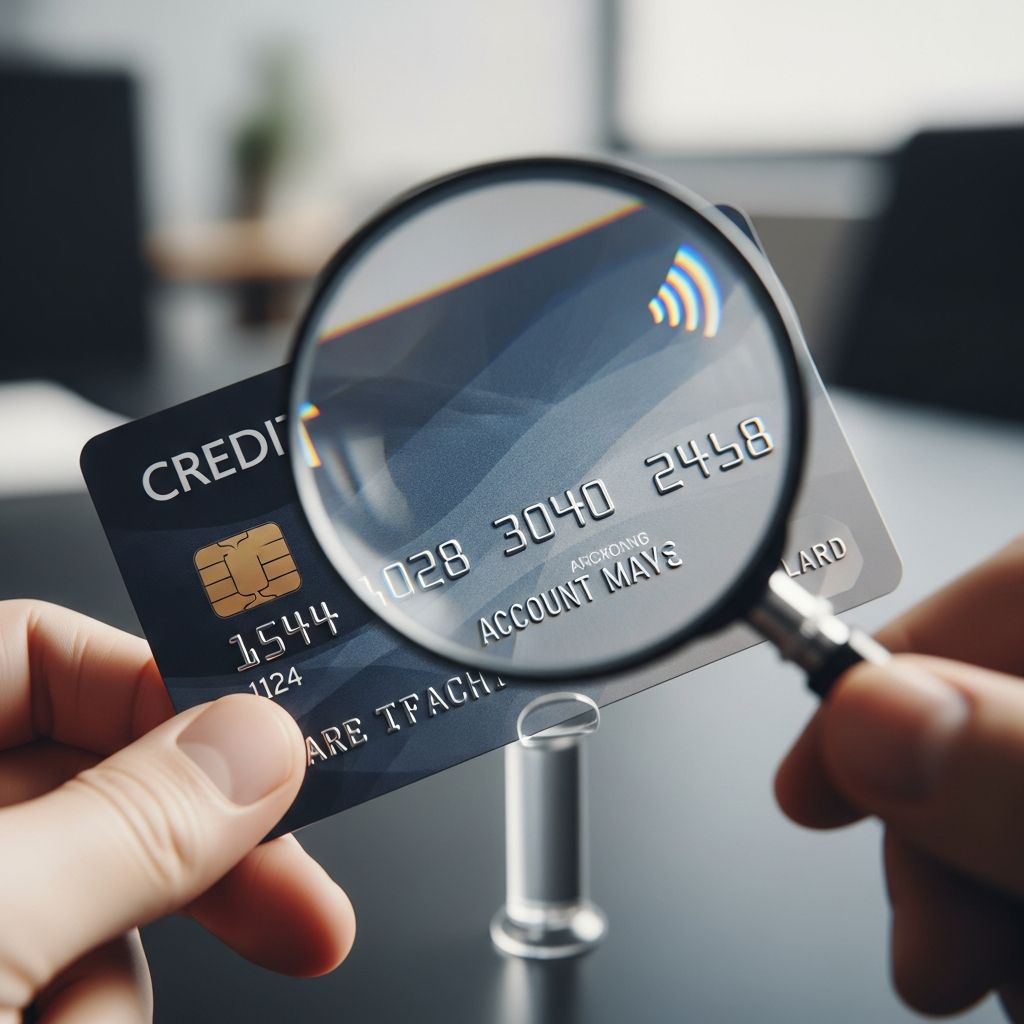
Your credit card account number is a vital piece of information for various financial tasks, typically consisting of 15 or 16 digits that uniquely identify your account with the issuer. This guide explores reliable methods to retrieve it securely, whether you have your physical card or not, drawing from standard banking practices across major issuers like Chase, American Express, and others.
Understanding Credit Card Account Numbers
Credit card account numbers serve as unique identifiers for your credit line, distinct from routing or checking account numbers used in banking. For most issuers, including Chase, the full 16-digit card number doubles as the account number, simplifying access for account holders. American Express cards, however, feature 15 digits and maintain this separation strictly on the physical card for security.
These numbers follow the ISO/IEC 7812 standard, starting with a Major Industry Identifier (MII). For instance:
| First Digit(s) | Network |
|---|---|
| 4 | Visa |
| 5 | Mastercard |
| 3 (34/37) | American Express |
| 6 | Discover |
The subsequent digits encode the issuer, account specifics, and end with a check digit validated via the Luhn algorithm to detect errors or fraud. Digits 7-15 typically form the core account identifier, ensuring uniqueness even across multiple cards on the same account.
Primary Location: Your Physical Credit Card
The most straightforward place to find your account number is on the physical card itself. It’s usually embossed or printed prominently on the front, alongside your name and expiration date, or sometimes on the back near the signature panel. For Chase cards, this 16-digit sequence is identical to your account number, making it directly usable for account-related inquiries.
Authorized users on the same account share the identical account number, though their individual card numbers may vary slightly for security. Always handle your card carefully, as exposing the full number unnecessarily can pose risks. If your card is lost, issuers like American Express emphasize requesting a replacement through your online account rather than sharing details over phone.
Accessing via Billing Statements
Billing statements, whether paper or digital, often display your account number. Log into your issuer’s online portal or app to download the latest PDF statement. Note that for privacy, only the last four digits might be visible, with the rest masked as asterisks (e.g.,
**
** **** 1234).- Check the top section where account summary details appear.
- Look for the ‘Account Number’ label explicitly stated near billing address info.
- For Discover cards, the credit card number matches the account number on statements.
Print or save statements securely, avoiding public printers to prevent unauthorized access.
Online Banking Portals and Websites
Most issuers provide secure online dashboards where your full account number is accessible after login. Navigate to ‘Account Details,’ ‘Card Information,’ or ‘Manage Cards’ sections. Browsers may also autofill stored card details from prior purchases, but verify accuracy and enable two-factor authentication (2FA) for safety.
Steps for common portals:
- Visit your issuer’s website (e.g., chase.com, capitalone.com).
- Log in with username, password, and 2FA code.
- Select the specific card account.
- View full details under summary or settings.
Capital One and similar platforms display the number partially masked but offer full views via secure pop-ups.
Mobile Apps for Quick Access
Banking apps from issuers like Chase offer fingertip access to account numbers. After biometric or PIN login, tap your card icon to reveal details. Digital masking applies here too, showing last four digits primarily, with options to unmask temporarily.
- Chase Mobile: Account info under ‘Account Services.’
- Amex App: Limited to physical card per policy; use for statements.
- Capital One: Full view in ‘Credit Cards’ tab after verification.
Enable app notifications for statements to stay updated without constant checks.
Digital Wallets and Payment Services
Services like Apple Pay, Google Pay, or PayPal tokenize your card number, replacing it with a virtual alias for transactions. You can usually view the last four digits in wallet settings, but full numbers require issuer app access. Payment platforms may store details from past entries, accessible via ‘Payment Methods’ after login.
Tokenization enhances security by never sharing the actual account number with merchants, reducing breach risks.
When and Why You Need Your Account Number
Unlike everyday purchases requiring full card number, expiration, and CVV (3-4 digits on back/front), account numbers are key for specific actions:
- Balance Transfers: Provide to new issuer for debt consolidation.
- Account Verification: Linking to apps like Venmo or utilities.
- Dispute Resolution: Customer service references.
- Authorized User Setup: Confirming shared account details.
CVV verifies physical possession, legally unstorable by merchants post-transaction.
Security Best Practices for Handling Account Numbers
Protecting your account number is crucial amid rising cyber threats. Follow these guidelines:
| Do | Don’t |
|---|---|
| Use 2FA on all accounts | Share full number via email/text |
| Mask numbers in shared docs | Store unencrypted in browsers |
| Monitor statements monthly | Respond to unsolicited calls |
| Report lost cards immediately | Write number on card itself |
If compromised, freeze the card via app and request replacement. Federal regulations like FACTA mandate free credit monitoring post-breach from major issuers.
Issuer-Specific Variations
Policies differ:
- Chase: Card number = account number; full access online/app.
- Amex: Physical card only; no phone disclosure.
- Discover: Matches on statements.
- Visa/MC via Banks: Often same as card number.
Axis Bank and others print it front-side. Always check your issuer’s help center.
Frequently Asked Questions (FAQs)
Is the credit card number the same as the account number?
For Chase and Discover, yes. Amex requires physical card.
How many digits is a credit card account number?
Typically 16; Amex 15.
Can I find it without my physical card?
Yes, via apps, statements, wallets—often partially masked.
What if I can’t access online?
Contact support with identity verification; avoid sharing full details verbally.
Does authorized user have same account number?
Yes, tied to primary account.
Advanced Tips for Digital Management
Leverage tools like password managers (e.g., LastPass) for secure storage of partial details. Set up account alerts for new logins or large transactions. For businesses, integrate with accounting software via tokenized APIs to avoid manual entry.
In multinational scenarios, confirm if international statements show full numbers, as regulations vary (e.g., GDPR in EU masks more aggressively).
References
- How to Find Your Credit Card Account Number — Chase.com. 2023. https://www.chase.com/personal/credit-cards/education/basics/how-to-find-credit-card-account-number
- Where can I find my account number? — American Express. 2024-01-15. https://www.americanexpress.com/us/customer-service/faq.account-number.html
- Account numbers: What they mean and how to find them — Plaid. 2023-05-10. https://plaid.com/resources/banking/account-numbers-explained/
- What Is a Credit Card Number? — Capital One. 2024. https://www.capitalone.com/learn-grow/money-management/what-is-a-credit-card-number/
- How to Find a Credit Card Number – 3 Easy Ways — Axis Bank. 2023-11-20. https://www.axis.bank.in/blogs/credit-card/how-to-find-a-credit-card-number
- What is a Credit Card Number? — Discover. 2024-02-01. https://www.discover.com/credit-cards/card-smarts/what-is-a-credit-card-number/
Similar Articles








Read full bio of Sneha Tete